Opening the Fungal Treasure Chest: How One Nosy Tailor Woke Up a Sleeping Factory
Natural Products and Bioprospecting, Volume 16, August 2026
Published in Chemistry and Biomedical Research


Fungi are nature's chemistry geniuses — every cell is packed with miniature drug factories, penicillin being the star graduate. The catch? Most of these factories refuse to work. Feed them all they want, pamper them in the lab, and they still sit idle, their gene clusters snoring away year after year.
Among these sleeping treasures, piperazines — nitrogen-containing heterocycles used in pharmaceuticals, agrochemicals, and dyes — are especially tempting. Add a prenyl "magic tail" and the drug effect often gets much stronger. Yet no fungus was known to own a dedicated DMATS enzyme for sewing that tail onto a piperazine. A blank spot on the map, in science, is an invitation.
The Treasure Hunt in Three Steps
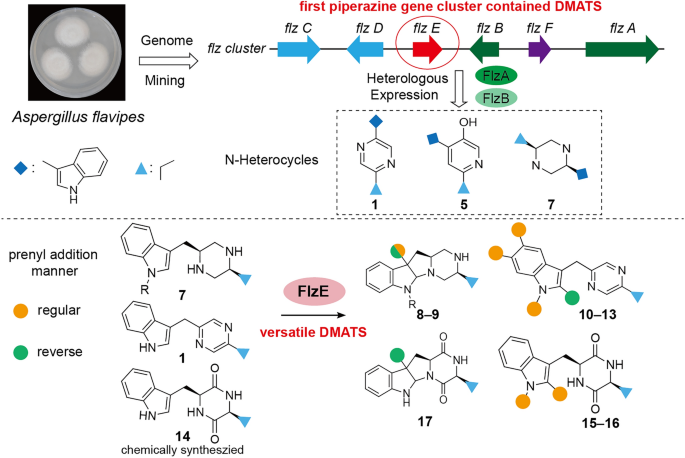
Step one: dig. The team scans the genome of Aspergillus flavipes, a fungus plucked from the intertidal mud of the Yangtze River in Wuhan, and finds 78 secondary metabolite gene clusters. One, named flz, immediately looks suspicious: besides FlzA and FlzB — the construction crew that builds the piperazine scaffold — it carries flzE, a DMATS gene never before seen in any piperazine cluster.
Step two: evict and reinstall. Since the original owner refuses to work, the team relocates flzA, flzB, and flzE to Aspergillus nidulans, an easy-going lab tenant. The sleeping cluster wakes up and runs at full speed.
Step three: the solo interview. The team isolates FlzE and tests its skills in a test tube.
Three Surprises in the Chest
First, the yield: 16 compounds in total (some further modified by the host's own enzymes or finished off in test-tube reactions), and 12 of them brand-new to science — a new family named the flaviazines.
Second, two star molecules: flaviazine H and flaviazine I, the first DMATS-catalyzed prenylated piperazines ever reported, sporting a novel 6-5-5-6 tetracyclic skeleton locked together like a traditional Chinese puzzle. Better still, the same enzyme sews the tail on backwards for H and forwards for I — one tailor, two styles, no extra charge.
Third, the tailor itself. FlzE never says no: it works not only on piperazines (its regulars), but also on pyrazines and diketopiperazines, which look nothing alike. It can sew at five positions — C-2, C-3, C-5, C-6, and N-1 — in either orientation. In an enzyme world famous for extreme pickiness, this promiscuity is a rare gift.
There's even office gossip: the cluster once employed one methyltransferase and two P450 oxidases, but all three have retired into pseudogenes. The team speculates that flzE, having gate-crashed this cluster via horizontal gene transfer long ago, simply out-competed its older colleagues and took over the modification department.
Why It Matters
For basic research, this is the debut of a DMATS enzyme in piperazine biosynthesis, refreshing what we thought this family could do and expanding the chemical map of indole alkaloids.
For drug discovery, the family has famous relatives: tryprostatin B inhibits microtubule polymerization with antitumor potential, and fumitremorgin C reverses multidrug resistance. The new molecules swell the candidate pool.
Best of all, FlzE is a ready-made green biocatalyst. Next time chemists need to prenylate an indole-containing molecule, they can skip the narrow single-plank bridge of step-by-step organic synthesis and let FlzE do it in one step, under mild conditions — saving time, labor, and the environment.
One genome mined, one sleeping factory awakened, one tail sewn in two directions. The chest is open; the story has only begun.


Editor, Kunming Institute of Botany, Chinese Academy of Sciences
Follow the Topic
Biomedical Research
Life Sciences > Health Sciences > Biomedical Research
Biological Chemistry
Physical Sciences > Chemistry > Biological Chemistry
-
Natural Products and Bioprospecting
This is a single blind peer-reviewed open access journal that devoted to rapidly disseminate research results in all areas of natural products.