People Affiliate more with AI that Resemble to Themselves
Published in Behavioural Sciences & Psychology and Mathematical & Computational Engineering Applications


The Personal Journey
New ideas often strike in unexpected places. The concept for this paper—exploring human-AI homophily—was actually born over WhatsApp while riding a train in London. What started as a digital brainstorming session in transit soon evolved into an academic pursuit.
This project represents an academic effort where our shared interests naturally brought us together—meaning it was our own homophily that inspired us to study human-AI homophily. Our team is also linked by a shared connection to Corpus Christi College (CCC), Oxford. At the time, Riddhi and Santiago were students at the Computational Psychopathology Research Group (PI: Prof Robin Murphy). Robin is a Professor at CCC, Santiago was a Stipendiary Lecturer at CCC, while Daniel served as a Junior Research Fellow there a couple of years back. We are thrilled that CCC students are still actively working on this line of research today.
The catalyst for bringing this idea to life was receiving an Academic Fellowship from OneReach.ai, which provided us with the conversational AI tools and platform necessary to design and run our study.
The Research
In human interactions, people tend to affiliate with others who share their characteristics, a concept sometimes referred to as homophily. We tend to like people who reflect aspects of ourselves, whether through shared interests, beliefs, or personality traits.
With the rapid advancement of Large Language Models (LLMs) that can generate highly contextual and human-like language, we wanted to ask a novel question: Does this same affiliative phenomenon occur with an AI instructed to mimic human psychology?
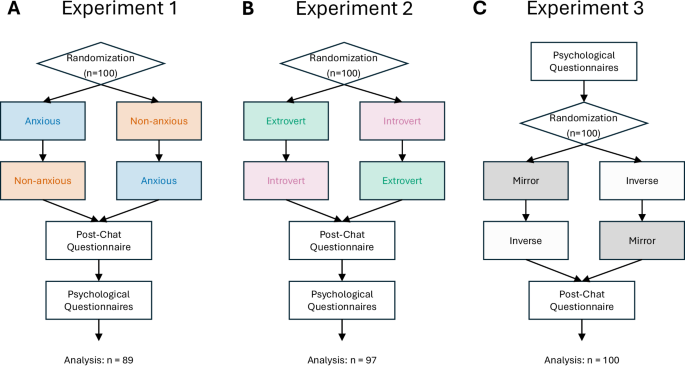
To find out, we designed three experiments where participants engaged in short, written interactions with different versions of a LLM (GPT-4) and then evaluated how connected they felt to each one. Participants were fully aware that they were interacting with an artificial system.
Here is a breakdown of what we did and what we found:
| Experiment Focus | How We Prompted the AI | Key Findings |
| Experiment 1: Anxiety | To use language mimicking either an anxious or non-anxious state. | Participants with anxiety reported a stronger connection to the AI that mimicked anxiety. This connection was also reflected in the actual sentiment of the messages they sent back to the AI. |
| Experiment 2: Extroversion | To use language mimicking either an extroverted or introverted personality. | Extroverted participants affiliated more closely with the AI that used extroverted language. |
|
Experiment 3: The Mirror (preregistered, see https://aspredicted.org/9yg6-y3xp.pdf) |
To act as an exact mirror of the participant's own "Big-Five" personality profile, or the exact inverse. | When interacting with the AI that mirrored their exact personality, participants reported much higher affiliation. Furthermore, they used more positive language in their messages to the mirrored AI. |
What Does It Means?
Ultimately, our results show that shared psychological traits, when conveyed through language, can foster a real sense of connection between humans and language-based AI. Even in a short interaction, and even knowing the chatbot was AI with no real mental life, humans perceive these linguistic cues and affiliate with machines similarly to how they connect with other humans.
The results suggest a method for LLMs to achieve a greater human-like correspondence. As AI becomes a larger part of our daily lives—perhaps even in sensitive areas like healthcare—tuning an AI's displayed psychology to mirror a human's could enhance the user's perception of care, empathy, and trust.
Santiago, Riddhi, Daniel, and Robin
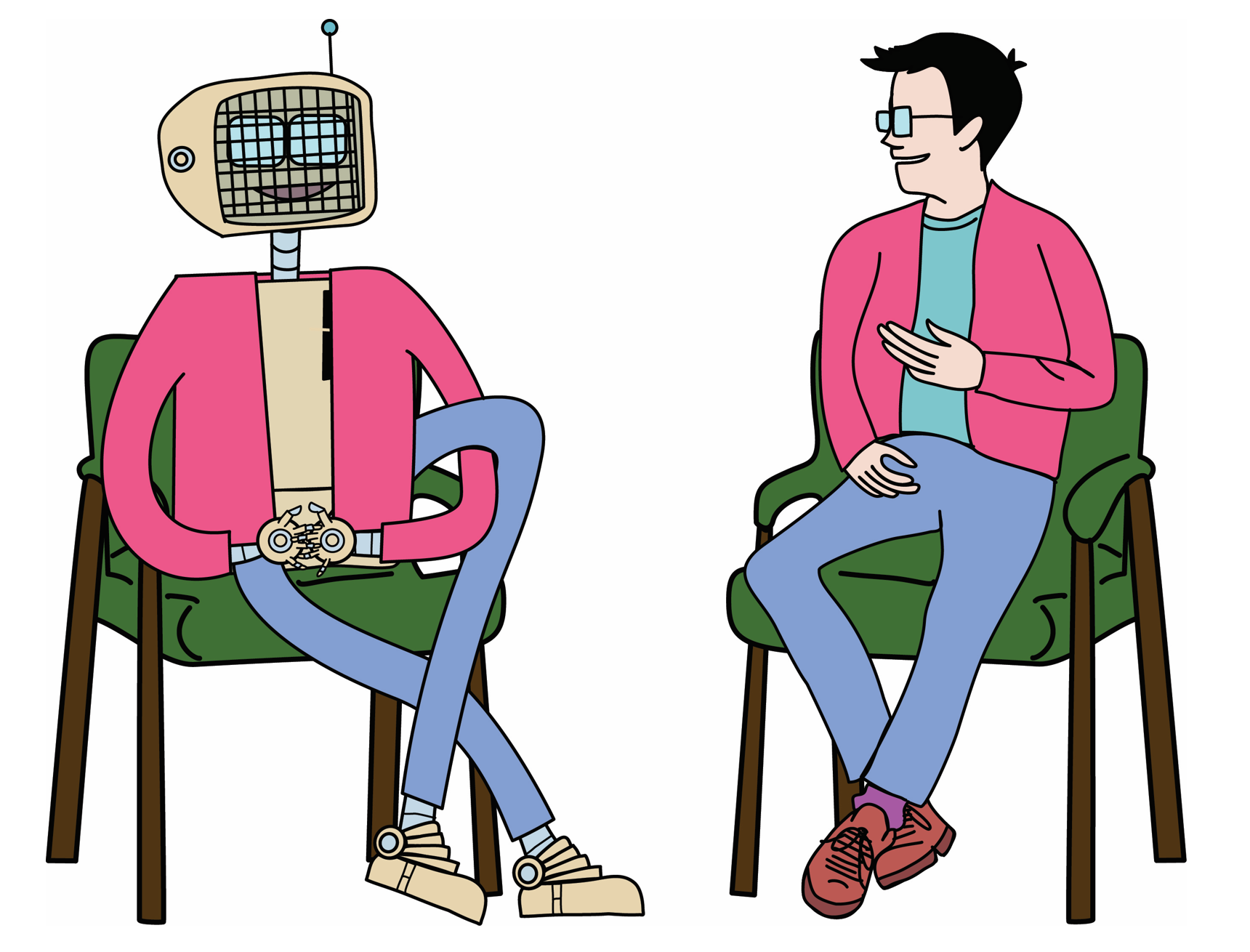
Acknowledgments: We thank digital artist Michael Firth for the illustration in this post.
Follow the Topic
-
Communications Psychology
An open-access journal from Nature Portfolio publishing high-quality research, reviews and commentary. The scope of the journal includes all of the psychological sciences.

Related Collections
With Collections, you can get published faster and increase your visibility.
Replication and generalization
Publishing Model: Open Access
Deadline: Dec 31, 2026
Stress and Health
Publishing Model: Open Access
Deadline: Nov 30, 2026