Predicting student satisfaction in career choices using machine learning: a case study
Published in Computational Sciences, Behavioural Sciences & Psychology, and Education




Background and motivation
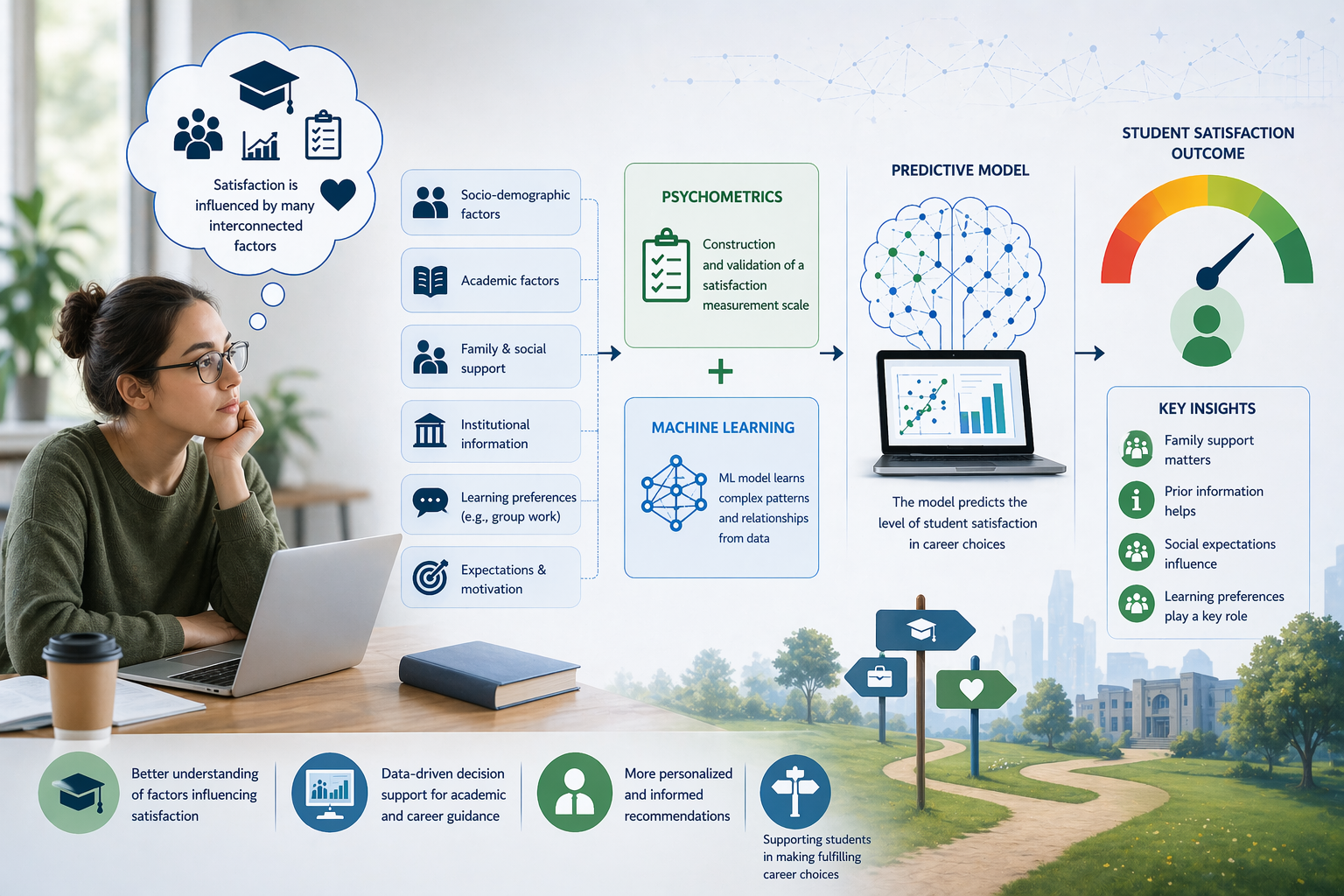
Choosing an academic or career path is not a straightforward decision. Students often have to balance their interests, abilities, expectations, and external constraints, all within an increasingly complex educational landscape. While guidance systems typically rely on measurable indicators such as grades or employment prospects, one important aspect is often overlooked: student satisfaction. Yet, satisfaction plays a crucial role. It influences engagement, persistence, and overall success. The challenge, however, is that satisfaction is subjective and shaped by many interacting factors, making it difficult to capture and even harder to predict.
This led us to ask a simple but important question: can student satisfaction be anticipated before decisions are made?
A hybrid methodological approach
To explore this question, we developed a hybrid framework that brings together psychometrics and machine learning.
On the psychometric side, we designed and validated a measurement instrument to assess student satisfaction in a reliable and structured way. This allowed us to capture key subjective dimensions such as perception, expectations, and motivation. On the machine learning side, we used Support Vector Machines (SVM) to model the relationship between satisfaction and a wide range of variables, including academic performance, socio-economic background, and contextual factors. This approach makes it possible to capture complex, non-linear interactions that traditional methods often miss.
By combining these two perspectives, we aimed to connect human-centered evaluation with predictive modeling.
Key findings
The model achieved an accuracy of 89% in predicting student satisfaction. More importantly, the results show that satisfaction is not driven by a single factor. Instead, it emerges from a combination of influences, including family support, prior information about the institution, environmental expectations, and learning preferences such as group work.
This confirms the importance of considering both individual and contextual dimensions together.
Implications for guidance
These findings open the way for more informed and personalized guidance systems. By integrating psychometric insights into predictive models, it becomes possible to identify potential dissatisfaction early and support better decision-making. At the same time, such tools should be seen as a complement to human expertise, not a replacement.
Looking ahead
This work highlights the value of combining rigorous measurement with advanced analytical techniques. Future research could further explore explainable AI methods and extend this approach to larger and more diverse datasets.
Access to the article :
https://doi.org/10.1007/s44217-026-01337-9

Follow the Topic
-
Discover Education
An international, peer-reviewed open access journal that publishes original work in all areas of education, serving the community as a broad-scope journal for academic trends and future developments in the field.

Related Collections
With Collections, you can get published faster and increase your visibility.
Advancing Teaching & Learning: Integrating AI, Emerging Technologies, and Pedagogical Innovation
Collection "Advancing Teaching & Learning: AI, Emerging Technologies and Pedagogical Innovation" addresses a major challenge in education today. There is a lack of resources that bring advanced technologies and innovative teaching together. AI, digital tools and emerging technologies are transforming classrooms. Yet many teachers and education leaders struggle to use these tools effectively. This Collection fills that gap. It offers expert insights, practical strategies and real-world examples for modern teaching and learning.
The Collection is linked to the United Nations Sustainable Development Goal 4 on quality education. It shows how to make learning more accessible, inclusive and effective for all. AI, adaptive learning platforms and immersive technologies can personalise instruction. They can engage students and support diverse needs. At the same time, the human element of teaching remains central.
Readers will find practical guidance on curriculum design, digital literacy and evidence-based teaching methods. The approaches can be applied in classroom, blended and online learning. Beyond tools, the Collection inspires educators to rethink traditional methods. It encourages them to embrace innovation while keeping learning meaningful and student-focused.
By addressing the lack of comprehensive resources on advanced technologies, Advancing Teaching & Learning helps teachers, school leaders and instructional designers navigate the digital age. It equips them to create engaging, future-ready learning experiences. Students are prepared for a connected, digital world. Educators gain the confidence to unlock the full potential of every learner.
This Collection supports and amplifies research related to the United Nations Sustainable Development Goal 4 on quality education. It shows how to make learning more accessible, inclusive and effective for all. AI, adaptive learning platforms and immersive technologies can personalise instruction. They can engage students and support diverse needs. At the same time, the human element of teaching remains central.
Keywords: Teaching and Learning; AI in Education; Emerging Technologies; Digital Tools in Classrooms; Pedagogical Innovation; Adaptive Learning Platforms; Immersive Technologies; Quality Education (SDG 4); Classroom Innovation; Blended and Online Learning; Student Engagement; Teacher Professional Development; Future-Ready Learning; Instructional Design; Educational Technology Integration.
Publishing Model: Open Access
Deadline: Apr 15, 2027
Advancing Health Professions Education: Innovations, Strategies, and Global Perspectives
Health Professions Education (HPE) plays an important role in preparing competent, ethical, and compassionate healthcare professionals capable of responding to the complex demands of contemporary healthcare systems. In recent years, the field of HPE has witnessed a paradigm shift towards learner-centred, competency-based, and interprofessional education models that prioritize not only clinical expertise but also communication, professionalism, teamwork, and leadership skills.
This Collection invites original research, systematic or scoping reviews, case studies and brief reports and that critically examine the evolving landscape of HPE across medicine, dentistry, nursing, pharmacy, and other allied health disciplines. Key areas of interest include curriculum design and reform, innovative teaching and assessment methods, integration of digital and blended learning technologies, interprofessional education (IPE), faculty development, educational management, student support and well-being, and strategies to promote equity, diversity, and inclusivity in HPE.
We also welcome contributions that explore challenges and best practices in clinical training, rural and underserved community placements, global health education, policy development, accreditation, and institutional leadership in health education. Studies from low- and middle-income countries are strongly encouraged to enhance global representation and to promote scholarly exchange on scalable and contextually relevant innovations.
By consolidating scholarly work in this Collection, we aim to advance the discourse on high-quality, evidence-informed HPE that supports the achievement of Sustainable Development Goals (SDG 3 and SDG 4) and ultimately contributes to improved healthcare outcomes worldwide.
Publishing Model: Open Access
Deadline: Nov 30, 2026