Releasing the hidden power of bystander T cells in cold tumours
Published in Bioengineering & Biotechnology, Cancer, and Immunology






Immune checkpoint inhibitors have transformed cancer therapy, yet their clinical impact remains uneven. While a subset of patients experience durable responses, the majority—particularly those with immune-cold tumours—derive little or no benefit. This limited efficacy is commonly attributed to T cell-related constraints, including insufficient infiltration, exhausted or dysfunctional states.
When we began this project, our question was surprisingly simple.
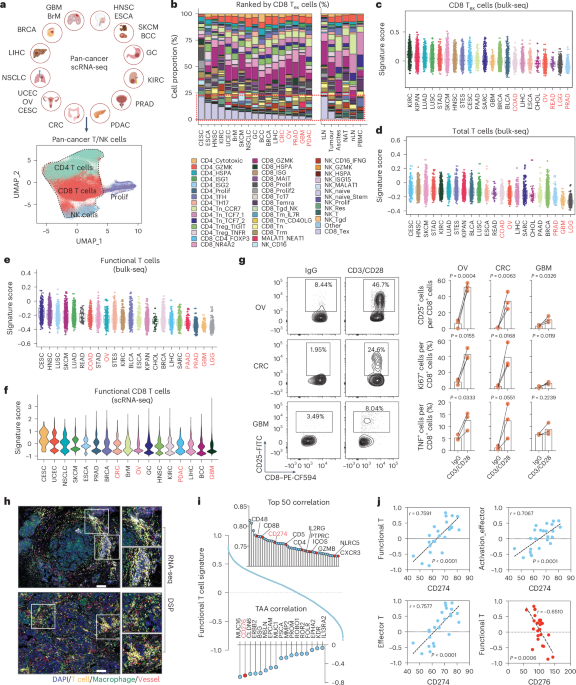
Across multiple cold tumours—including ovarian cancer, colorectal cancer and glioblastoma—we isolated tumour-infiltrating T cells from primary patient samples and re-stimulated them ex vivo. To our surprise, many of these T cells could still be robustly activated and produced high levels of interferon-γ. This behaviour did not fit with the prevailing view that T cells in cold tumours are terminally exhausted or irreversibly dysfunctional.
This observation raised a key question: what kind of T cells are actually present in these tumours?
To explore this further, we turned to large-scale public single-cell datasets and performed a pan-cancer integration analysis with a focus on T-cell subtypes. What emerged was striking. In classical cold tumours such as glioblastoma, ovarian cancer and colorectal cancer, tumour-specific T-cell populations were extremely rare. This helped explain why immune checkpoint inhibitors (ICIs)—which primarily act by reinvigorating tumour-specific exhausted T cells—show limited efficacy in these settings. Yet another paradox quickly became apparent. Despite the scarcity of tumour-specific T cells, the total number of infiltrating T cells in some of these tumours was not particularly low. This discrepancy led us to suspect that a substantial fraction of infiltrating T cells might be bystander T cells—cells that are functional, but not specific for tumour antigens. We then returned to the tumours themselves. Using multiplex immunofluorescence on tumour sections, we observed that many T cells were not in direct contact with tumour cells but instead localized predominantly within the stromal regions, forming a spatially segregated pattern around tumour nests. This spatial organization further supported the idea that these cells were present, capable, but simply not engaged in tumour killing.
At this point, our central question became: can we harness the antitumour potential of these bystander T cells?
To answer this, we performed spatial transcriptomic analyses focusing on T-cell–rich regions. An unexpected pattern emerged. T-cell infiltration showed a negative correlation with tumour-associated antigens such as B7-H3, but a positive correlation with PD-L1 expression. In other words, as tumour burden increased, T-cell infiltration decreased, while immunosuppressive PD-L1 signalling intensified. This suggested a dual barrier preventing effective tumour killing: first, bystander T cells fail to recognize tumour cells; second, even when present, their activation is restrained by PD-L1–mediated suppression.
These insights guided us toward a new design principle.
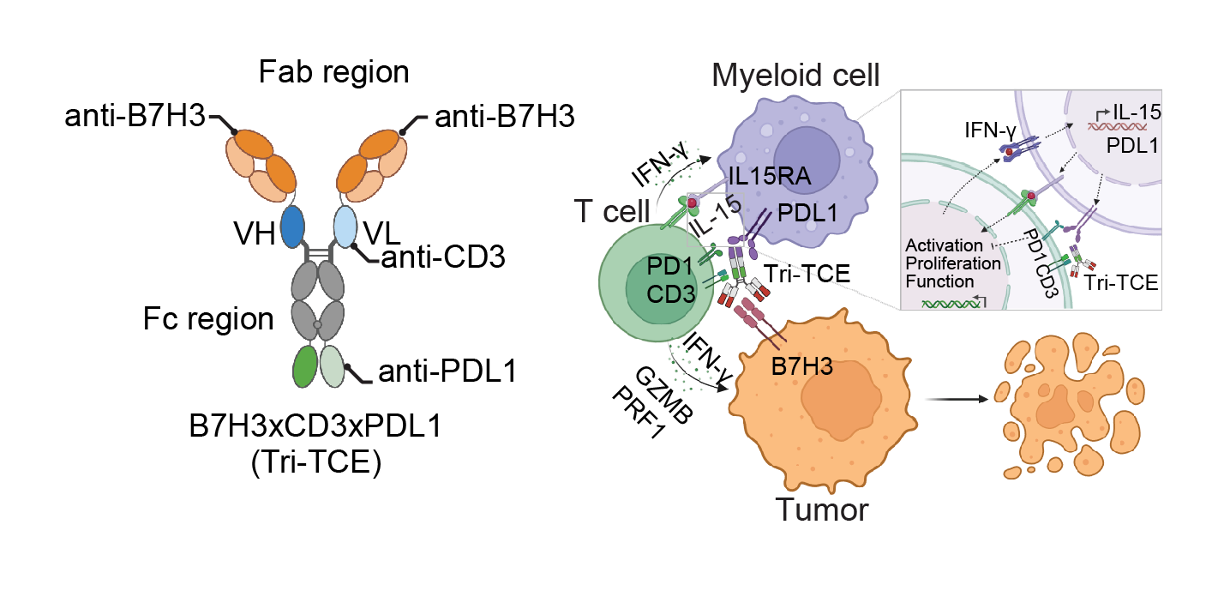
Rather than trying to amplify tumour-specific T cells—which are scarce in cold tumours—we aimed to redirect existing bystander T cells toward tumour cells while simultaneously relieving local immunosuppression. This led us to develop a trispecific T-cell engager targeting B7-H3, CD3 and PD-L1. Crucially, the innovation was not only in target selection, but also in antibody architecture. Using a modular and affinity-tuned design, we engineered a “dynamically accessible” multispecific format. High-affinity bivalent binding anchors the antibody to B7-H3 on tumour cells; the CD3-binding module is structurally recessed, becoming accessible only in close proximity to tumour cells to avoid off-target T-cell activation; and the PD-L1-binding module is deliberately designed with lower affinity to maintain controllable interactions within the tumour microenvironment. Across tumour cell–PBMC co-cultures, patient-derived tumour suspensions and intact tumour sections, this strategy consistently unleashed potent T-cell cytotoxicity. In multiple humanized mouse models, we observed profound tumour regression and, in some cases, complete tumour clearance—even in tumours with extremely low baseline T-cell infiltration.
Perhaps the most unexpected finding emerged during mechanistic dissection. In this trispecific context, PD-L1 no longer functioned merely as a suppressive checkpoint to be blocked. Instead, it became a structural and functional hub that physically bridged PD-L1⁺ macrophages and activated T cells. Within this confined interaction interface, T-cell–derived IFN-γ reprogrammed immunosuppressive macrophages into a pro-inflammatory state and induced IL-15 secretion. IL-15, in turn, further amplified T-cell proliferation and cytotoxicity. Simultaneously, IFN-γ upregulated PD-L1 on nearby myeloid cells, recruiting additional cells into this self-reinforcing feedback loop. Through this emergent multicellular circuit, a small number of T cells could generate a disproportionately large antitumour effect—effectively enabling “doing more with less” in immune-cold tumours. To support clinical translation, we further integrated cross-cancer ex vivo efficacy data with transcriptomic features to develop a machine-learning–based prediction model, aiming to identify patients most likely to benefit from this strategy.
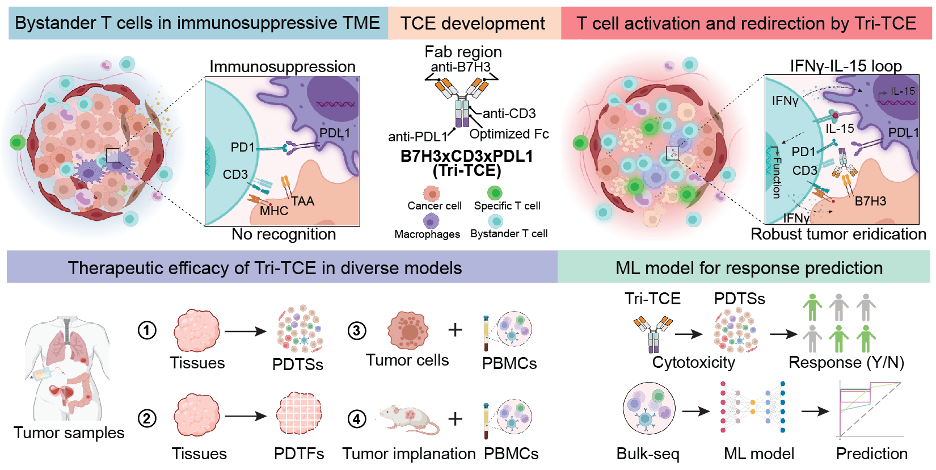
In retrospect, this work represents a shift in how we think about immune activation in cold tumours. Rather than viewing bystander T cells as irrelevant or inert, we show that they constitute a latent resource that can be strategically redirected through spatially informed, structurally engineered multispecific antibodies. By exploiting multicellular cooperation within the tumour microenvironment, this approach offers a new conceptual and therapeutic framework for next-generation immunotherapies.
We encourage readers to find more details in our full-text publication.
Follow the Topic
-
Nature Biomedical Engineering
This journal aspires to become the most prominent publishing venue in biomedical engineering by bringing together the most important advances in the discipline, enhancing their visibility, and providing overviews of the state of the art in each field.

Ask the Editor – Inflammation, Metastasis, Cancer Microenvironment and Tumour Immunology
Got a question for the editor about inflammation, metastasis, or tumour immunology? Ask it here!
Continue reading announcementRelated Collections
With Collections, you can get published faster and increase your visibility.
Implantable wireless communication technologies
Publishing Model: Hybrid
Deadline: Nov 28, 2026
Medical Ultrasound: Emerging Techniques and Applications
Publishing Model: Hybrid
Deadline: Jan 29, 2027





Please sign in or register for FREE
If you are a registered user on Research Communities by Springer Nature, please sign in
Excellent Job!
Thanks a lot !
This research on activating bystander T cells in cold tumors shows how new scientific ideas can bring hope in the fight against cancer. In such challenging health situations, people also turn toward faith and prayer for strength — reciting surah yasin pdf reminds believers of patience, hope, and trust in Allah’s mercy. In this way, modern research and spiritual reflection together inspire courage and positivity.Read more at surahayasin.com