Rethinking Access to CRISPR Across Medicine and Agriculture
Published in Sustainability, Biomedical Research, and Agricultural & Food Science



From Bioethics to Access: A Shift in Legal Focus
Much legal analysis of CRISPR has focused on bioethical concerns, particularly on limiting potentially harmful applications. While these debates initially drew us to the topic, they are not the primary focus of my research. My work instead examines how access to transformative technologies is structured, and how legal frameworks determine who can participate in innovation and who cannot. This perspective lies at the intersection of contract law, intellectual property law, and competition law. In practice, access is rarely decided abstractly, but negotiated through agreements, exclusivity regimes, and market structures.
The impetus for this research interest did not emerge from legal dogmatics alone, but from exchange with scientists at international conferences. However, these discussions made clear that designing access rules for CRISPR requires not only interdisciplinary dialogue, but also renewed legal thinking – combining legal theory and future doctrinal development.
The Public–Private Ecosystem
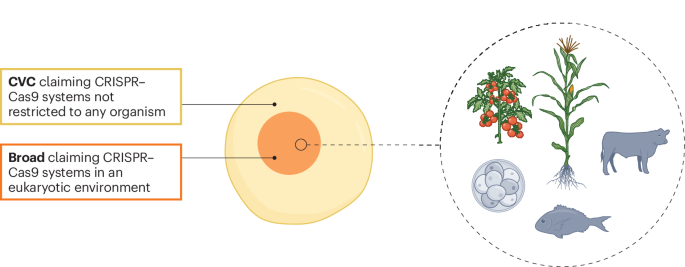
We anticipated from the outset that analyzing CRISPR patents would be complex, not least because of the sheer number of patent claims and the ongoing patent disputes that continue to shape the field. What we did not anticipate, however, was how much more complex the picture would become once patent commercialization itself emerged as the central mechanism through which access to the technology is governed. Looking beyond patent ownership to the ways patents are actually used revealed a largely invisible layer of contractual relationships. Licensing agreements, collaboration contracts, and technology transfer arrangements determine who can work with CRISPR technologies - yet their existence is often opaque, and their terms and conditions even more so.
The more closely we examined the relationships among actors in the CRISPR innovation ecosystem, the more apparent its deeply intertwined public–private character became. As is typical for biotechnology innovation, foundational inventions are frequently made in universities, while further development, scaling, and commercialization largely take place in the private sector. This division of roles is not unusual; however, it renders restrictions on access particularly consequential. When participation in downstream innovation depends on contractual and proprietary structures that remain largely invisible, questions of access become not only legal but systemic.
The Limits of Traditional Access Mechanisms
Traditional legal and governance measures — such as compulsory licensing, patent pools, patent pledges, or ethical licensing initiatives — are typically based on the assumption that barriers to access constitute exceptional disruptions within otherwise functioning innovation systems. Our analysis points to the opposite: barriers to access often emerge from system-wide lock-in effects embedded in existing intellectual property and licensing frameworks. Consequently, conventional legal and governance responses reveal significant limitations when applied to CRISPR’s public–private innovation ecosystem.
This insight raises a more fundamental question: how can legal frameworks be designed to reduce structural barriers to transformative technologies without undermining the innovation incentives that intellectual property law seeks to create?
Conclusion: Rethinking Access Through the Right to Science
As a normative response, we propose rethinking access through the lens of the international human Right to Science (Art. 15 of the International Covenant on Economic, Social and Cultural Rights). Rather than treating this right as a purely aspirational norm, we interpret it as a contemporary governance framework capable of guiding how access to CRISPR can be structured. Read in this way, the Right to Science conceptionally shifts attention from correcting isolated market failures toward addressing systemic deficiencies and shaping participation in complex innovation ecosystems.
Current work therefore focuses on concretizing this proposal at the transactional level, exploring how access-oriented principles might be translated into contractual norms capable of operating within dynamic real-world innovation environments. Advancing this effort necessarily depends on collaboration with international organizations, investors and research institutions, whose practical experience is essential for initiating and testing such approaches.
Follow the Topic
-
Nature Biotechnology
A monthly journal covering the science and business of biotechnology, with new concepts in technology/methodology of relevance to the biological, biomedical, agricultural and environmental sciences.

What are SDG Topics?
An introduction to Sustainable Development Goals (SDGs) Topics and their role in highlighting sustainable development research.
Continue reading announcement


