Rethinking Air Filtration with a Liquid-Lined Interface
Published in Earth & Environment and Sustainability


What if an air filter could renew itself?
Most conventional air filters capture and retain particles on solid surfaces. Over time, pores become blocked, airflow resistance rises, electrostatic charges decay, and filters eventually needs to be replaced.
That raised a question. Could a filter move beyond surface adsorption to overcome a persistent trade-off among filtration efficiency, lifetime and operating cost?
From liquid gating to air filtration
Our starting point was liquid gating technology, introduced by Professor Xu Hou and colleagues in 2015 (Nature, 2015, 519: 70–73). A liquid held within a porous material can reconfigure under pressure, opening transport pathways while maintaining a liquid-lined interface. This showed how liquids could serve as both structural and functional materials.
In 2022, we extended this approach to air purification, introducing a mechanism based on dynamic gas–liquid interfaces (Nature, 2022, 610: 74–80). These interfaces capture airborne particles and transfer them into the liquid bulk, expanding pollutant storage from the limited surface area of solid filters into the volume of a functional liquid.
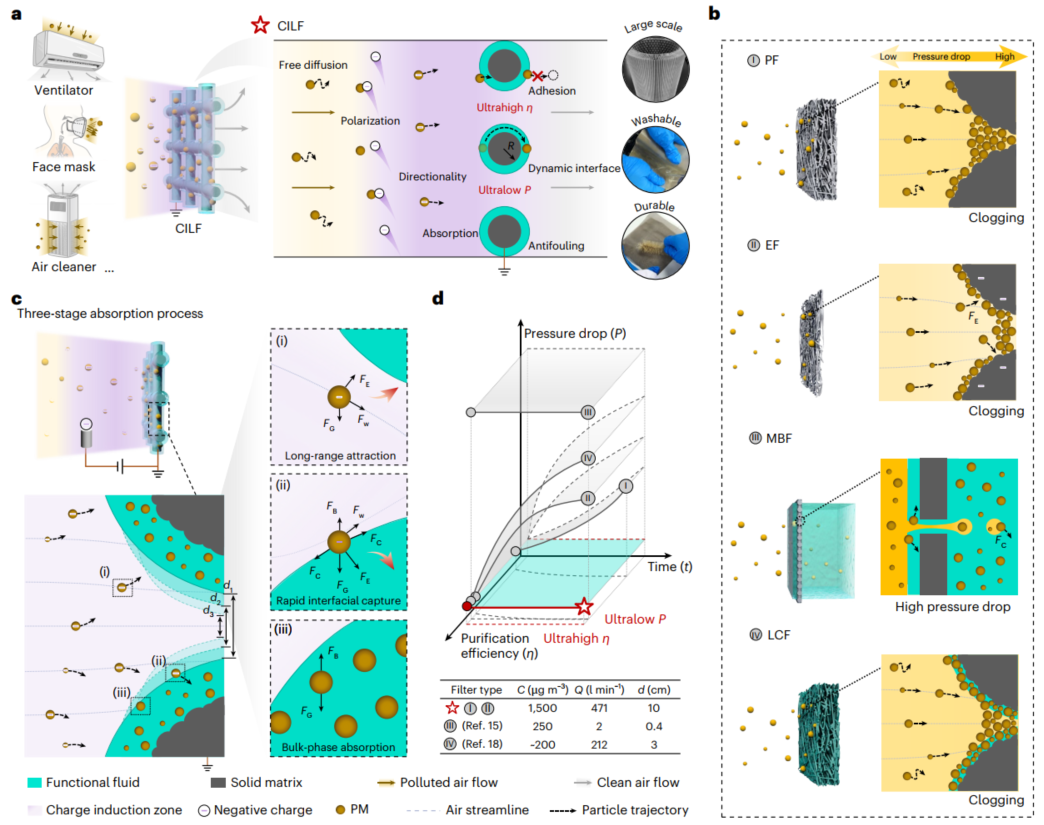
Our 2026 study builds on this foundation by combining a thin liquid lining along open pore walls with electrostatic particle guidance. The resulting charge-induced liquid-lined filter (CILF) enables efficient particle capture while maintaining low airflow resistance and long-term performance.
Attract, capture, absorb
The CILF combines three processes. First, an electrostatic field guides airborne particles towards the liquid-lined pores. Second, capillary forces at the liquid–air interface strongly retain arriving particles and suppress their release back into the airflow. Third, captured particles enter and redistribute within the liquid lining, reducing accumulation at pore entrances.
Microscale fluid transport helps move particles away from the capture sites, renewing the interface available to incoming particles. This connects long-range particle guidance with interfacial capture and liquid-volume storage, allowing efficient filtration while preserving open airflow pathways.
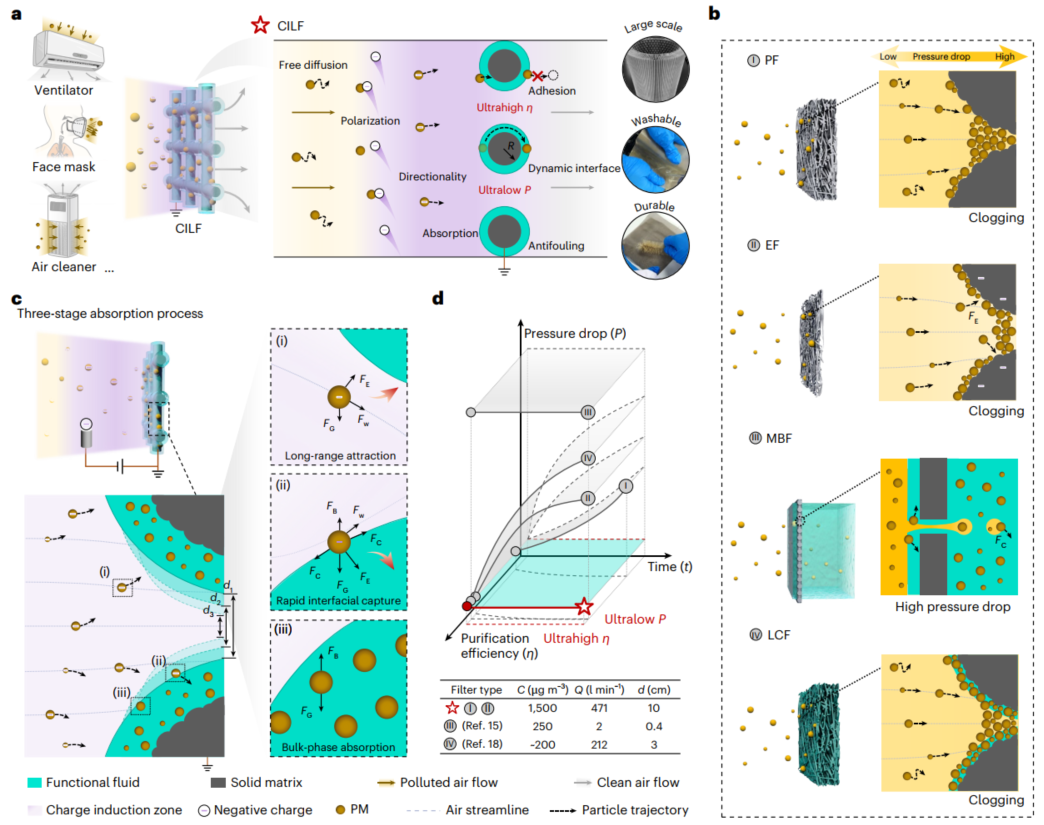
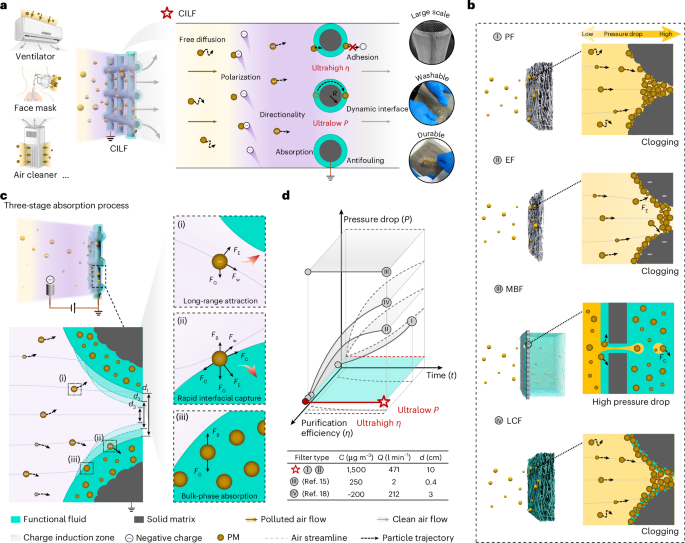
Concept and operating principle of the charge-induced liquid-lined filter. Source: Nature Sustainability.
Finding the “just right” interface and measuring it
Holding a liquid on a porous framework sounds straightforward. The design challenge is to make that liquid stable enough to remain in place, yet mobile enough to accommodate captured particles.
We addressed this through surface modification, pore-size selection and controlled liquid loading. The modified framework lets the liquid spread along the pore walls and remain anchored there. Adjusting the liquid loading establishes a continuous lining while preserving open pores. These choices connect the behavior of the interface to the performance of the whole filter.
Reliable measurements were equally important. Our experimental platform incorporated the new liquid gating intelligent tester and analyzer, GIFT-E1 Pro, to measure the pressure drop across the filters. Together with separate measurements of particle concentration, this allowed us to assess capture efficiency together with airflow resistance.
The CILF achieved single-pass purification efficiency of up to 99.6% at an air velocity of 1 m/s through the filter. During more than 3,500 hours of continuous operation, it maintained efficiency above 99% with a low, stable pressure drop.
Toward more sustainable air filtration
Sustainable air filtration should deliver clean air with less energy, fewer replacements and less waste. The CILF combines a reusable porous framework with a refillable liquid lining. Its resistance to clogging maintains a low pressure drop over time, which reduces the energy needed to move air and extends the filter lifetime. This also lowers material consumption and maintenance needs. Our life cycle assessment showed lower environmental impacts than the conventional filter materials evaluated.
These advantages are especially valuable in ventilation-limited spaces that require continuous air purification. We demonstrated the CILF in air cleaners and electric masks, as well as in an air purification system designed for microgravity environments such as space stations.
Help shape the next questions
This work is part of our broader exploration of liquid-based materials. Led by Professor Xu Hou at Xiamen University, our group studies liquid gating and bioinspired nanofluidics, connecting interfacial science with applications in air purification, sensing, energy conversion, water treatment and biomedicine.
How can functional liquids be tailored to different pollutants? How can experiments and modelling guide better regeneration? How can dynamic interfaces be integrated into practical devices? These are opportunities for researchers working across chemistry, physics, materials science, fluid mechanics and engineering.
We welcome talented prospective master’s and doctoral students, early-career researchers and collaborators interested in pursuing these questions. If you enjoy exploring fundamental mechanisms and turning them into technologies that address real-world challenges, we would be pleased to hear about your background, research interests and ideas.
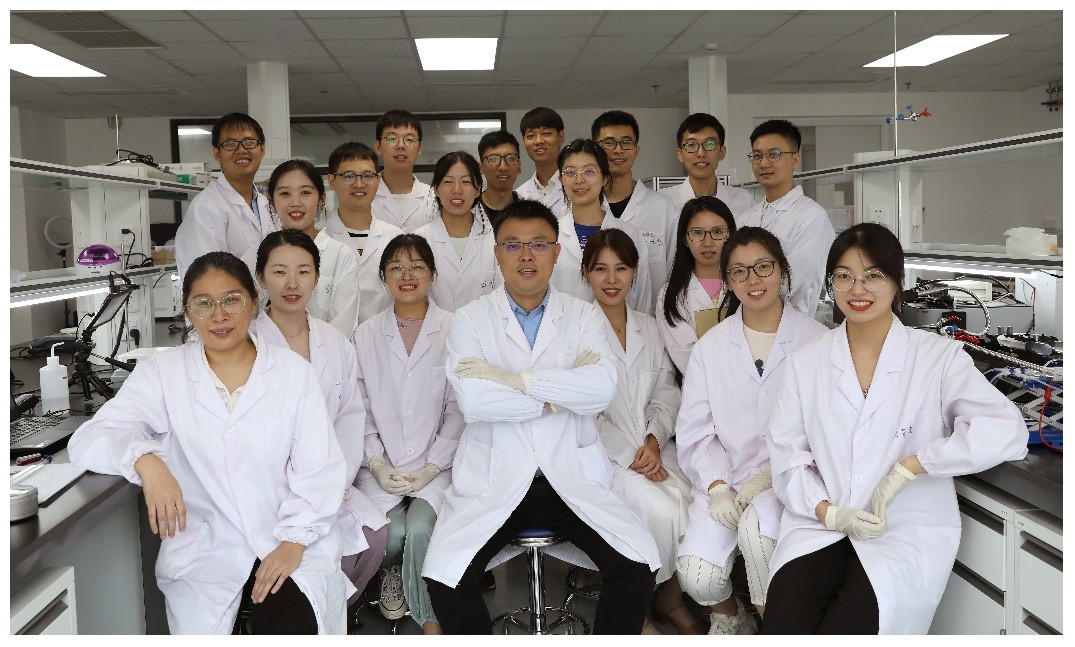
Xu Hou Group at Xiamen University. Visit our website to explore the group’s research, publications and members, and learn more about our work.
Related paper:https://doi.org/10.1038/s41893-026-01920-w
Group website: https://xuhougroup.xmu.edu.cn/
Contact: houx@xmu.edu.cn
Xu Hou is a Nanqiang Distinguished Professor at Xiamen University and a Fellow of the Chinese Chemical Society, the Royal Society of Chemistry, and the International Society of Bionic Engineering. He conducted postdoctoral research in Professor Joanna Aizenberg’s group at Harvard University (2012–2015), followed by research at the Harvard–MIT Program in Health Sciences and Technology, before joining Xiamen University in 2016.
His research focuses on liquid gating technology, bioinspired nanofluidics, and functional interfacial materials, with applications in air purification, energy conversion, intelligent sensing, chemical detection, water treatment, and biomedicine. His work connects fundamental studies of fluid transport and dynamic interfaces with the development of technologies for environmental sustainability, clean energy, human health, and artificial intelligence.
Prof. Hou was appointed Chief Scientist of a National Key R&D Program of China in 2018, received the National Science Fund for Distinguished Young Scholars in 2020, and was awarded the XPLORER Prize in 2022. His leading liquid gating technology and bioinspired nanofluidic iontronics were selected as IUPAC’s Top Ten Emerging Technologies in Chemistry in 2020 and 2024, respectively.
Follow the Topic
-
Nature Sustainability
This journal publishes significant original research from a broad range of natural, social and engineering fields about sustainability, its policy dimensions and possible solutions.

What are SDG Topics?
An introduction to Sustainable Development Goals (SDGs) Topics and their role in highlighting sustainable development research.
Continue reading announcement