Ruptured Internal Carotid Artery Aneurysm Presenting as Epistaxis and Melena: A Diagnostic Pitfall
Published in Neuroscience and Biomedical Research
Case summary
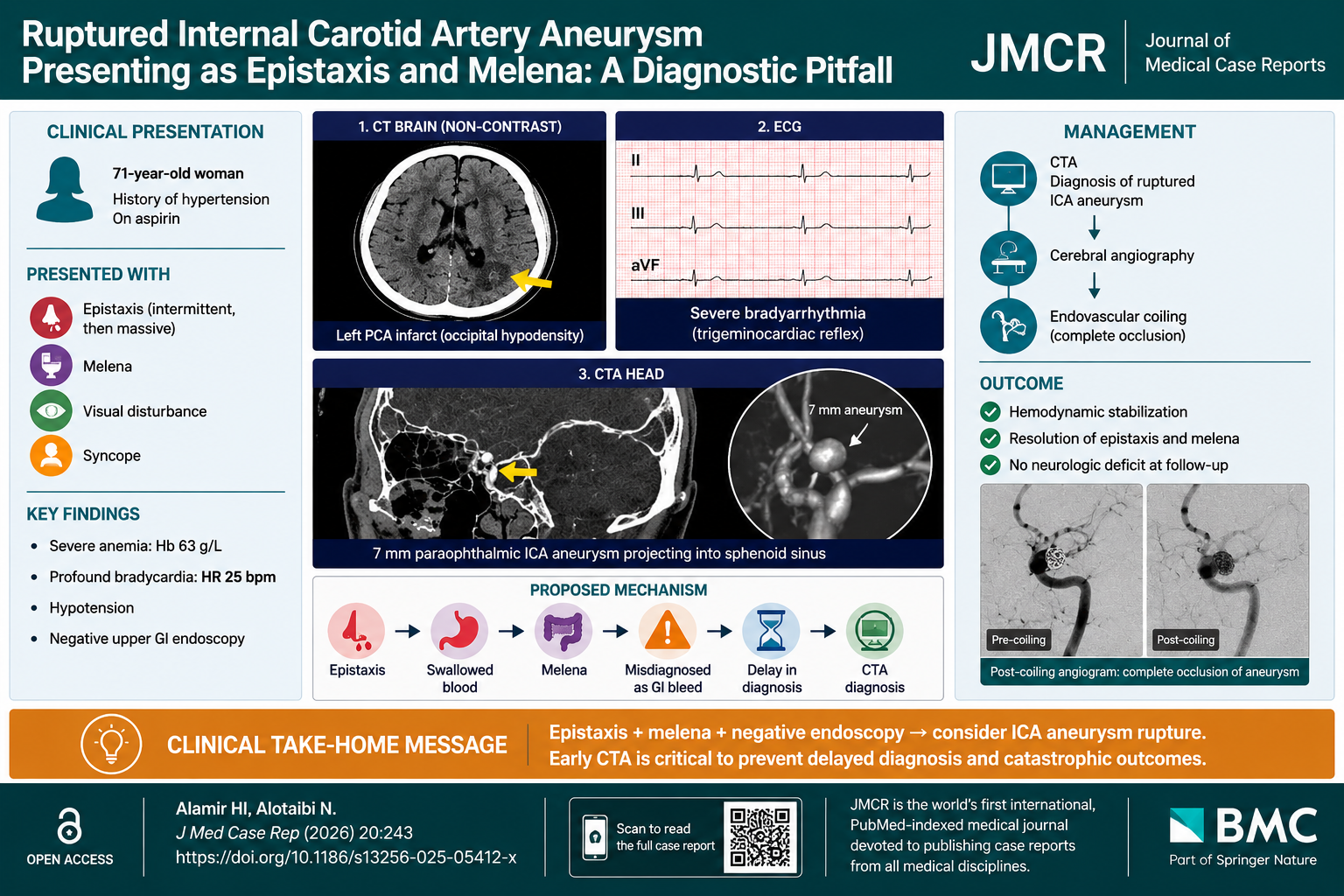
A 71-year-old woman with hypertension on aspirin presented with recurrent syncope, intermittent epistaxis, melena, and visual disturbances. She was found to have severe anemia (hemoglobin 63 g/L), hypotension, and profound bradycardia requiring temporary pacing. A gastrointestinal source was initially suspected; however, upper endoscopy was negative, creating diagnostic uncertainty.
Brain CT revealed a left posterior cerebral artery infarct, correlating with her visual symptoms. Following clinical deterioration and a massive episode of epistaxis, computed tomography angiography (CTA) of the head and neck was performed, demonstrating a 7 mm paraophthalmic internal carotid artery (ICA) aneurysm projecting into the sphenoid sinus, consistent with rupture.
Her bradycardia was attributed to the trigeminocardiac reflex, likely triggered by nasal packing, further complicating the presentation. Diagnosis was confirmed with cerebral angiography, and the patient underwent successful endovascular coiling with complete aneurysm occlusion.
She stabilized rapidly post-procedure, with resolution of bleeding and no further neurologic decline. This case highlights a rare but important presentation of a ruptured ICA aneurysm mimicking gastrointestinal bleeding and underscores the need for early vascular imaging in atypical cases.
Why this case matters
Epistaxis may reflect intracranial vascular rupture
Melena from swallowed blood can mimic GI bleeding
Trigeminocardiac reflex may cause bradycardia after nasal packing
Early CTA is essential in unexplained anemia with negative endoscopy
Question
Which finding most strongly suggested a non-gastrointestinal source of bleeding?
A. Melena
B. Severe anemia
C. Negative upper endoscopy
D. Hypotension
Correct answer
C. Negative upper endoscopy
Explanation
A negative endoscopy despite melena and anemia pointed to a non-GI source—ultimately leading to diagnosis of a ruptured ICA aneurysm.
Clinical Take-Home Message
In patients presenting with unexplained anemia, melena, and epistaxis—especially when gastrointestinal evaluation is negative—clinicians should consider a vascular etiology such as a ruptured internal carotid artery aneurysm and proceed with early CTA to prevent delayed diagnosis and life-threatening hemorrhage.
Journal of Medical Case Reports is the world’s first international, PubMed-listed, medical journal devoted to publishing case reports from all medical disciplines and will consider any original case report that expands the field of general medical knowledge, and original research relating to case reports. The journal is open access, and strongly endorses the CARE guidelines for case reports, requiring authors to submit populated CARE checklists with submissions to improve transparency in reporting.

Richard Alan Rison is the interim Editor-in-Chief of Journal of Medical Case reports. He is also an associate neurology editor (editorial board) for BMC Neurology, and the former lead editor for case reports of BMC Research Notes (currently on the editorial board). His scholarly work focuses on medical case reporting, reporting standards, and editorial methodology. Dr. Rison participated in the development and dissemination of the CARE guidelines for clinical case reporting and has authored numerous publications addressing both neurological disorders and the role of case reports in advancing medical knowledge. Dr. Rison practices general neurology and served as the founding medical director of the PIH Health Hospital-Whittier Stroke Program and the PIH Health Hospital-Whittier Non-Invasive Vascular Laboratory, is a clinical assistant professor of neurology at the University of Southern California Keck School of Medicine and Los Angeles County Medical Center, and is a Fellow of the American Academy of Neurology, the American Neurological Association, and the American Association of Neuromuscular and Electrodiagnostic Medicine. Dr Rison is board-certified by the American Board of Psychiatry and Neurology in neurology and vascular neurology, and neurocritical care and neuroimaging by the United Council of Neurologic Subspecialties. He is also board-certified by the American Board of Electrodiagnostic Medicine in electrodiagnostic medicine. Dr. Rison is a former president of the Los Angeles Neurological Society.
Follow the Topic
-
Journal of Medical Case Reports
This journal will consider any original case report that expands the field of general medical knowledge, and original research relating to case reports.

Your space to connect: The Psychedelics Hub
A new Communities’ space to connect, collaborate, and explore research on Psychotherapy, Clinical Psychology, and Neuroscience!
Continue reading announcement

Please sign in or register for FREE
If you are a registered user on Research Communities by Springer Nature, please sign in