Saturated Alcohols Electrocatalytic Oxidations on Ni‑Co Bimetal Oxide Featuring Balanced B‑and L‑Acidic Active Sites
Published in Bioengineering & Biotechnology, Chemistry, and Materials
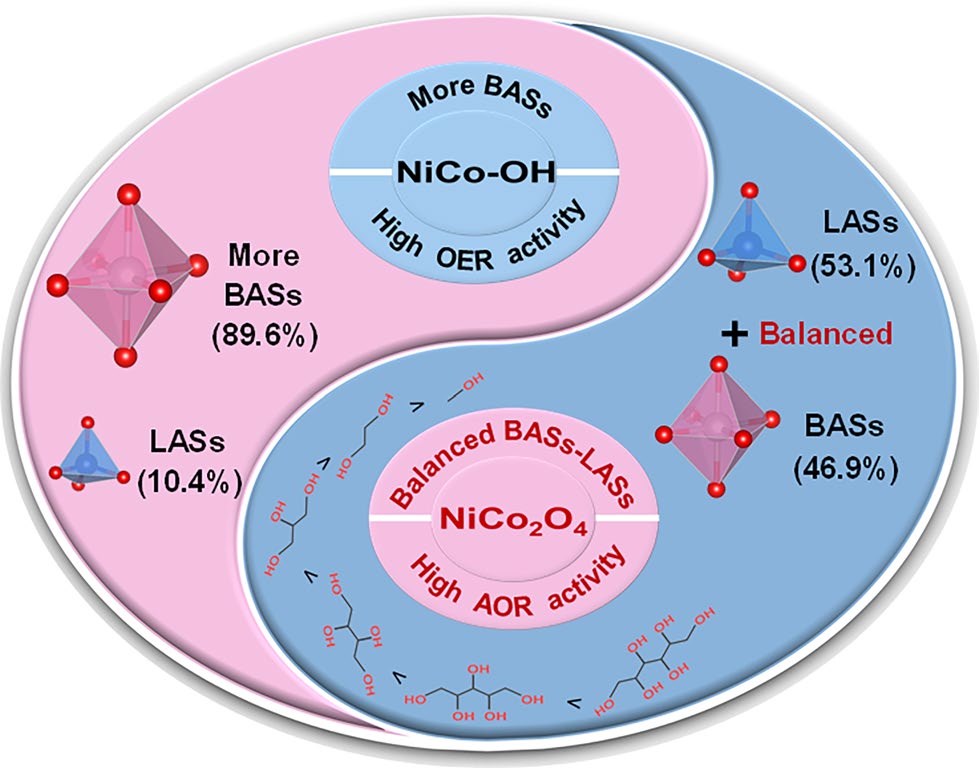
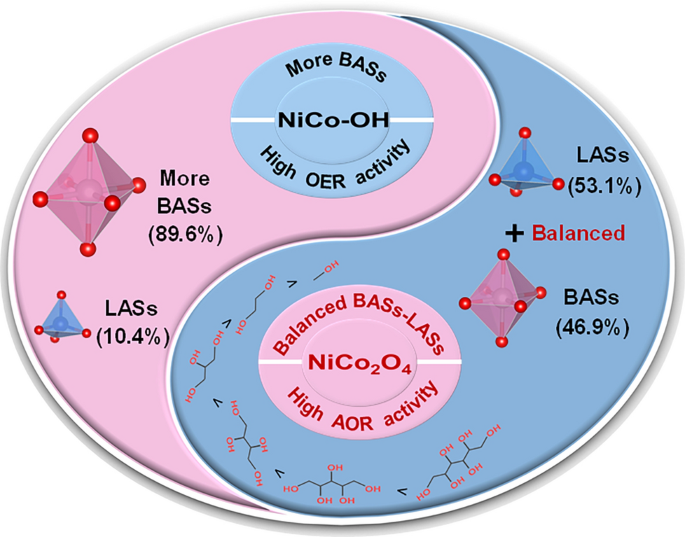

As the global push for green chemistry intensifies, the electrocatalytic upgrading of biomass-derived alcohols into high-value chemicals has emerged as a sustainable alternative to traditional oxidation processes. Now, researchers from Tongji University, Taizhou University, and Shanghai Institute of Ceramics, led by Prof. Jiacheng Wang and Prof. Xiangzhi Cui, have developed a solid-acid NiCo2O4 electrocatalyst with balanced Brønsted and Lewis acid sites (BASs and LASs) that enables efficient and selective electrooxidation of C1–C6 saturated alcohols to formate. This work offers a new strategy for designing high-performance, non-noble metal catalysts for biomass valorization.
Why Balanced Acid Sites Matter
-
Enhanced Alcohol Adsorption & Activation:
A near-equal ratio of LASs (53.1%) and BASs (46.9%) in NiCo2O4 promotes co-adsorption of alcohol molecules and OH⁻, facilitating faster alcohol oxidation reaction (AOR) kinetics. -
High Formate Selectivity:
The catalyst achieves up to 100% selectivity for formate from methanol and >90% from C2–C6 alcohols, outperforming many reported non-noble metal systems. -
Structure–Activity Insight:
In contrast, NiCo–OH with 89.6% BASs favors oxygen evolution reaction (OER) due to strong OH⁻ adsorption, highlighting the critical role of acid site balance in steering reaction pathways.
Innovative Design and Features
-
Thermal Transformation Strategy:
Layered NiCo–OH nanosheets are converted into spinel-structured NiCo2O4 via low-temperature calcination, enabling precise tuning of surface acid sites. -
Systematic C1–C6 Alcohol Screening:
The oxidation activity increases with hydroxyl group number:
methanol < ethylene glycol < glycerol < meso-erythritol < xylitol < sorbitol, while formate selectivity slightly decreases from 100% to ~86%. -
Mechanistic Understanding:
DFT calculations reveal that more hydroxyl groups lower the HOMO–LUMO gap and enhance adsorption energy, making sorbitol the most reactive substrate.
Applications and Future Outlook
-
Scalable Electrooxidation Platform:
The NiCo2O4 catalyst demonstrates stable performance across a wide range of alcohol concentrations and pH conditions, with low overpotentials and high current densities. -
Green Formate Production:
Formate, a key chemical feedstock and potential hydrogen carrier, is produced efficiently and selectively, offering a sustainable route from biomass to valuable chemicals. -
Guidelines for Catalyst Design:
This study establishes acid site balance as a design principle for solid-acid electrocatalysts, paving the way for next-generation systems in biomass upgrading, hybrid water electrolysis, and organic electro-synthesis.
This comprehensive work provides a molecular-level understanding of how acid site engineering and alcohol structure jointly dictate electrocatalytic performance, offering a rational framework for developing efficient, selective, and durable catalysts for biomass valorization and green chemical production.
Stay tuned for more innovations from Prof. Jiacheng Wang and Prof. Xiangzhi Cui and their teams!

Editor of Nano-Micro Letters, which is an Open-Access, peer-reviewed journal reported papers that have at least one dimension ranging from a few sub-nanometers to a few hundreds of micrometers. The journal is published by Springer Nature and indexed by SCI, EI, SCOPUS, Pubmed, etc. The 2025 JCR Impact Factor is 38.5. The 2025 CiteScore is 58.9.
Follow the Topic
-
Nano-Micro Letters
Nano-Micro Letters is a peer-reviewed, international, interdisciplinary and open-access journal that focus on science, experiments, engineering, technologies and applications of nano- or microscale structure and system in physics, chemistry, biology, material science, and pharmacy.