Scalable and Healable Gradient Textiles for Multi‑Scenario Radiative Cooling via Bicomponent Blow Spinning
Published in Materials and Mechanical Engineering
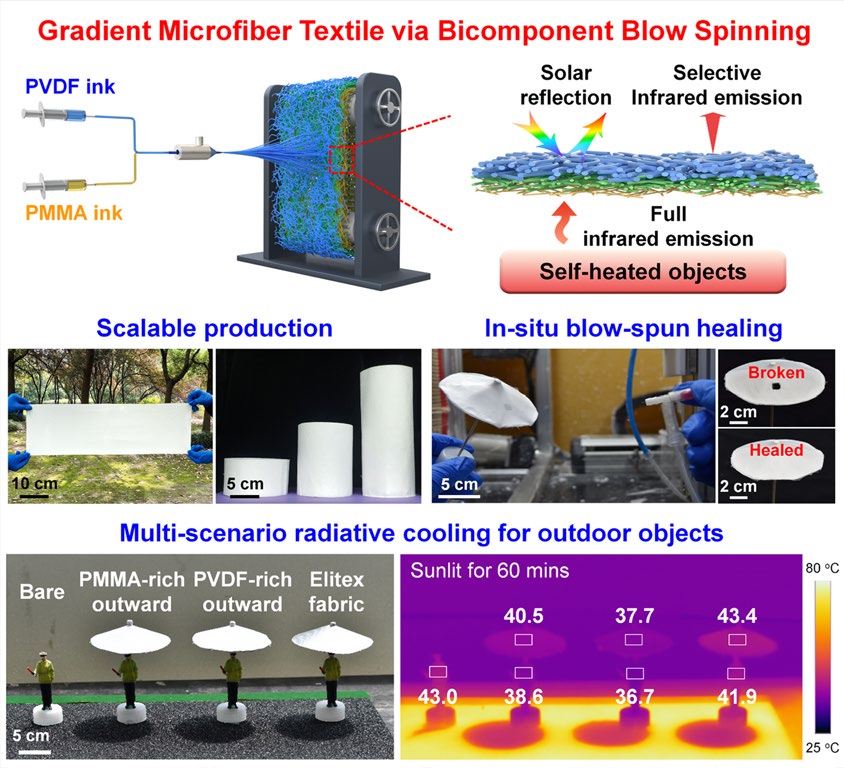
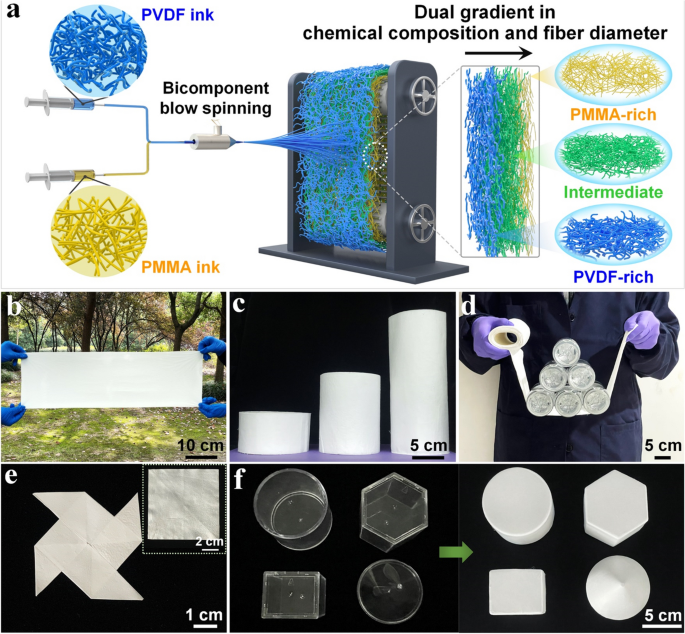

As heat waves intensify, keeping people, packages and gadgets cool without extra energy is climbing the global tech wish-list. A Donghua–Jiangnan University team led by Prof. Chao Zhang and Prof. Tianxi Liu now unveils a single-step bicomponent blow-spinning route that delivers kilometre-scale rolls of an ultra-flexible, self-healing micro-fibre textile engineered with two built-in gradients—one in fibre diameter (2.0 → 0.3 µm) and the other in polymer chemistry (PVDF → PMMA). The dual-gradient architecture behaves like a Janus optical engine: the sun-facing side reflects 98.7 % of solar irradiance while beaming 95 % mid-IR radiation to outer space; the human-facing side absorbs a broad IR spectrum, pulling heat away from self-heated objects such as electronic housings or human skin. Outdoor tests show 7.8 °C sub-ambient cooling for neutral objects and 13.6 °C temperature drop for internally heated enclosures—outperforming commercial aluminium-coated shade cloth by more than 5 °C.
Why This Matters
- Real-World Ready: Roll-to-roll production reaches 80 cm width; mechanical strength (4 MPa) supports 5 kg loads and 100 bending cycles without delamination.
- Self-Healing on Site: A portable blow-spinning gun re-deposits gradient fibres across tears, restoring both 98 % reflectance and mechanical integrity in minutes.
- Weather Tough: Hydrophobic surface (137° contact angle) sheds dust; 240 h UV aging retains 97.9 % solar reflectance.
- Energy-Free Cooling: Modelling predicts 114.8 W m-2 daytime cooling power under 1000 W m-2 solar irradiation even at h = 9 W m-2 K-1 convection—competitive with active HVAC.
Innovative Design & Features
- Hierarchical Pores: Continuously varying fibre diameters generate Mie-scattering centres sized to the 0.3–2.5 µm solar window, shortening photon path length and deepening penetration depth control.
- Janus Spectral Selectivity: PVDF-rich outer layer emits selectively at 8–13 µm (γ = 1.68); PMMA-rich inner layer offers 90 % broadband IR absorption (γ = 1.04), enabling rapid heat exchange with enclosed heat sources.
- Thickness Optimised: FDTD and experiments converge on ~300 µm as the sweet spot—thick enough for multiple scattering yet thin enough to avoid uniformity-induced reflectance loss.
- Multi-City Validation: Field trials in Beijing (dry, –8.7 °C) and Hong Kong (humid 90 % RH, –5.6 °C) confirm consistent sub-ambient performance under disparate humidity loads.
Applications & Future Outlook
- Wearable Thermal Management: Lightweight (area density < 40 g m-2) and air-permeable for cooling vests, sportswear and military uniforms.
- Logistics & EVs: Wraparound shields for battery packs, food containers and 5G outdoor cabinets, cutting peak temperatures by 10–15 °C.
- Built Environment: Retrofit awnings, tents and truck tarpaulins; simulation shows GMFT-covered roofs can lower indoor cooling demand by 20 % in subtropical climates.
- Next Steps: Team is coupling the textile with phase-change layers and exploring recyclable PVDF/PMMA blends to close the materials loop while scaling nozzle counts for metre-per-minute throughput.
The gradient-textile paradigm shifts radiative cooling from static, single-emission surfaces to adaptive, healable fabrics that can be manufactured, deployed and repaired on demand—pointing toward a truly sustainable route to beat the heat anywhere under the Sun.

Editor of Nano-Micro Letters, which is an Open-Access, peer-reviewed journal reported papers that have at least one dimension ranging from a few sub-nanometers to a few hundreds of micrometers. The journal is published by Springer Nature and indexed by SCI, EI, SCOPUS, Pubmed, etc. The 2025 JCR Impact Factor is 38.5. The 2025 CiteScore is 58.9.
Follow the Topic
-
Nano-Micro Letters
Nano-Micro Letters is a peer-reviewed, international, interdisciplinary and open-access journal that focus on science, experiments, engineering, technologies and applications of nano- or microscale structure and system in physics, chemistry, biology, material science, and pharmacy.