Searching for the human-facing side of the virome
Published in Microbiology and Genetics & Genomics

When most microbiologists think about the host of a bacteriophage, they think about bacteria.
That is not surprising given that phages are viruses that infect bacteria, and for more than a century, we have understood their role primarily through that relationship. Even today, as phages are being explored as alternatives to antibiotics, the focus is usually on which bacteria they kill and how efficiently they kill them.
Yet over the last decade, a growing number of observations have hinted that this picture might be incomplete.
Phage DNA has been detected in blood, cerebrospinal fluid, and other body sites. Some studies have reported that phages can cross epithelial barriers and enter mammalian cells. These findings were intriguing, but they also raised an interesting question: are these rare exceptions, or are we missing something more general?
Our project started from a deceptively simple idea. Instead of studying one phage at a time (looking at you T4 and M13), could we systematically search the human gut virome for phages that physically interact with epithelial cells?
At the time, we did not expect a particularly dramatic answer.
The human gut contains thousands of different phages, most of which have never been cultured or experimentally characterized. We assumed that if epithelial interactions existed, they would probably be limited to a handful of unusual phages carrying specialized adaptations.
To test this, we built a selection system. We exposed complex mixtures of gut phages to epithelial cell layers and repeatedly washed away everything that did not remain associated with the cells. We then sequenced the phages that stayed behind and asked a simple question: what do they have in common?
The first surprise was that the answer was remarkably consistent.
The phages enriched by the selection frequently encoded proteins containing immunoglobulin-like domains. These domains had been discussed before in the context of mucus binding, but their actual function remained largely speculative. More importantly, the phages carrying them were not rare curiosities. Many belonged to some of the most abundant and prevalent phages in the human gut, including the still enigmatic crAss-like phages.
At this point, we only had a correlation, not solid proof.
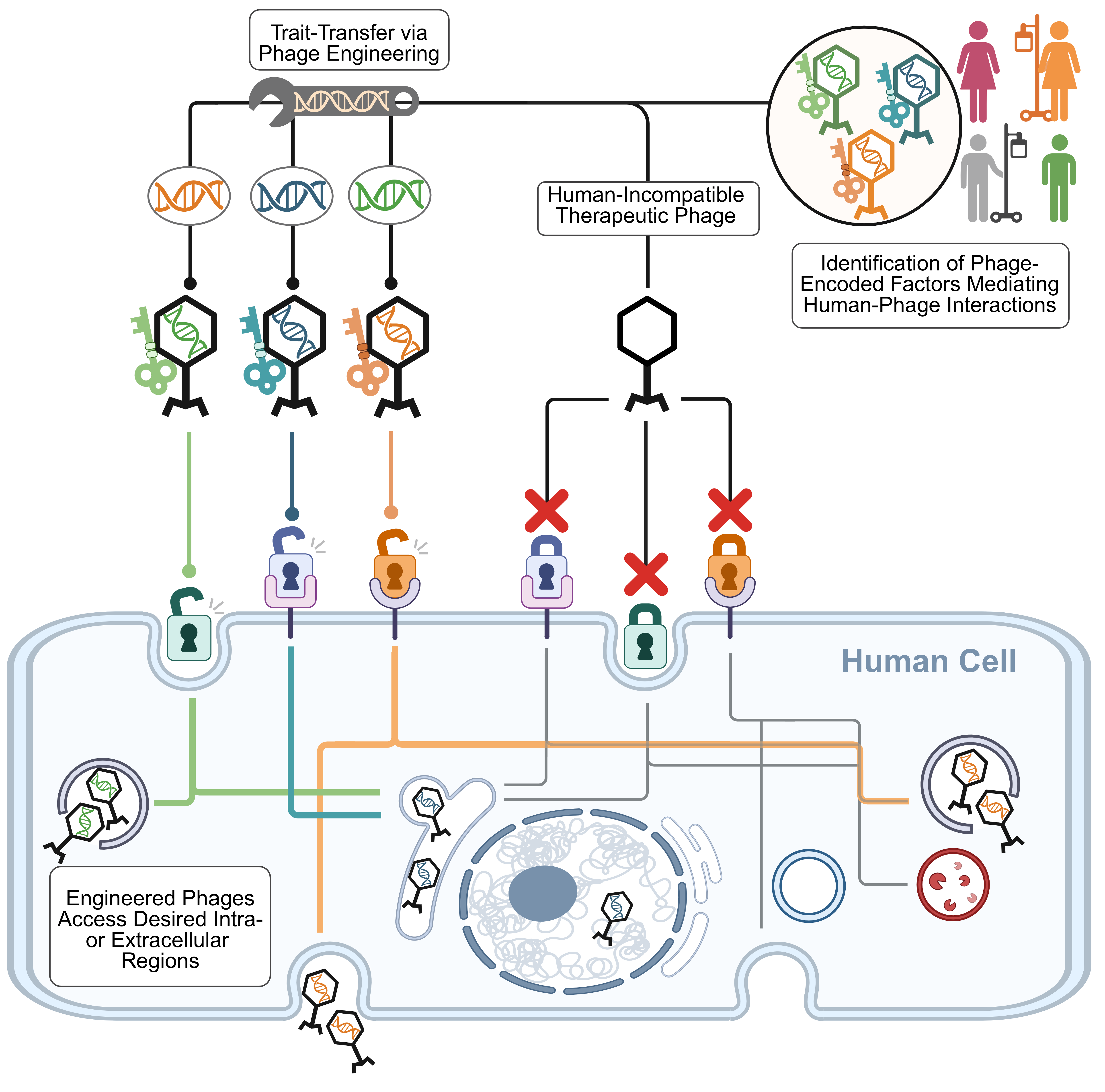
The critical experiment was to determine whether these proteins were actually responsible for the interaction. To do this, we transferred several candidate adhesins onto a phage that normally shows little interaction with epithelial cells.
The result was surprisingly clear. The engineered phages gained the ability to bind epithelial cells and enter them. Even more interestingly, very small sequence differences altered how the phages interacted with the cell surface. Two closely related proteins that differed by only two amino acids showed distinct interaction patterns with mucus or glycocalyx-associated structures.
For us, this was one of the most exciting moments of the project. It suggested that these proteins are not simply sticky surface decorations. Rather, they appear to function as modular host-interaction elements whose specificity can be tuned through sequence variation.
The next question was obvious: what happens after a phage enters a cell?
Many of us expected that the particles would ultimately end up in lysosomes, the cellular compartments responsible for degrading foreign material, often associated with non-specific uptake. Instead, fluorescence microscopy revealed a very different picture. Internalized phages trafficked through the Golgi apparatus and accumulated in the endoplasmic reticulum.
This was not where we expected the story to go.
The project had started as an attempt to understand mucus adhesion. Suddenly, we were observing phages accessing intracellular trafficking pathways that are usually discussed in the context of bacterial toxins and animal viruses.
Of course, our results do not imply that phages infect human cells. They do not replicate there. But they do suggest that interactions between phages and the human body may be considerably more intimate than we previously appreciated.
Looking back, what surprised us most was not the existence of these interactions, but their apparent prevalence. The proteins we identified are encoded by some of the most successful phages in the human gut ecosystem. When we expanded our analysis to large-scale virome datasets, phages carrying these adhesins were disproportionately abundant and widespread.
This raises a number of questions that we cannot yet answer. Do these interactions influence immunity? Do they affect inflammation or microbiome stability? Why do some phages appear to engage epithelial surfaces while others do not? And can these naturally evolved adhesins eventually be harnessed for therapeutic delivery?
We hope our study provides a starting point for addressing some of these.

Follow the Topic
-
Nature Communications
An open access, multidisciplinary journal dedicated to publishing high-quality research in all areas of the biological, health, physical, chemical and Earth sciences.

Related Collections
With Collections, you can get published faster and increase your visibility.
Neuroengineering
Publishing Model: Hybrid
Deadline: Oct 31, 2026
Women's Health
Publishing Model: Hybrid
Deadline: Ongoing