Secondhand exposure to e-cigarette aerosol and lung health
Published in Earth & Environment, Protocols & Methods, and Biomedical Research



Review Article
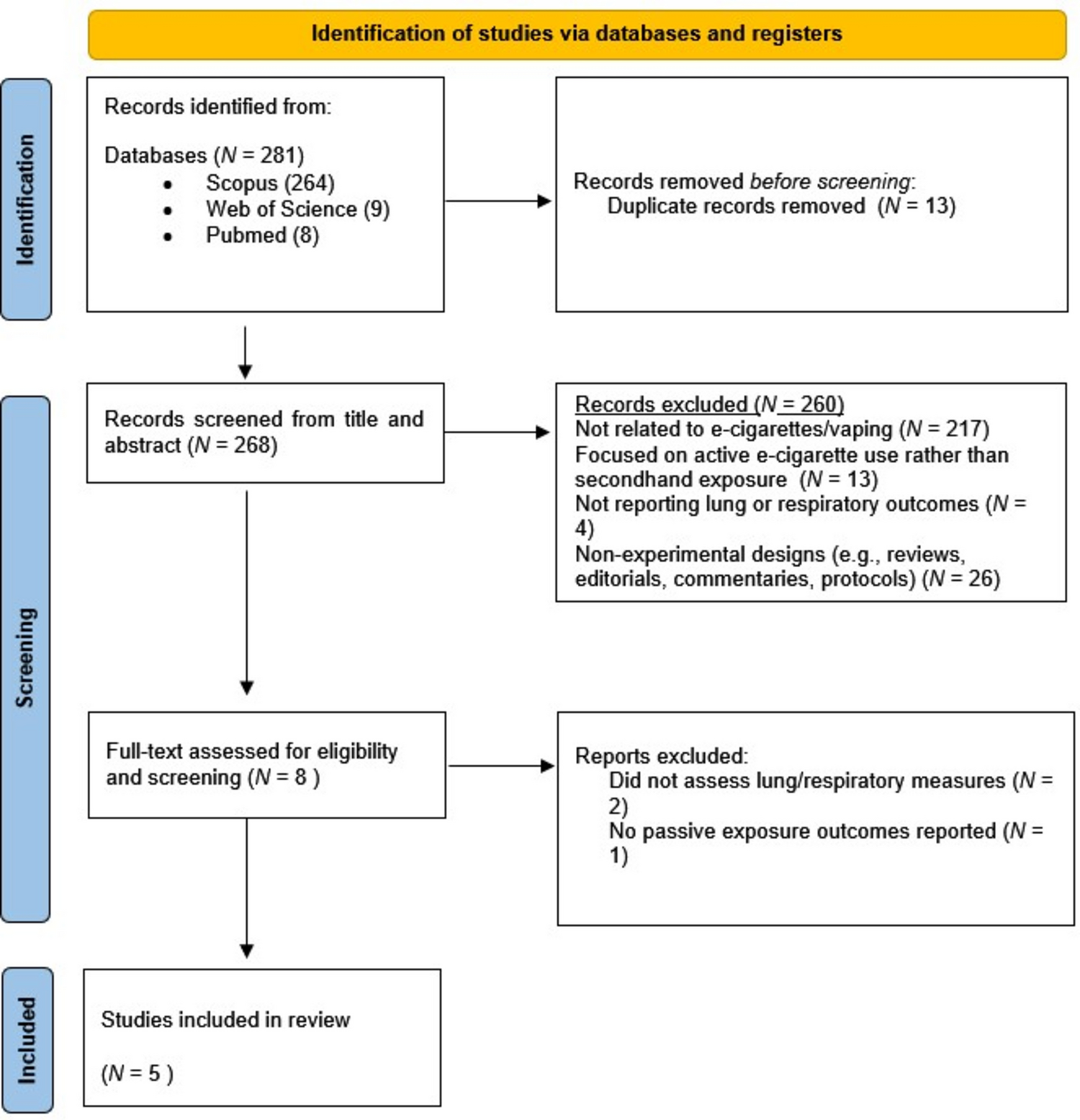
Effects of secondhand exposure to e-cigarette aerosol on lung health: a systematic review
What we found
Even with only a handful of studies, the pattern is clear.
In adolescents and young adults:
Living with someone who use e-cigarette is linked to more cough, shortness of breath, and asthma-related symptoms. The more frequent the exposure, the higher the risk.
In healthy adults (short-term exposure):
Just 30 minutes in an e-cigarette aerosol environment can cause:
- Throat and airway irritation
- Cough and discomfort
- Measurable changes in airway function
Some effects don’t disappear immediately after exposure ends.
In people with lung disease (COPD):
A few hours of exposure can:
- Increase inflammatory markers
- Affect lung-related proteins
- Slightly worsen lung function
These are not just mild annoyances. They interact with existing disease.
What’s actually in the air
E-cigarette aerosol isn’t smoke, but it’s not clean air either.
It contains:
- Ultrafine particles that reach deep into the lungs
- Volatile chemicals
- Reactive compounds like aldehydes
- Nicotine
And importantly, these don’t stay with the user. They spread into the surrounding air.
The key point
Across all studies, the same thing shows up:
- People report symptoms
- Lung function changes are detectable
- Inflammatory signals shift
- Air quality measurements confirm exposure
Different angles, same conclusion.
Secondhand exposure is real, and it has biological effects.
Putting it in context
Yes, the effects are generally smaller than cigarette smoke. But “smaller” is not the same as “safe.” And unlike active use, this exposure is involuntary. That matters.
What we still don’t know
Most studies are short-term or observational. So there are open questions:
- Do repeated exposures add up over time?
- Does the body adapt, or does damage accumulate?
Right now, both are possible.
Why this matters
This shifts the conversation.
It is no longer only about whether e-cigarette use is safer for the user. It is about what non-users inhale, often without choice. The evidence points to a clear conclusion: secondhand e-cigarette exposure is not harmless.
Risk may be lower than smoking, but lung effects are still detectable. That is sufficient to warrant caution, particularly for children and those with respiratory disease.
Reference
Sailis AB, Noh MABM, Leo BF, Faruqu FN, Yee A, Sim MS. Effects of secondhand exposure to e-cigarette aerosol on lung health: a systematic review. Journal of Public Health. 2026. https://doi.org/10.1007/s10389-026-02740-0
Full text available here: link

Ardie Barry Sailis is a PhD researcher in pharmacology and toxicology at the University of Malaya, studying how environmental exposures affect human health at the molecular and cellular levels. His work combines experimental and integrative approaches to understand how chemical exposures disrupt normal biological function. He has contributed to research on cellular stress, metabolic regulation, and tissue function, with a focus on how these processes relate to disease. His research aims to connect molecular changes with broader physiological outcomes to better understand mechanisms of toxicity.
Follow the Topic
-
Journal of Public Health

The Journal of Public Health: From Theory to Practice is an interdisciplinary publication for the discussion and debate of international public health issues, with a focus on European affairs.


Please sign in or register for FREE
If you are a registered user on Research Communities by Springer Nature, please sign in