STING Agonism and B Cells in Liver Cancer: How Immune Activation Can Drive Both Tumor Control and Metastasis—and Why Targeting Regulatory B Cells Can Unlock Durable Anti-Tumor Immunity
Immunotherapy can potently activate anti-cancer immunity, yet liver cancer often resists it. Our new research reveals one reason why: STING agonism or PD1/VEGFR2 blockade increases regulatory B cells that suppress T cells. Targeting these B cells can restore the immune balance and block metastasis.
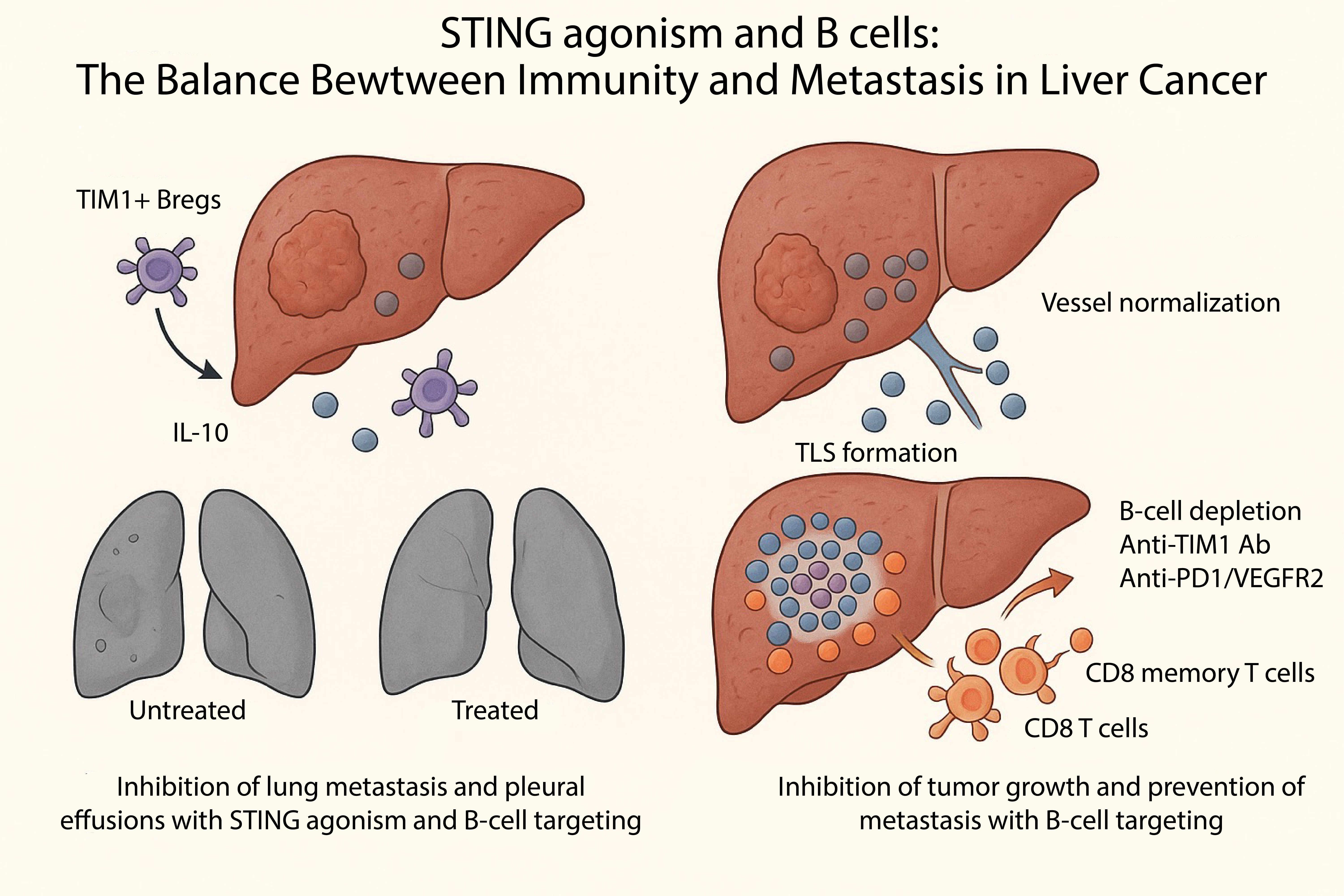
Immunotherapy has transformed cancer treatment, but in liver cancer—including hepatocellular carcinoma (HCC)—its efficacy remains limited. Even powerful immune-activating strategies often fail to produce durable responses. The illustration below summarizes a key reason why: the immune system can activate both tumor-fighting and tumor-suppressing pathways at the same time.
When Immune Activation Backfires
STING agonists are drugs designed to stimulate innate immunity. By activating the STING pathway, they trigger type I interferon signaling, improve blood vessel function in tumors (vessel normalization), and promote immune cell infiltration. In HCC models, STING activation also drives the formation of tertiary lymphoid structures (TLS)—organized immune cell clusters that can support anti-tumor immunity.
However, STING activation has a critical downside: it increases B-cell infiltration into the tumor microenvironment. Among these B cells is a regulatory subset known as TIM-1⁺ regulatory B cells (Bregs). These cells produce IL-10, an immunosuppressive cytokine that dampens CD8⁺ T-cell activity. As shown in the upper-left panel, this creates a brake on the immune response just as it is being activated.
The Dual Role of B Cells
B cells are not inherently harmful. In some contexts, they contribute to antigen presentation and help organize effective immune responses within TLS. But in HCC treated with STING agonists or immune checkpoint blockade, the balance shifts. Regulatory B cells accumulate, suppress cytotoxic T cells, and limit the overall effectiveness of therapy.
This helps explain a long-standing puzzle: why strong immune activation does not always translate into tumor control.
Targeting B Cells Unlocks Anti-Tumor Immunity
The lower-right panel illustrates the key therapeutic insight. When B cells are depleted, or when TIM-1 is blocked (using anti-TIM-1 antibodies), the suppressive arm of the immune response is removed. In combination with STING agonism and immune checkpoint therapy (such as anti–PD-1/VEGFR2 antibodies), this leads to:
Normalization of tumor vessels
Enhanced CD8⁺ T-cell infiltration
Expansion of CD8⁺ memory T cells
Durable tumor control
Prevention of metastatic spread and decreased disease morbidity
Anti-Metastatic Effects
Distant metastasis—including to the lungs—is a major cause of mortality in liver cancer. The lower-left panel highlights a striking finding: STING agonism combined with B-cell targeting significantly reduces lung metastases and pleural effusions. This anti-metastatic effect is rarely seen among current HCC immunotherapies and indicates that immune reprogramming can act systemically, not just at the primary tumor site.
A New Therapeutic Balance
Together, these findings show that successful immunotherapy in liver cancer is not just about “turning immunity on.” It is about shaping the immune response—amplifying tumor-killing T cells while restraining immunosuppressive B-cell pathways.
Combined STING activation with B-cell targeting leads to durable anti-tumor and anti-metastatic immunity.
Figure: STING agonism enhances immune activation in hepatocellular carcinoma (HCC) but simultaneously increases infiltration of regulatory B cells that suppress T-cell function via IL-10. Combining STING activation with B-cell depletion or TIM-1 blockade restores effective CD8⁺ T-cell immunity, inhibits tumor growth, and prevents lung metastasis.
This balance may be the key to converting immunotherapy-resistant liver cancers into long-term responders.
An open access, multidisciplinary journal dedicated to publishing high-quality research in all areas of the biological, health, physical, chemical and Earth sciences.
Tumor Microenvironment Crosstalk and Therapeutic Implications
With this cross-journal Collection, the editors at Nature Immunology, Nature Communications, Communications Medicine and Scientific Reports invite manuscripts that highlight cutting-edge research on TME crosstalk and its therapeutic implications. Topics of interest include immune modulation and checkpoint pathways, cancer-associated fibroblasts and stromal remodeling, angiogenesis and vascular normalization, metabolic reprogramming within the TME, and the role of microbiota in tumor-immune dynamics. We also welcome studies on novel therapeutic approaches that exploit TME vulnerabilities to advance cancer treatment.
We use cookies to ensure the functionality of our website, to personalize content and advertising, to provide social media features, and to analyze our traffic. If you allow us to do so, we also inform our social media, advertising and analysis partners about your use of our website. You can decide for yourself which categories you want to deny or allow. Please note that based on your settings not all functionalities of the site are available.