Stochastic Emergence of Irregular Infection Fronts in Motile Bacteria-Phage Populations
Published in Microbiology, Physics, and Mathematics







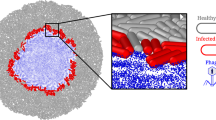

A stochastic predator–prey system
The main topic of this research is bacteriophages, or phages for short, viruses that specifically infect bacteria. Phages are not living organisms, but they carry genetic material that allows them to reproduce. To do so, they rely entirely on bacterial hosts, using their machinery to produce new viral particles. The infection usually ends with the bacterium being lysed (bursting open), releasing tens to hundreds of new phages.
Phages move through space mostly by diffusion, meaning their motion is random until they encounter a suitable host. From a physicist’s perspective, this makes them an interesting system: infection is not deterministic, but governed by chance encounters and probabilistic events. It is an important system to study because bacteria and phages are ubiquitous. The human body alone contains on the order of 1012-1013 bacteria, and phages play an important role in shaping these populations. Identifying mechanisms that are shared across different phage systems, despite their diversity in infection strategies and host specificity, could therefore help us predict and eventually control microbial communities.
From smooth fronts to irregular patterns
The system we study in this research is based on experiments where motile bacteria grow and spread on soft agar plates. As they consume nutrients, they form expanding fronts, driven by a combination of growth and chemotaxis, the directed movement of bacteria towards nutrients or attractants.
When phages are inoculated with the bacteria, they infect them and create a “killing front” that spreads through the population. Previous experiments (Ping et al. 2020) have shown that this system can produce a variety of spatial patterns, from smooth circular fronts to more complex structures.
When considering bacterial expansion without phages, the front is typically smooth and symmetric, well described by existing theoretical models. However, when phages are present, especially in conditions where they spread at similar speeds to bacteria, the infection front can become irregular. These irregular patterns are not well explained by deterministic models, which led us to think about what mechanism could produce them. This discrepancy was the starting point of this work.
Why a discrete stochastic model
Most theoretical descriptions of phage–bacteria spatio-temporal dynamics use deterministic partial differential equations (PDEs), which describe how densities evolve in space and time. These models have been successful in reproducing many experimental observations. However, they rely on the assumptions that populations are large enough for fluctuations to average out. In this framework, the system behaves smoothly, and individual events do not play a significant role.
The experimental observations suggest that this assumption breaks down in certain regimes. This raised a question for us: could the observed irregular patterns be driven by stochastic effects, rather than deterministic dynamics?
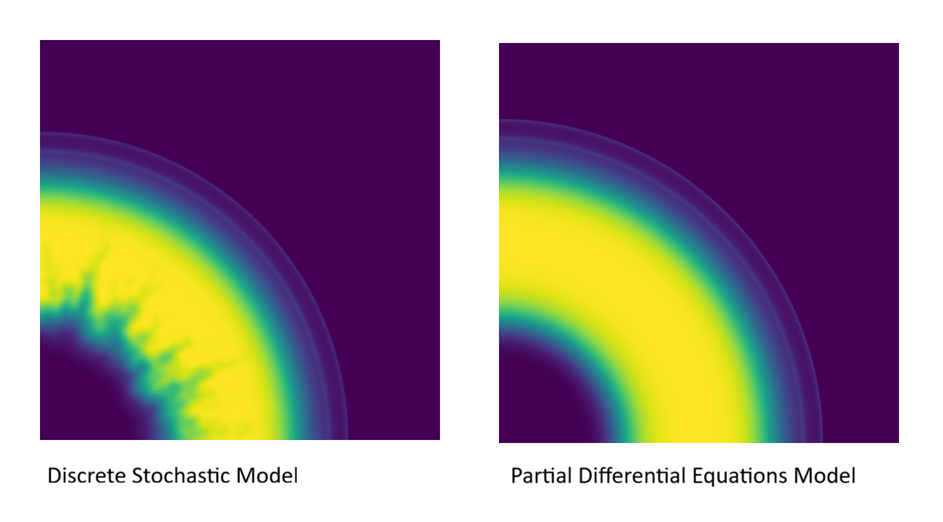
To investigate this, we developed a discrete stochastic model of phage–bacteria interactions. Instead of treating populations as continuous densities, we represent bacteria and phages as integer numbers on a lattice. Nutrients and chemical attractants are treated as continuous fields. All biological processes, growth, movement, infection, and lysis, are implemented as probabilistic events.
Because the dynamics are stochastic, the system evolves differently in each realization. This allows us to capture effects that are inherently linked to fluctuations and finite population sizes.
The role of rare events
When we ran simulations, we discovered that irregular infection fronts originate from rare, microscopic events. A typical scenario is the following: a single bacterium at the edge of the population gets infected, but instead of lysing immediately, it continues moving, carrying the infection forward. If it travels far enough before bursting, it can lyse ahead of the main bacterial front. Bacteria from the expanding front will arrive in this region, where phages are already present. The newly arrived bacteria can then be rapidly infected, leading to a local amplification of the infection. From there, the infection grows, more phages are released, and a visible protrusion appears in the front.
In this way, a single infection event can influence the large-scale structure of the system.
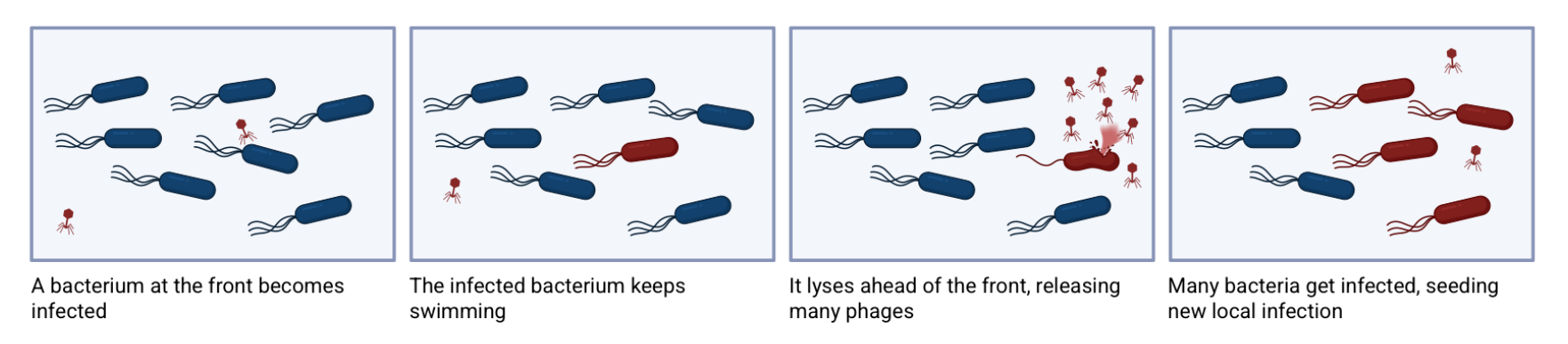
Created in BioRender. Bergamaschi, L. (2026) https://BioRender.com/k1xw7ds
When stochasticity matters
The appearance of irregular fronts is strongly dependent on the system's parameters. We identify three main regimes: when infection is weak, bacteria outrun phages; when infection is strong, the bacteria population collapses; and at intermediate levels, irregular fronts arise. A key parameter controlling this behavior is the product of adsorption rate (how quickly phages infect bacteria) and burst size (the number of phages released at lysis), which determines how efficiently infections propagate. Intermediate values of this parameter correspond to a regime where the bacterial front and the infection front propagate at similar velocities. In this regime, stochastic effects are most visible.
The role of population size and variability
Another important factor is the effective population size. In the model, this can be tuned by changing how many individuals occupy each spatial site. Increasing this number reduces fluctuations, as expected from the law of large numbers. As the population size increases, the irregular fronts become smoother and symmetric, approaching the predictions of deterministic models.
We also examined the role of the latent period, the time between infection and lysis. Not only the mean value, but also the variability of this time, affects the spatial patterns. When the latent period is highly variable, irregular fronts are more pronounced. When it is narrowly distributed, the fronts become smoother. In particular, rare early lysis events play a dominant role, as they can quickly seed and amplify infection regions ahead of the front.
Why this matters
More generally, this work highlights the importance of stochasticity in spatial biological systems. In many cases, randomness is treated as a secondary effect that can be neglected at large scales. Here, it plays a central role in shaping the dynamics. The spatial structure of the infection front is not just a result of average behavior, but of rare events that are amplified over time. This idea is not specific to phage–bacteria systems. Similar mechanisms are expected to occur in other contexts, such as microbial range expansions, ecological invasions, or epidemic spread, where dynamics are driven by processes at the leading edge.
In conclusion, what we want to show is that what initially appears as noise or irregularity can reflect a well-defined mechanism. The gap between experiments and deterministic models was not due to missing parameters or incorrect assumptions, but to the fact that an entire class of effects, the rare stochastic events, was not included. In that sense, the irregular patterns were not a problem to fix, but a feature to understand.
References
Ping, D., Wang, T., Fraebel, D. T., Maslov, S., Sneppen, K., & Kuehn, S. (2020). Hitchhiking, collapse, and contingency in phage infections of migrating bacterial populations. ISME Journal, 14(8), 2007-2018. https://doi.org/10.1038/s41396-020-0664-9
Follow the Topic
-
Communications Physics
An open access journal from Nature Portfolio publishing high-quality research, reviews and commentary in all areas of the physical sciences.

Related Collections
With Collections, you can get published faster and increase your visibility.
Nonlinear dynamics of living systems
Publishing Model: Open Access
Deadline: Nov 09, 2026
High-Energy Light Sources - From Tabletop to Large Facilities
Publishing Model: Open Access
Deadline: Sep 30, 2026

