Sustainable Crop Protection Policies: Scaling Precision IPM for Global Food Security and Environmental Health
Published in Earth & Environment and Agricultural & Food Science
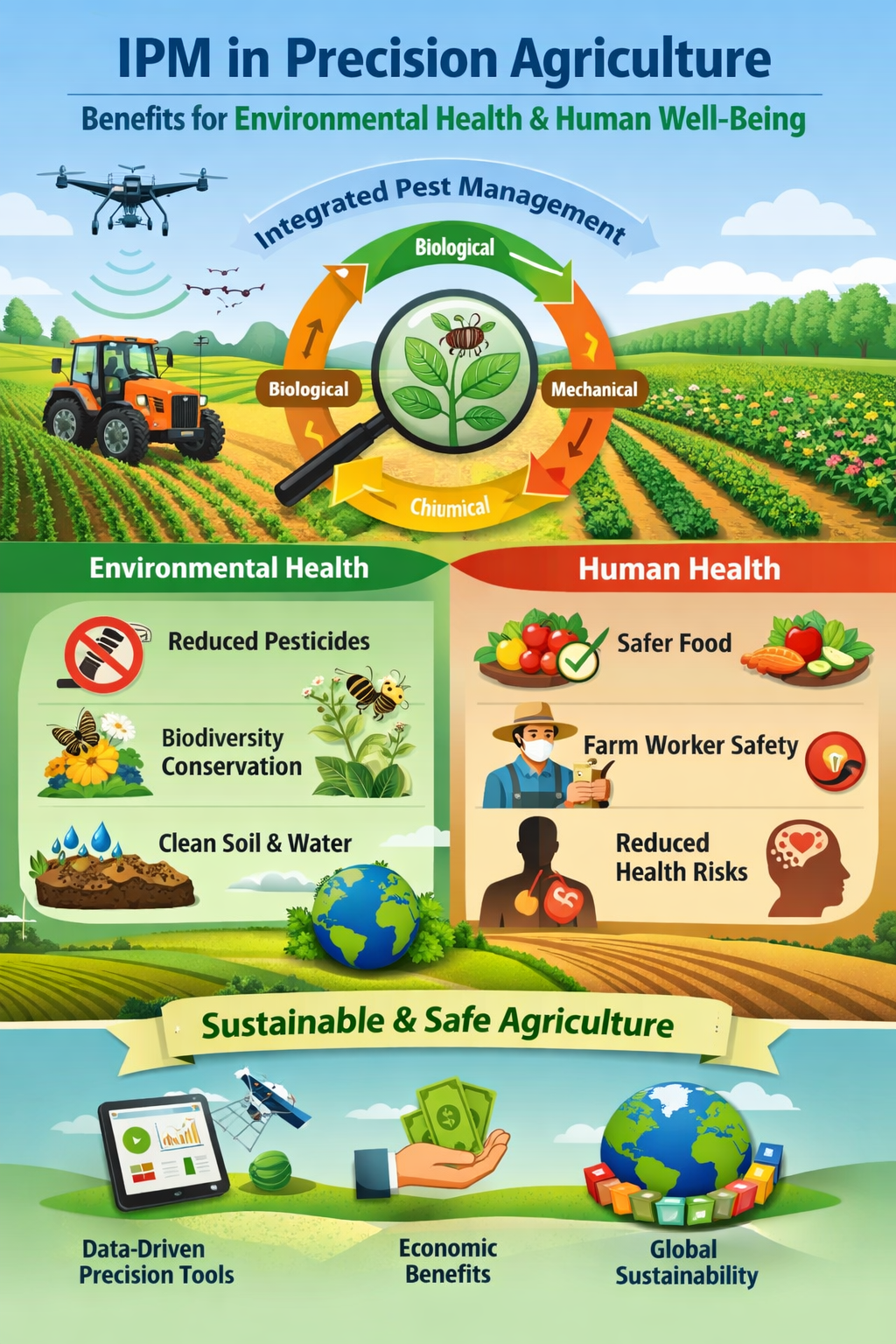



As global agriculture faces the dual challenge of meeting rising food demands while protecting natural ecosystems, Precision Agriculture (PA) has emerged as a transformative solution. By integrating data-driven technologies such as remote sensing, GPS, drones, and decision-support systems, PA enables site-specific crop management that optimizes inputs and minimizes waste. Within this framework, Integrated Pest Management (IPM) plays a critical role by offering an environmentally sound and human-safe approach to pest control.
The convergence of IPM and Precision Agriculture represents a powerful pathway toward sustainable crop protection. This integrated approach aligns closely with global sustainability goals, including climate resilience, biodiversity conservation, food safety, and long-term agricultural productivity.
Integrated Pest Management in the Era of Precision Agriculture
Integrated Pest Management is a holistic pest control strategy that combines biological, cultural, mechanical, and chemical methods to keep pest populations below economic injury levels. Unlike conventional pesticide-dependent approaches, IPM emphasizes prevention, monitoring, and informed decision-making.
When IPM is supported by precision technologies, its effectiveness increases substantially. Tools such as satellite imagery, unmanned aerial vehicles (UAVs), GPS-enabled sprayers, and digital pest surveillance platforms allow farmers to detect pest outbreaks early, assess spatial variability, and apply interventions only where and when they are required.
Precision-enabled IPM facilitates:
-
Real-time pest monitoring and early warning systems
-
Accurate estimation of economic threshold levels
-
Site-specific pesticide application instead of blanket spraying
This targeted approach reduces chemical dependence while maintaining effective crop protection, making pest management both efficient and ecologically responsible.
Environmental Health Benefits of Precision-Based IPM
The integration of IPM within Precision Agriculture delivers multiple environmental benefits that extend beyond pest suppression.
Reduced Pesticide Load
Precision-guided applications significantly reduce unnecessary pesticide use. By treating only infested areas, chemical inputs are minimized, leading to lower contamination of soil, water, and air.
Biodiversity Conservation
Reduced pesticide exposure protects non-target organisms such as pollinators, natural enemies, birds, and soil microorganisms. This helps maintain ecological balance and enhances natural pest regulation services.
Soil and Water Sustainability
Site-specific application prevents pesticide leaching and surface runoff, preserving soil fertility and protecting groundwater resources. Healthy soils, in turn, improve nutrient cycling and water retention.
Climate Resilience
Lower chemical inputs and optimized resource use contribute to reduced greenhouse gas emissions. Precision IPM systems also enhance agroecosystem resilience by supporting biologically diverse and stable farming systems.
Collectively, these benefits strengthen ecosystem services and contribute to long-term agricultural sustainability.
Human Health and Food Safety Implications
Excessive pesticide use poses serious health risks to farmers, agricultural workers, consumers, and nearby communities. Precision-enabled IPM directly addresses these concerns by minimizing human exposure to hazardous agrochemicals.
Safer Food Systems
Reduced pesticide applications result in lower chemical residues on food products, enhancing food safety and consumer confidence.
Improved Occupational Health
Precision technologies reduce the frequency, duration, and intensity of pesticide handling, lowering health risks for farm workers, including respiratory, neurological, and dermatological disorders.
Public Health Protection
Minimizing environmental contamination decreases the risk of chronic health conditions associated with pesticide exposure, such as endocrine disruption and neurotoxicity.
Through these pathways, IPM-driven precision agriculture supports healthier farming communities and safer food systems.
Economic and Social Advantages
Beyond environmental and health benefits, precision-based IPM offers important economic and social gains.
Cost Efficiency
Reduced pesticide use lowers input costs without compromising yield or crop quality. Improved pest control efficiency often leads to higher profitability.
Farmer Empowerment
Decision-support tools enable farmers to make informed, timely, and location-specific pest management decisions, reducing uncertainty and dependency on routine spraying schedules.
Policy and Sustainability Alignment
Precision IPM aligns with international frameworks such as:
-
FAO’s Integrated Production and Pest Management guidelines
-
United Nations Sustainable Development Goals (SDGs), particularly SDG 2 (Zero Hunger), SDG 3 (Good Health), and SDG 15 (Life on Land)
These advantages support resilient farming systems and sustainable rural livelihoods.
Future Perspectives
The future of IPM within Precision Agriculture lies in the integration of artificial intelligence (AI), machine learning, and big data analytics. Emerging innovations include:
-
Predictive pest outbreak modeling
-
Automated pest identification through image recognition
-
Real-time advisory platforms linked to weather and crop data
However, widespread adoption will require:
-
Strengthening interdisciplinary research
-
Expanding farmer training and digital literacy
-
Developing supportive policies and affordable technologies, particularly for smallholder farmers in developing regions
Bridging technological innovation with practical implementation will be essential to scale precision IPM globally.
Conclusion
The synergy between Integrated Pest Management and Precision Agriculture represents a paradigm shift toward environmentally responsible, human-safe, and economically viable farming systems. By minimizing chemical dependence and promoting ecosystem-based pest control strategies, precision-enabled IPM protects crops while safeguarding environmental integrity and public health.
As agriculture transitions toward sustainability, the widespread adoption of IPM-driven precision agriculture will be critical for achieving global food security, enhancing ecosystem functioning, and preserving natural resources for future generations.
"Future agricultural sustainability will increasingly rely on IPM-driven precision agriculture to reduce chemical inputs, protect ecosystems, safeguard human health, and ensure long-term global food security".
Selected References
-
FAO. (2018). Integrated Production and Pest Management in Agriculture. FAO, Rome.
-
Wu, W., & Ma, B. (2015). Integrated nutrient and pest management for sustainable crop production. Science of the Total Environment, 512, 415–427.
-
Pretty, J., et al. (2018). Global assessment of agricultural system redesign for sustainability. Nature Sustainability, 1, 441–446.
-
Popp, J., Pető, K., & Nagy, J. (2013). Pesticide productivity and food security. Agronomy for Sustainable Development, 33, 243–255.
-
Zhang, C., & Kovacs, J. M. (2012). The application of small UAVs for precision agriculture. Precision Agriculture, 13, 693–712.

I am currently serving as an Assistant Professor at the Meerut Institute of Technology, Meerut. I have also served as a peer reviewer for reputable scientific journals, reviewing three manuscripts in agriculture and plant sciences. I hold a Ph.D. in Horticulture with a specialization in Floriculture and Landscaping Architecture, reflecting a strong academic foundation and a commitment to advancing agricultural sciences.
With a distinguished academic and research profile, I have received three prestigious international awards recognizing my scientific contributions, and I hold three patents that demonstrate my innovative approach and dedication to developing practical horticultural solutions. My scholarly output includes 24 research and review papers published in reputed national and international journals, 27 popular science articles, 11 book chapters, and authorship of 8 books—collectively showcasing my expertise and passion for knowledge dissemination.
Beyond publications, I have actively participated in 15 national and international conferences, where I presented my research, shared insights, and collaborated with experts from across the world. My commitments also extend beyond academics, as reflected in my Course on Computer Concepts (CCC) certification, 6 Month DLC (diploma in Landscaping in CAD), and National Service Scheme (NSS) participation, highlighting both my technical proficiency and dedication to community service.