Tackling the Polyurethane Pollution Crisis Through Microbial Solutions
Published in Bioengineering & Biotechnology, Chemistry, and Earth & Environment






The Growing Problem We Can't Ignore
Imagine a material so versatile it's in your mattress, car seats, building insulation, and even medical devices. That's polyurethane (PU) — a wonder polymer that's everywhere in modern life. But here's the catch: the global PU market is projected to reach nearly $129 billion by 2034, and most of this material ends up persisting in our environment for decades, if not centuries.
This realization hit us hard. While polyurethane has revolutionized countless industries with its durability and flexibility, these same properties make it incredibly resistant to natural breakdown. The result? Accumulating waste in landfills, microplastic contamination in oceans, and toxic gas emissions from incineration.
Why We Wrote This Review
As researchers at the Department of Biosciences, Veer Narmad South Gujarat University, we've been following the emerging field of microbial plastic degradation with great interest. When we started diving deeper into polyurethane biodegradation specifically, we realized something crucial: while there's exciting research happening globally, the field lacks a comprehensive overview that connects the dots between microbial mechanisms, practical challenges, and future solutions.
Our review, recently published in Discover Environment, aims to bridge this gap by providing researchers, environmental scientists, and industry professionals with a complete picture of where we stand — and where we need to go.
The Microbial Solution: Nature's Recyclers
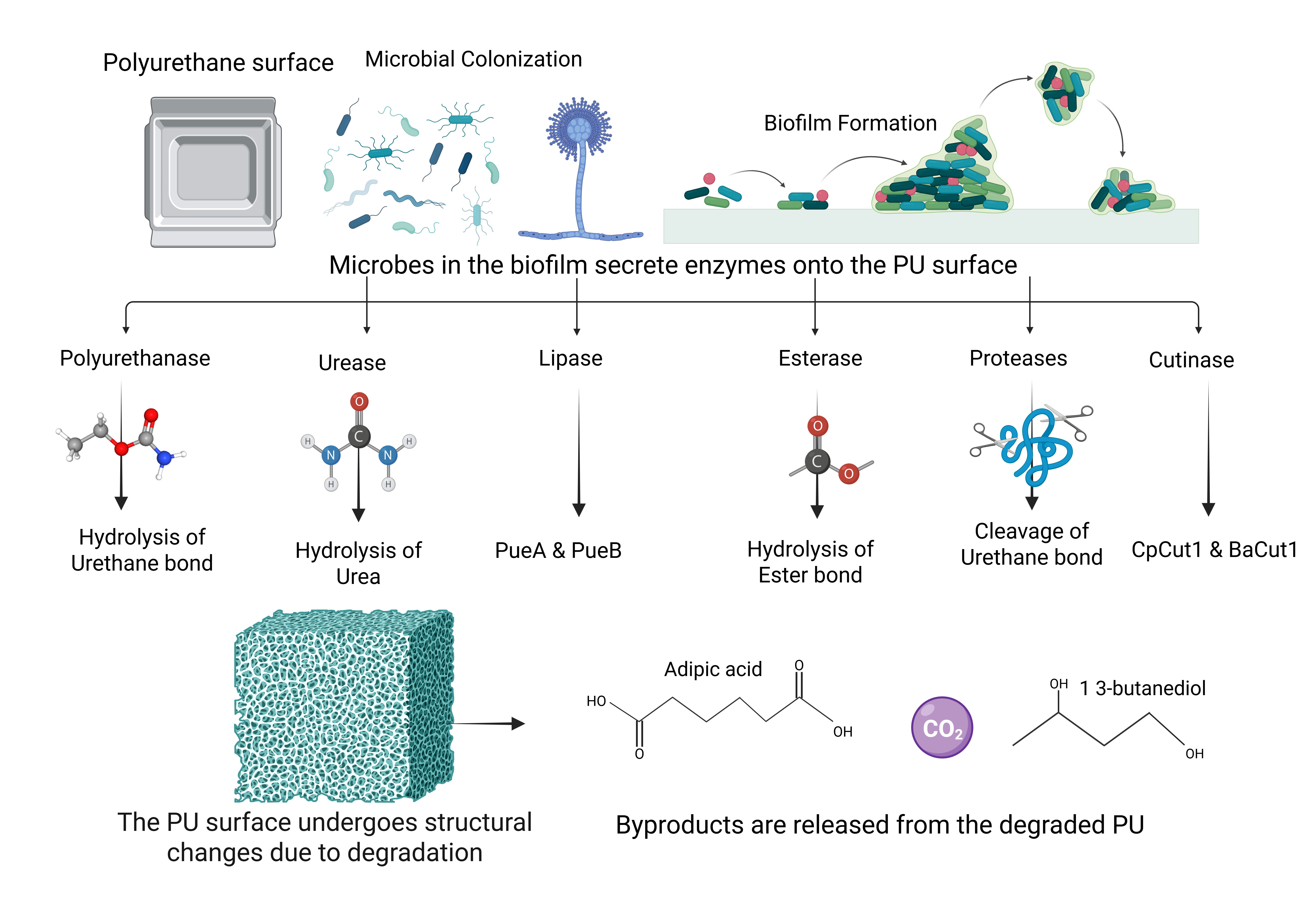
The most fascinating discovery in our research was the sheer diversity of microorganisms capable of breaking down polyurethane. From bacteria isolated from insect guts to fungi found in landfill sites, nature has already been working on this problem. These microbes produce specialized enzymes — cutinases, esterases, and the newly discovered urethanases — that can actually cleave the chemical bonds holding PU together.
What really stands out is how these microorganisms colonize PU surfaces, forming biofilms that work like microscopic factories, systematically breaking down the polymer structure. Some species, like Aspergillus versicolor, can degrade up to 55% of PU under optimal conditions. Even more impressive, certain engineered strains show 2.3-fold improvements in degradation efficiency compared to wild-type organisms.
The Reality Check: From Lab to Real World
But here's where our review gets real. Despite these promising laboratory results, scaling up microbial PU degradation to industrial levels faces significant hurdles:
- Speed matters: Most processes take months, when industries need weeks
- Environmental sensitivity: Temperature shifts from 15°C to 40°C can inhibit enzyme activity by up to 87%
- Chemical complexity: Commercial PU contains additives that can reduce microbial degradation rates by 35-60%
- Structural diversity: Polyester-based PU degrades much faster than polyether-based variants
These aren't insurmountable obstacles, but they require honest acknowledgment and targeted research.
The Path Forward: Integration and Innovation
What excites us most about the future of this field is the convergence of multiple approaches:
Genetic Engineering: CRISPR-Cas9 is enabling precise modifications to boost enzyme production in degrading microorganisms.
Synthetic Consortia: Combining multiple microbial species creates synergistic effects that outperform single-species systems.
Hybrid Approaches: Integrating chemical pretreatments (like mild oxidation) with biological processes significantly enhances degradation rates.
Omics Technologies: Genomics, proteomics, and metabolomics are revealing the molecular intricacies of how microbes actually break down PU, opening new avenues for optimization.
Nanobiocatalysts: Enzyme-nanoparticle conjugates are showing 82% activity retention across multiple cycles, making enzyme reuse economically viable.
Why This Matters Now
The urgency of addressing polyurethane waste cannot be overstated. As PU production continues to grow at 4.10% annually, every year of delay means millions more tons of persistent plastic in our environment. But unlike many environmental challenges, this one has a clear biological solution waiting to be optimized and deployed.
What We Hope Readers Take Away
Our review isn't just a catalog of what microbes can do — it's a roadmap for action. We've identified critical research gaps, outlined practical challenges, and highlighted the most promising technological solutions. Whether you're a microbiologist hunting for novel enzymes, an engineer designing bioreactors, or a policy maker evaluating waste management strategies, we hope this work provides valuable insights.
The key message? Microbial PU degradation is scientifically viable, technologically promising, but requires sustained, multidisciplinary effort to transition from laboratory curiosity to industrial reality.
Looking Ahead
The future we envision involves integrated waste management systems where PU products are designed with end-of-life degradation in mind, where engineered microbial consortia work in optimized bioreactors, and where degradation products are recovered as valuable chemical feedstocks — not just waste elimination, but resource recovery.
We're at an inflection point. The science is advancing rapidly, but the gap between laboratory proof-of-concept and real-world application remains wide. Closing that gap requires collaboration between microbiologists, chemical engineers, industry partners, and regulators.
Join the Conversation
We'd love to hear from researchers working on related challenges:
- What degradation mechanisms have you observed in your systems?
- What are the biggest practical obstacles you've encountered in scale-up?
- Are there novel microorganisms or enzymes from extreme environments worth exploring?
The polyurethane pollution crisis is global, but the solution will be built through countless individual contributions from researchers worldwide. We hope our review serves as a useful foundation for your work.
Read the full paper: Microbial mechanisms and applications of polyurethane biodegradation https://link.springer.com/article/10.1007/s44274-025-00351-2
Authors: Komal Antaliya, Sanjana Pathak, Manoj Godhaniya, Ashaka Vansia, Rajesh Patel Department of Biosciences, Veer Narmad South Gujarat University, Surat, Gujarat, India
Published in Discover Environment (2025)
What's your take on microbial plastic degradation? Share your thoughts and experiences in the comments below!

Follow the Topic
-
Discover Environment
This is a transdisciplinary, open-access journal that provides a leading platform for the rapid dissemination of knowledge and advances covering the research and innovation that is taking place across the environmental sector.

Related Collections
With Collections, you can get published faster and increase your visibility.
Monitoring environmental pollution and impact on health
The intensification of human activities and the expansion and densification of urban areas cause various damages to the environment, necessitating continuous monitoring to assess the impact and extent of potential risks to both the environment and human health, in order to ensure urban sustainability.
This collection, “Monitoring Environmental Pollution and Impact on Health,” invites contributions that utilize tools related to health impact assessment, human health risk, ecological risk, data modeling, geospatial data, and Geographic Information Systems (GIS) to analyze impacts within urban environments. We also encourage the publication of research on the dynamics of pollution and health in rural and peri-urban areas, interdisciplinary studies between environmental sciences and public health, epidemiology, and urban planning for a holistic assessment of the multifaceted impacts of pollution on human well-being. In addition, studies that contribute actionable policy recommendations for local governments, environmental agencies, or public health institutions dealing with urban pollution are welcome. Research (time series or longitudinal studies) that demonstrate public health trends related to chronic exposure to pollutants, aiming for a better understanding of long-term urban sustainability issues, are also encouraged. Studies addressing health risks for vulnerable populations (such as children, the elderly, or low-income communities) exposed to environmental pollution in densely populated areas are of particular interest. We welcome studies on participatory monitoring and the development of citizen science, empowering communities to act in collaboration with local environmental health surveillance managers. Research involving satellite pollution monitoring and remote sensing is also encouraged. Comparative studies on pollution and health across different regions, identifying critical hotspots and globally replicable mitigation strategies, are of interest. We also welcome research that investigates environmental justice and urban socio-demographic inequalities/disparities in health due to environmental pollution. Review studies and meta-analyses exploring trends, methodologies, and gaps in urban environmental health research are also welcome.
Keywords: Health impact assessment, Environmental quality monitoring (air, water, and soil), Pollution sources and emissions, Spatial analysis, Geospatial technology, Climate change, Urban sustainability, Machine learning, Ecological risk assessment, Human health risk assessment
This Collection supports and amplifies research aligned with the following Sustainable Development Goals (SDGs): SDG 11.
Publishing Model: Open Access
Deadline: Feb 28, 2027
Water Environment: Addressing Global Water Challenges
Water is an indispensable natural resource, yet it faces escalating threats from pollution, climate change, and human activity. The Water Environment: Addressing Global Water Challenges section of Discover Environment Journal is dedicated to publishing innovative research on the dynamics of water systems—tracing their journey from source to fate while examining the interplay between natural processes and anthropogenic influences. This section delves into critical domains, including chemical hydrology, watershed and basin science, glacier environments, and land-use impacts. We welcome contributions that address pressing issues such as water pollution, the transport and transformation of contaminants, hydrological modeling, and sustainable water management strategies. We place particular emphasis on the consequences of land-use changes on hydrological cycles, the stability of glacier-fed water systems, and effective approaches to safeguarding freshwater and marine ecosystems.
Key topics include:
Chemical Hydrology: Analysis of water composition, pollutant behavior, and geochemical interactions shaping water quality.
Basin and Catchment Science: Investigations into watershed hydrology, sediment transport, and hydrogeomorphological processes.
Glacier Environments: Research on cryospheric hydrology, glacier-fed rivers, and the influence of climate change on water availability.
Land-Use Systems: Examining the effects of agriculture, urbanization, deforestation, and industry on water resources.
Water Pollution & Remediation: Addressing emerging contaminants (e.g., microplastics, pharmaceuticals, PFAS), nature-based solutions, and policy frameworks for water protection.
Sustainable Water Management: Innovations in water conservation, resilience-building strategies, and alignment with Sustainable Development Goals (SDGs), particularly SDG 6 (Clean Water and Sanitation).
Methodological advancement in water research
Furthermore, to enhance the scope and impact of the section, we strongly encourage submissions that:
• Include case studies from underrepresented regions, particularly Sub-Saharan Africa and small island states, to showcase diverse hydrological challenges and locally relevant water management solutions.
• Promote the integration of traditional ecological knowledge and community-based water governance practices to enhance the cultural relevance and sustainability of proposed water stewardship strategies.
• Explore transboundary water issues, including shared aquifers and river basins, to highlight the importance of cooperation and policy in sustainable resource management.
• Emphasize the value of coupling remote sensing and GIS technologies with in-situ hydrological data for improved water quality monitoring and modeling accuracy across scales.
• Focus on emerging contaminants such as microplastics, pharmaceuticals, and PFAS in both freshwater and marine environments, reflecting current global research priorities.
• Give greater attention to groundwater-surface water interactions and their implications for long-term water availability, especially under changing climate and land-use patterns.
• Highlight the role of climate change scenarios and projections in shaping adaptive water management frameworks, particularly in glacier-fed and drought-prone regions.
• Feature interdisciplinary collaborations between hydrologists, ecologists, social scientists, and engineers to propose holistic and inclusive water resource solutions.
• Promote alignment of all submissions with SDG targets, especially SDG 6 (Clean Water and Sanitation) and SDG 13 (Climate Action), to strengthen policy relevance.
• Include policy briefs or synthesis articles that translate technical findings into actionable guidance for water managers and decision-makers.
By fostering interdisciplinary collaboration and highlighting diverse perspectives, the Water Environment: Addressing Global Water Challenges section serves as a vital platform for advancing knowledge on global water challenges and informing policy for sustainable water stewardship.
This Collection supports and amplifies research related to: SDG 6 & SDG 13
Keywords: Water Systems, Water Pollution, Climate Change, Land-Use Impacts, Sustainable Water Management, Emerging Contaminants, Hydrological Modeling, Interdisciplinary Collaboration, SDG 6 (Clean Water and Sanitation), Chemical Hydrology, Watershed Science, and Glacier Environments.
Publishing Model: Open Access
Deadline: Dec 30, 2026