Taming the Digital Giants: Why Regulators Need an Ecological Lens on Platform Power
Published in Ecology & Evolution, Mathematics, and Economics

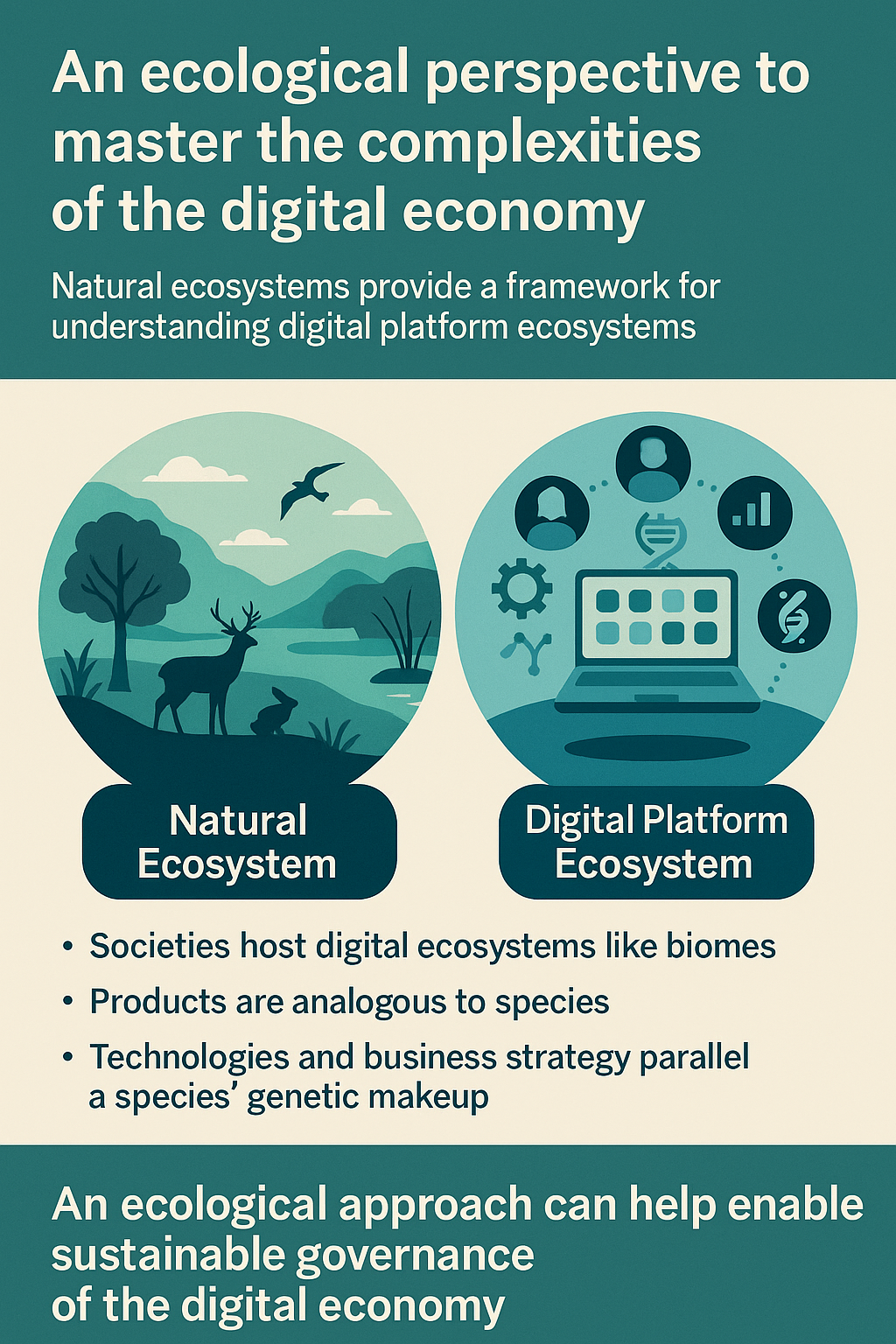




In recent years, digital platforms have become some of the most powerful economic and societal actors on the planet. From Amazon and Google to TikTok and Meta, a small group of companies—often dubbed the “digital giants”—have amassed extraordinary influence over markets, media, data, and even political discourse. As their reach and impact have grown, so too have the concerns of policymakers, regulators, and the public.
Antitrust authorities across the globe are grappling with a common set of questions:
- How do we define and measure dominance in digital ecosystems?
- How can competition be preserved in markets driven by algorithms and data monopolies?
- How can regulation keep up with rapid innovation without stifling it?
Many experts, regulators, policymakers, and business leaders agree that the platformized economy represents a fundamental departure from traditional economic models. But what exactly makes it different? While the discourse has highlighted several defining features—such as network effects, data-driven value creation, and ecosystem dynamics—it has lacked a unified framework for understanding, debating, and, ultimately, regulating this new economic paradigm consistently.
In this context, our newly published paper, “An Ecological Perspective to Master the Complexities of the Digital Economy” (npj Complexity, 2025) applies ecological and evolutionary thinking to digital platforms and provides regulators and policymakers with a systemic, dynamic, and scalable lens to understand the complex, adaptive, and evolving nature of digital platform ecosystems.
Why Traditional Regulation Struggles with Platform Ecosystems
One of the most pressing challenges regulators face is that digital platforms do not behave like traditional firms. They are not just service providers—they are ecosystem orchestrators, coordinating a vast and constantly shifting network of users, businesses, technologies, and data streams.
This makes applying conventional antitrust logic difficult as platforms:
- Blur market boundaries, combining retail, logistics, cloud computing, media, and AI;
- Create winner-takes-most dynamics through network effects;
- Internalize externalities, turning users into both producers and consumers of value;
- Evolve rapidly, reshaping their offerings and business models in response to technological or regulatory pressures.
As a result, regulators often find themselves two steps behind: by the time dominance is diagnosed using old tools, the harm is done—or the market has already shifted.
Digital Ecosystems as Complex Adaptive Systems
This is where our ecological perspective becomes crucial. In our research, we argue that digital platforms function as complex adaptive systems, much like natural ecosystems. They consist of interdependent actors and components that:
- Co-evolve over time,
- Exhibit non-linear dynamics,
- Adapt in response to internal and external stimuli, and
- Produce emergent behaviors that cannot be predicted from individual parts.
This complexity explains why regulatory interventions often have unintended consequences. Like ecological systems, digital ecosystems can resist, adapt, or morph in response to external shocks—including regulation.
A Hierarchical Framework for Regulatory Insight
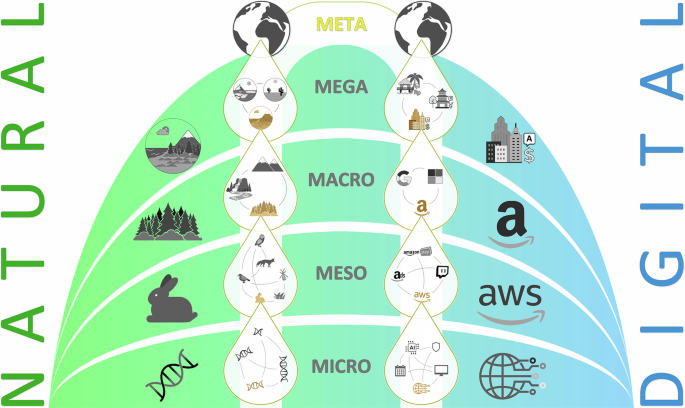
Our framework introduces a systematic, multi-level structure to analyze digital ecosystems, drawing analogies from ecological and evolutionary theory:
- Genes ~ Technologies and Strategies: The underlying code, algorithms, and business models that shape platform behavior.
- Species ~ Products and Services: Offerings that evolve and compete for user attention and market share.
- Natural Ecosystems ~ Digital Platform Ecosystems: Dynamic environments where multiple services and actors interact under a shared infrastructure and governance.
- Biomes ~ Societies and Markets: The broader cultural, regulatory, and economic systems in which platforms are embedded.
Mapping platform ecosystems in this way provides a consistent ‘system of systems’ framework to understand, debate, and justify innovation in regulation.
Implications for Antitrust and Platform Regulation
This ecological lens offers several concrete advantages for regulatory practice:
-
Dynamic Market Understanding:
Instead of trying to pin down a static definition of a “market,” regulators can analyze how platform boundaries shift and how new “species” (products, apps, services) are introduced or phased out over time. -
Resilience and Fragility Assessment:
Just as biodiversity boosts the resilience of natural ecosystems, a healthy digital ecosystem should support pluralism, interoperability, and competition. An ecological framework can help identify monocultures, choke points, or dependencies that threaten the system’s sustainability. -
Feedback Loops and Evolutionary Pressure:
Policies that target only outcomes (e.g., prices or market share) may miss underlying feedback loops—such as how data accumulation feeds algorithmic advantage. Ecological thinking emphasizes evolutionary pressure, helping regulators design incentives that shift the entire system toward healthier behaviors. -
Scenario Planning and Foresight:
By recognizing that platform ecosystems are in constant flux, regulators can move from reactive enforcement to proactive governance—using foresight methods and systems thinking to anticipate disruptions, such as AI breakthroughs or new forms of monetization.
Beyond Control: Toward Co-evolutionary Governance
A central insight of our paper is that regulation should not aim to control digital ecosystems, but rather to co-evolve with them. In practice, this means:
- Encouraging modularity and interoperability to reduce systemic risk.
- Designing adaptive regulations that evolve through feedback and monitoring.
- Supporting ecosystem diversity to avoid dominance by any single actor or architecture.
- Enabling shared governance models involving users, developers, civil society, and regulators.
Much like environmental policy shifted from command-and-control to adaptive management, digital governance must transition from rigid enforcement to systemic stewardship.
Bridging Research and Regulation
We recognize that adopting an ecological mindset is a shift—not just for regulators, but for economists, technologists, and platform leaders. Yet as calls for a digital economy that is inclusive, transparent, and resilient grow louder, the need for fresh thinking is urgent.
Our framework does not offer all the answers, but it opens new ways of asking the right questions—questions that reflect the complex, evolving nature of digital power.
By drawing inspiration from nature, we hope to equip regulators and policymakers with the conceptual tools needed to govern the digital future wisely and sustainably.
📖 Read the full paper:
An Ecological Perspective to Master the Complexities of the Digital Economy, npj Complexity, 2025
Follow the Topic
-
npj Complexity
This is an open access, international, peer-reviewed journal dedicated to publishing the highest quality research on complex systems and their emergent behaviour at multiple scales.

Related Collections
With Collections, you can get published faster and increase your visibility.
Variational, Nonequilibrium, and Optimization Principles of the Coevolution of Structure and Dynamics in Complex Systems
Publishing Model: Open Access
Deadline: Feb 03, 2027
Pedagogy and Complexity
Publishing Model: Open Access
Deadline: Dec 31, 2026