Temporary loss of social-ecological system resilience during rural to urban transition
Published in Earth & Environment




Urbanization is accelerating globally as urban populations grow and cities expand, particularly across the Global South. This process is blurring rural–urban boundaries and creating transition zones where rural and urban processes converge, forming frontlines of human–environment interactions. Although these zones cover a small proportion of Earth’s surface, they accommodate approximately one-quarter of the global population and contribute to climate regulation and ecosystem service provision. Nevertheless, they face intensifying environmental pressures, infrastructure deficits, and social marginalization, impeding progress towards Sustainable Development Goals. From a social-ecological system (SES) perspective, rural–urban transition zones can be conceptualized as transitional SESs, termed rural–urban transition systems here, where human activities interact with mosaic landscapes. SESs continually restructure, evolve and may undergo regime shifts, which are large, unexpected and persistent transitions in structure, function and feedbacks. Although regime shifts are widely documented in natural and human-dominated systems, empirical evidence of regime shifts associated with rural–urban transitions remains scarce.
Resilience provides a unique lens for investigating regime shifts. During rural–urban transition, resilience can be understood as the capacity of a SES to absorb disturbances and adapt to change under natural and social-economic pressures. A system approaching a tipping point may lose resilience, manifested as slower recovery from perturbations, known as critical slowing down (CSD). CSD has been documented across diverse systems, with rising autocorrelation and variance used as proxies for slower recovery rates. Drawing on CSD, when SESs undergo rural–urban transition, that is, shifting from non-urban to urban systems, a loss of resilience is anticipated in the pre-shift stage. However, SESs are continuously reshaped and rarely return to prior states, making recovery rates impractical to measure directly. Examining whether resilience loss emerges during rural–urban transition therefore offers an alternative to detecting CSD directly. However, most datasets retain a rural–urban dichotomy without delineating transition systems, complicating resilience comparisons across SESs. Recent advances in social–ecological archetype mapping and open geospatial data offer opportunities for fine-scale assessment.
Here, this study endeavors to investigate regime shifts that emerge during rural–urban transitions by monitoring SES resilience dynamics in the Beijing–Tianjin–Hebei (BTH) urban agglomeration. Using multi-source data from 2000 to 2020, we mapped five social‑ecological system archetypes at 1‑km resolution, including natural, seminatural, agricultural, rural–urban transition and urban systems. Resilience was then quantified by considering disturbance, encompassing natural disturbances and human pressures, and adaptability, which denotes the capacity to respond through ecosystem regulation and human adjustments. We first perform a cross-sectional comparison of resilience across rural, urban, and rural–urban transition systems for the year 2020 and examine the resilience variations across spatial boundaries of rural–urban transition systems. We then analyzed the transition-induced resilience changes between 2000 and 2020 during rural–urban transition using a spatial moving window strategy.
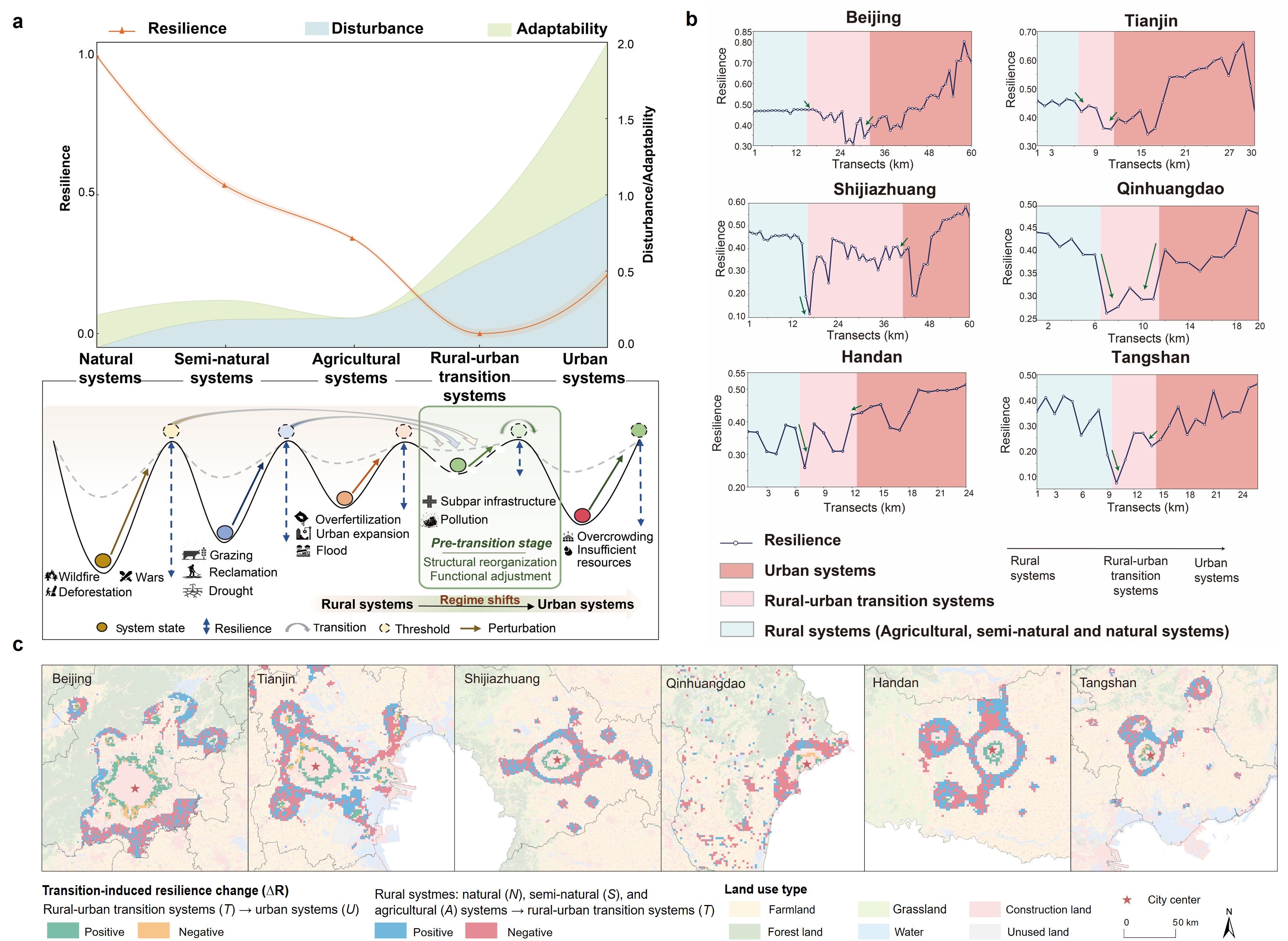
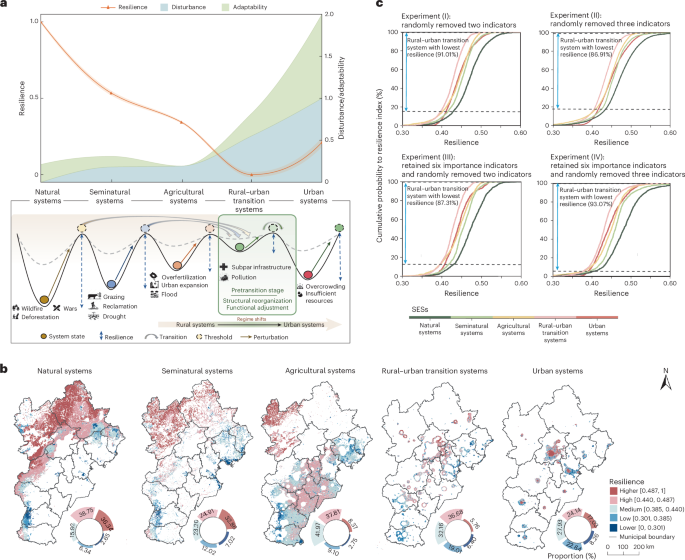
The main finding is that rural–urban transition systems form a resilience trough. Resilience exhibits a U-shaped trajectory across the sequence from natural to semi-natural, agricultural, rural–urban transition, and finally to urban systems, peaking in natural systems and troughing in rural–urban transition systems. The rural–urban transition systems are depicted as the shallowest basin of attraction, where accelerating disturbances exceed the system adaptability, thereby leading to a highly unstable state. Spatially, SES resilience drops sharply at the boundaries between rural–urban transition systems and their adjacent systems, with declines ranging from 0.36% to 60.34% across cities. Temporal analysis further revealed a dual‑belt pattern. The outer belts, where rural systems shift into rural–urban transition systems, are dominated by negative transition-induced resilience change values (relative resilience loss), whereas the inner belts, where rural–urban transition systems shift into urban systems, are dominated by positive transition-induced resilience change values (relative resilience gain). Together, these findings provide archetypical evidence of impending SES regime shifts in rural–urban transition contexts.
Urbanization is global but unfolds unevenly, with rural–urban transition systems emerging as particularly vulnerable areas, where persistent poverty, informal settlements, environmental degradation and fragmented governance collectively undermine sustainability. Although this study does not directly detect CSD, the identified resilience dynamics exhibit notable similarities to theoretical expectations of regime shifts in complex SESs. Particularly, the temporary loss of resilience before regime shifts and the recovery following system reorganization are broadly consistent with the notion that systems approach critical thresholds before shifting to alternative stable states. Consequently, resilience-based metrics may serve as indicators of regime shift–like processes during rural–urban transition, providing a useful lens for capturing the stability and transition of SESs, complementing existing approaches rooted in ecological theory. Based on these findings, achieving sustainable rural–urban transition requires a paradigm shift toward adaptive governance that integrates cross‑jurisdictional planning, multi‑stakeholder engagement, and investment in infrastructure.
Fig. 1 Resilience across SES archetypes, along rural–urban transects, and the spatial pattern of transition-induced resilience change in the BTH region. a, U-shaped curve depicting SES resilience along the theoretical sequential order of rural–urban transition. In the ball-and-cup conceptual model of SES resilience, cup width is fixed while cup depth represents resilience. The ball denotes the SES state at a given time, the single arrow represents perturbations, and the cup bottom signifies a steady state. b, Resilience change curves along the transects across cities in the BTH region. c, Spatial dual-belt pattern of transition-induced resilience change, characterized by outer resilience-loss belts and inner resilience-gain belts.
Looking forward, several directions warrant further investigation. One priority is extending this framework to other rapidly urbanizing regions, particularly the Global South. Comparative studies across different governance systems, socioeconomic conditions and natural endowments can test whether the resilience trough observed here is a general feature of rural–urban transition. In addition, longer time-series data are needed to trace the full trajectory of resilience before, during and after transition. Such data could help distinguish temporary instability from long-term degradation and improve the detection of early warning signals. Furthermore, leveraging emerging methods such as deep learning and coupled social-ecological modelling will help identify where transition systems are approaching critical thresholds. At a broader theoretical level, the nexus between urban–rural relations and human–earth interactions constitutes a foundational scientific proposition; social-ecological systems and coupled human–earth systems are deeply intertwined in both theory and practice. Unraveling the mechanisms of human–earth interaction during rural–urban transformation and advancing the human–earth system science (HESS) hold immense promise, yet the task remains formidable. This calls for integrated research encompassing multi-scale detection, dynamic monitoring, and scenario simulation of human–earth systems under the dual imperatives of climate change and the digital-intelligence era—necessitating multidisciplinary, cross-sectoral, and trans-regional collaboration. Rural–urban transition zones are the seedbeds of tomorrow's cities, and recognizing and strengthening their resilience is essential for steering urbanization toward a more equitable and sustainable future.
Funding:
This research was supported by grants from the National Natural Science Foundation of China (42371300; 42293271) and the Scientific Research Funds of Renmin University of China.
Reference:
Yuanyuan Yang, Wenkai Bao, Yuyu Wei, Mingying Yang, Alex de Sherbinin, Yansui Liu. Temporary loss of social-ecological system resilience during rural to urban transition. Nature Cities, 2026.
Contact: LIU Yansui: liuys@igsnrr.ac.cn , YANG Yuanyuan: yangyuanyuan@ruc.edu.cn
Link: https://www.nature.com/articles/s44284-026-00493-1
DOI: 10.1038/s44284-026-00493-1

Professor Yansui Liu is a distinguished scholar specializing in human-economic geography and land science. He is a Fellow of The World Academy of Sciences (TWAS) and a Fellow of the Geographical Society of China (GSC), and currently serves as Vice President of Henan University and Director of the Faculty of Geographical Science and Engineering. His major research areas encompass urban-rural transformation and urbanization, poverty alleviation and rural revitalization, human-earth system science, and geographical engineering.
Integrating theory, technological methodology, and practical application, Professor Liu leads his research team into grassroots villages and diverse land-use settings across typical regions for in-depth field surveys. Through this approach, he has developed a systematic scientific understanding of urban-rural developmental challenges and formulated the innovative Geo-STEP (Geographical Science–Technology–Engineering–Practice) paradigm. These scholarly insights have been widely applied to guide regional development, inform policy formulation, and support national decision-making on a global scale.
Professor Liu has spearheaded the establishment of five national comprehensive geographical engineering research and demonstration bases, advancing land engineering technology demonstration and high-quality development practice. In 2016, he initiated the founding of the International Geographical Union's Commission on Agricultural Geography and Land Engineering (IGU-AGLE) and served as its inaugural chair. In 2020, he launched the Alliance for Poverty Reduction and Development (ANSO-APRD) under the Belt and Road Initiative and served as its first chairman, thereby leading the internationalization of research on agricultural geography, land engineering, targeted poverty alleviation, and rural revitalization. As Principal Investigator, Professor Liu has undertaken over 70 research projects funded by the National Natural Science Foundation of China (NSFC), NSSFC, the Chinese Academy of Sciences (CAS), the Ministry of Natural Resources (MLR), the Ministry of Agriculture and Rural Affairs (MARA), the Ministry of Science and Technology, and the European Research Council, among others.
Professor Liu has received more than 20 technology and scholarly awards, including: The Third National Innovation Pacesetter Award, China Association for Science and Technology (2023); the IGU Distinguished Geographical Practice Award, International Geographical Union (2022); Fellowship of the Geographical Society of China (2022); the China New Development Award, Springer Nature (2022); the National Advanced Collective for Poverty Alleviation, awarded by the Central Committee of the Communist Party of China and the State Council (2021); the TWAS Prize in Social Sciences (2017); and the Second Prize of the State Scientific and Technological Progress Award, State Council (2019).
Professor Liu has published over 600 scientific papers, of which more than 290 have appeared in leading SCI/SSCI journals, including Nature, Science, Nature Cities, Land Use Policy, and Applied Geography. He has also authored 20 monographs and contributed 36 commentaries and policy analyses to major national newspapers. He has been recognized as a Top 1% Scientist by Thomson Reuters, a Global Highly Cited Researcher by Clarivate Analytics since 2018, and one of the World's Top 2% Scientists by Stanford University since 2019.
Follow the Topic
-
Nature Cities
This journal aims to deepen and integrate basic and applied understanding of the character and dynamics of cities, including their roles, impacts and influences — past, present and future.