The armhole, not the sleeve: redesigning DNA landing sites for large gene integration
Published in Bioengineering & Biotechnology, Microbiology, and Plant Science


When I describe our recent work to friends outside the lab, I borrow something every tailor knows.
Most gene editing so far works on what is already in the garment. CRISPR can find the one seam among three billion that is pulling wrong and take it out. It is exacting, valuable work, and it has changed what biology can do. But it alters what the cloth already contains, and once the alteration is made, the job is finished.
What we do is set in a whole new piece. We deliver a complete working panel—thousands of letters of DNA long—and join it so that it holds for the life of the garment, and is still holding when the garment is handed down. Sometimes that piece replaces one that wore through. Sometimes it is something the garment never had at all.
And here is what every tailor knows: the sleeve was never the hard part. The armhole is. It has to be cut to the right shape, eased to take the fullness, and set on the grain—or the sleeve twists and hangs wrong, however well it was made.
That’s exactly the challenge of large DNA integration—whether you’re engineering human cells or improving crops. You want to insert a whole functional cassette, precisely, once, and cleanly, into an opening that will hold it.
Why we looked at Bxb1
We chose to work with Bxb1, a large serine integrase from bacteriophages. It’s already a favorite among synthetic biologists because it recognizes two specific DNA sequences—attB and attP—and stitches them together with remarkable precision. No random cutting across the genome. Just one clean recombination event.
But here’s the catch: Bxb1 isn’t a simple pair of molecular scissors. It has to do something much harder. The enzyme must recognize its DNA targets, assemble into a precise tetramer complex, and go through a tightly choreographed series of shape changes. Miss a step, and efficiency drops.
One obvious way to improve things is to engineer the enzyme itself—mutate residues, run directed evolution, make it “faster.” Many labs, including ours early on, have tried. But Bxb1 is a big, multi-domain protein. Push too hard on activity, and you might lose control: higher enzyme speed does not automatically mean cleaner genome behavior.
So, we flipped the question.
Instead of asking, “How can we make the enzyme stronger?” we asked:
What if the bottleneck isn’t the enzyme—but the opening we’re asking it to set into?
Treating DNA sites as a language
Bxb1 recognizes a pair of natural sequences. We started by comparing these sequences and looking at what we know from structural biology: which bases the protein actually touches.
What struck us was that these recognition elements aren’t a monolithic code. They’re more like a set of modular letters. So rather than randomly mutating every base—which often kills the system entirely—we borrowed only the “letters” nature already uses.
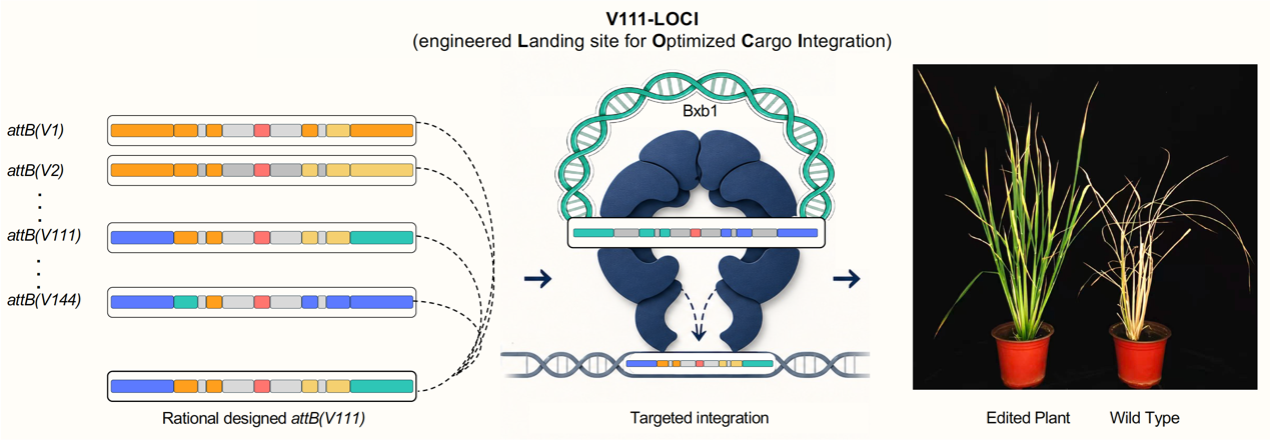
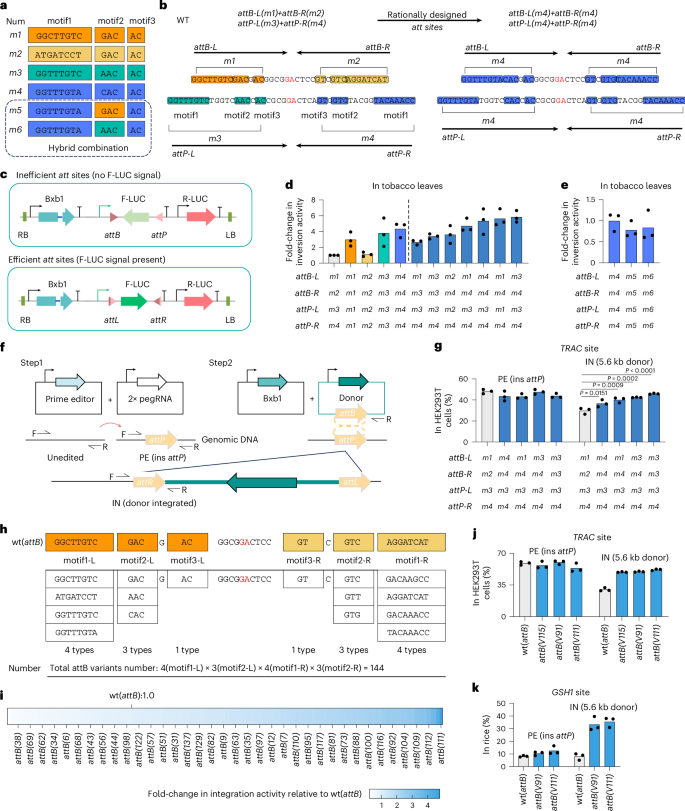
We kept the essential backbone of the attB site, but rationally recombined fragments from different natural variants. At four positions in the sequence, we allowed 4, 3, 3, and 4 natural options, respectively. That gave us 144 engineered attB variants—not random mutants, but curated combinations of nature-tested parts.
It felt less like forcing the sleeve and more like recutting the armhole to take it.
A surprisingly simple winner
All 144 variants worked. That alone told us the design logic was sound. One stood out immediately: attB(V111).
- In human HEK293T cells, integration efficiency reached 51.9%, about 1.7-fold over the wild-type site.
- In rice protoplasts, efficiency hit 35.6%, roughly 4.4-fold higher.
- When paired with an optimized Bxb1 enzyme variant, we could more efficiently integrate clinically relevant cassettes, such as a CD19 CAR and an OTC expression unit.
We named this platform V111-LOCI (V111-engineered Landing site for Optimized Cargo Integration).
Interestingly, we didn’t redesign attP at the same scale. Our data suggested that the main limitation sat on the attB side. By focusing there, we avoided an explosion of complexity and solved the part that mattered most.
Putting it to the test in plants
We then used this system to insert a 5.8 kb functional cassette into a defined rice locus. Among regenerated plants, 24% carried stable integration. Long-read Oxford Nanopore sequencing showed that the inserts were complete and accurately joined. Within the limits of our detection, we saw no unintended integration elsewhere in the genome.
Just as importantly, edited plants transmitted the insertion to the T1 generation. The change wasn’t a transient fix—it stuck.
Why this matters beyond the lab bench
Plant breeding rarely starts from scratch. Most of the time, breeders aren’t looking for a brand-new plant; they’re looking to carefully upgrade an existing variety that already yields well, tastes good, or survives local stress. Think: adding disease resistance, heat tolerance, or improved nutrient use efficiency—without disrupting everything else.
This is where landing site design becomes more than a technical detail.
Around the world, regulators are increasingly focused on what has been changed in a crop’s DNA, not just how it was changed. If an edit only uses sequences that already exist in a crop’s natural gene pool, and doesn’t disrupt the plant’s own genes, it is far more likely to move through standard breeding pathways rather than the most restrictive GMO routes.
Our system is built with exactly that in mind. By giving Bxb1 a well-defined, clean landing site, we can integrate functional DNA cassettes without leftover vector backbone and without unnecessary genome disturbance. That means breeders can add useful traits: disease resistance, stress tolerance, better nutrition, while keeping the rest of the plant exactly where it already performs well.
It’s not a shortcut around regulation, but it is a more predictable way to build crops that regulators and farmers can both trust.
Sometimes, genome engineering doesn’t need a more powerful enzyme.
It just needs a better opening to set into.

Follow the Topic
-
Nature Biotechnology
A monthly journal covering the science and business of biotechnology, with new concepts in technology/methodology of relevance to the biological, biomedical, agricultural and environmental sciences.