The Agro-Delivery Blind Spot: Why Current Nano-Fertilizers Are Leaving Heavy Metals in the Soil
Published in Materials and Agricultural & Food Science

The Precision Agriculture Hype
The global agricultural sector is trapped in a devastating environmental cycle. To feed a growing population, industries apply millions of tons of synthetic nitrogen and phosphorus fertilizers annually. Yet, due to immediate soil runoff and leaching, less than 40% of these nutrients are actually absorbed by the crop roots. The rest pollutes freshwater aquifers and drives massive marine eutrophication.
The widely celebrated solution to this crisis is precision nano-agriculture. By encapsulating nutrients within smart nanocarriers, researchers are designing stimuli-responsive agro-delivery systems. These systems are engineered to release their payload slowly or trigger delivery only in response to specific root-zone signals (like localized pH or enzymatic activity).
The initial laboratory and greenhouse data appear spectacular, securing top-tier journal covers. But behind the papers, our community is ignoring a massive, long-term environmental liability: The carrier afterlife.
The Accumulation Paradox
Most highly effective nano-fertilizer research currently relies on inorganic nanostructures as the core delivery vehicles:
-
Carbon nanotubes
-
Silica nanoparticles
-
Metal oxides (such as titanium dioxide or zinc oxide)
-
Rigid, metal-based porous frameworks
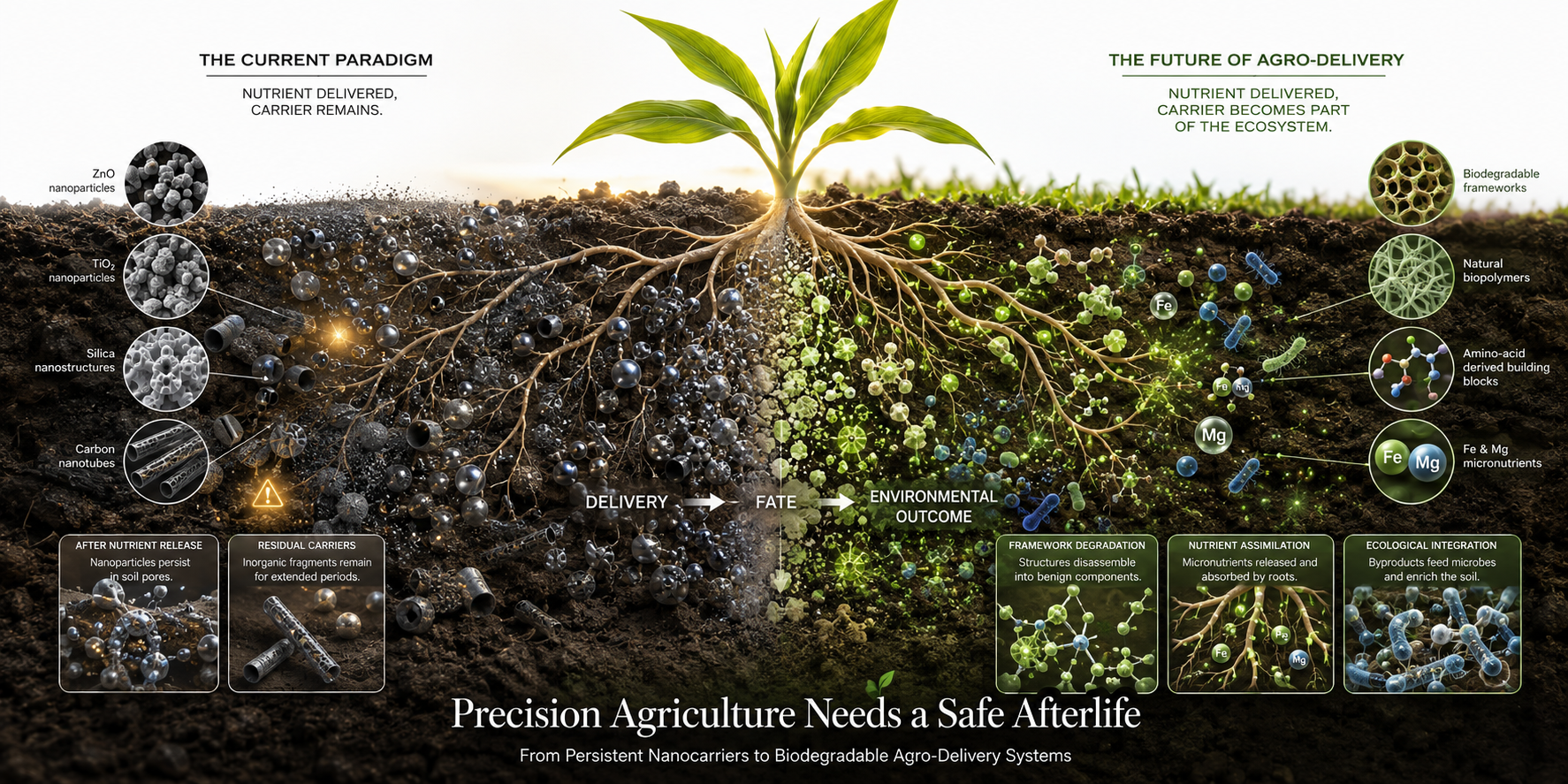
While these materials excel at protecting payloads and facilitating target-specific accumulation, they are fundamentally non-biodegradable. When a farmer applies tons of these smart nano-formulations season after season, the nutrients are absorbed, but the inorganic delivery matrices remain behind.
Over time, these synthetic nanoparticles accumulate in the topsoil. They interact with soil organic matter, form complex eco-coronas, and alter the local soil chemistry. Even worse, as these metallic or carbonaceous matrices slowly degrade over years, they risk leaching heavy metals or triggering localized phytotoxicity. We are effectively attempting to solve a short-term chemical runoff crisis by engineering a permanent, structural soil toxicity problem.
The Pivot to Biologically Degradable Frameworks
To transition nano-agriculture from an academic proof-of-concept into a sustainable real-world technology, the advanced materials community must completely re-engineer the delivery matrix. We must stop using rigid, indestructible inorganic frameworks for open-environment applications.
The future belongs to biologically degradable organic architectures. Instead of synthetic silica or metal oxides, next-generation precision agro-delivery must be built exclusively from natural polyelectrolyte complexes (such as chitosan-alginate assemblies), or specialized metal-organic frameworks (MOFs) engineered with completely non-toxic, nutrient-based metal nodes (like iron or magnesium) and organic linkers (like amino acids or food-grade organic acids).
When these biologically degradable frameworks release their fertilizer payload, the matrix itself completely dissociates into harmless, bio-assimilable micro-nutrients or organic molecules that soil microbes can safely digest. The carrier becomes part of the fertilizer, leaving zero synthetic residue in the rhizosphere.
Moving Beyond Single-Season Metrics
This paradigm shift requires a cultural change within environmental and agricultural materials research. Right now, the criteria for a "successful" paper are high encapsulation efficiency and increased crop yield across a single harvesting cycle.
This short-sighted testing methodology is a dangerous regulatory blind spot. If we expect regulatory bodies and large-scale agricultural operations to adopt nano-enabled systems, we must start proving their safety over multiple, cumulative seasons. Ecotoxicology assays for agro-delivery must step out of sterile laboratory Petri dishes and start evaluating multi-year soil accumulation, microbial population shifts, and systemic bioaccumulation up the food chain.
Conclusion
Nano-enabled agro-delivery represents one of our greatest opportunities to build a sustainable food system. But if our smart materials leave an indestructible trail of nanochemical debris in the Earth's most fertile soils, we are simply trading one ecological disaster for another.
True innovation in agricultural materials science is not defined by how efficiently a carrier delivers its payload. It is defined by how seamlessly it disappears when the job is done.
Should journals begin enforcing mandatory degradation and soil accumulation testing across multiple simulated crop cycles for all newly published nano-fertilizers? Or would that threshold aggressively stifle early-stage materials innovation? Let's discuss.
#NanoAgriculture #PrecisionFarming #Biomaterials #Sustainability #EnvironmentalScience #AgroSensing #SoilToxicity #AdvancedMaterials #ResearchCommunities