The Critical-Mineral Blind Spot: Why the Future of Clean Energy Must Be Polymer-Based
Published in Bioengineering & Biotechnology, Earth & Environment, and Materials
The Absurdity of the New Dependency
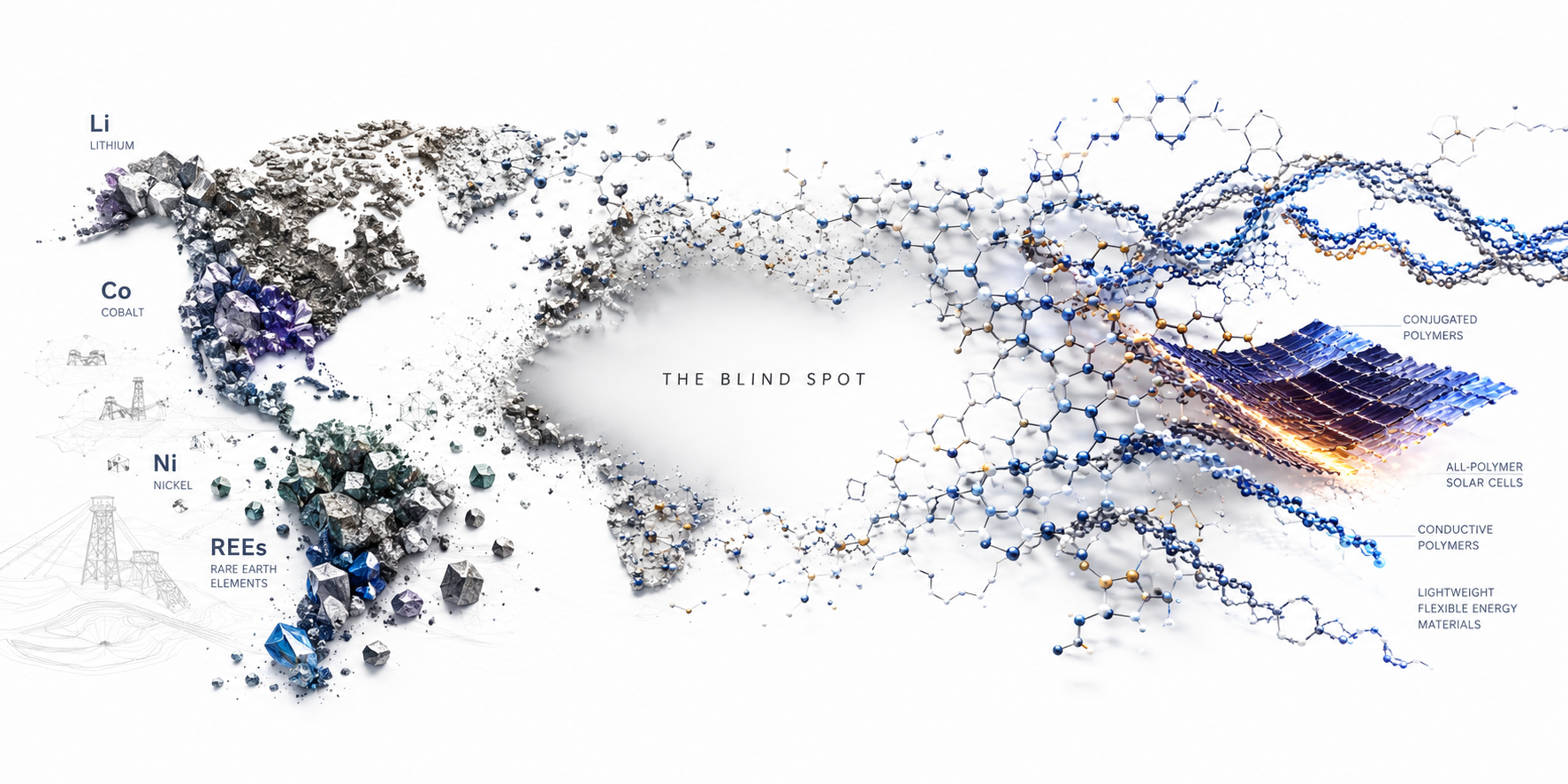
The global energy transition is celebrated as a triumph over fossil-fuel dependence. However, beneath the surface, we are quietly engineering a massive strategic vulnerability: the race for critical minerals.
Lithium, cobalt, nickel, tellurium, and rare earth elements have become the undisputed bottlenecks of modern decarbonization. From grid-scale batteries to next-generation wind turbines, we are electrifying the globe. But in doing so, we are simply replacing petro-state dependency with a highly concentrated, geographically fragile mineral supply chain.
The irony is striking. The technologies designed to save the planet rely on extraction processes that trigger devastating environmental footprints, ecosystem disruption, and water depletion. We must ask an uncomfortable question: Are we solving a climate crisis just to ignite a global resource war?
The Academic "Efficiency Trap"
This impending bottleneck is largely ignored in academic literature due to what I call the Efficiency Trap.
Much of today's energy materials research is myopically focused on breaking laboratory performance records. We chase higher photovoltaic efficiencies, denser battery outputs, and faster charging kinetics. These goals are important, and they secure high-impact journal covers. But they overshadow a broader, systems-level reality.
A material that achieves record-breaking laboratory metrics is functionally useless to society if its supply chain is vulnerable, expensive, or environmentally ruinous. Performance is only one dimension of technological survival. In the real world, scalability and manufacturability will always trump peak performance. History repeatedly shows that commercially dominant technologies are rarely the most efficient—they are the most robust, cost-effective, and accessible.
Enter Polymer-Based Technologies
This is where the materials science community must pivot. Unlike inorganic energy materials constrained by geological scarcity, polymer-based energy technologies offer a fundamentally different path. They allow for molecular design, low-temperature solution processing, lightweight manufacturing, and—most importantly—independence from critical heavy metals.
Researchers are already demonstrating remarkable, scalable progress in:
-
All-polymer solar cells (rapidly closing in on commercial efficiency thresholds)
-
Conductive polymers for metal-free supercapacitors
-
Solid-state polymer electrolytes for safer, next-generation batteries
-
Organic photovoltaics for flexible and wearable energy systems
Historically, these technologies have been dismissed as low-efficiency, niche alternatives to silicon or lithium-ion systems. That comparison is dangerously outdated. When evaluated through the lens of supply-chain resilience, carbon footprint, and roll-to-roll continuous manufacturing, polymers shift from a "niche alternative" to a strategic imperative.
Beyond Performance: Toward Resource-Aware Innovation
The transition to sustainable energy requires more than just low-carbon technologies. It demands low-carbon technologies that can be produced affordably and securely at a global scale.
We must shift from performance-centric innovation to resource-aware innovation. Funding agencies, policymakers, and researchers must start evaluating energy materials based on their geopolitical risk, elemental abundance, and end-of-life recyclability.
Polymer-based systems have not yet solved every energy challenge. But they offer an extraction-free, tunable approach to a problem that mining simply cannot fix.
The future energy landscape will require a diverse portfolio of technologies. But as the geopolitical and environmental costs of critical minerals continue to soar, polymer science will emerge as a crucial contributor to global energy security.
The clean-energy transition is a battle against carbon. But it will ultimately be won or lost on materials.
To my colleagues in energy materials: Should funding agencies prioritize grants for materials made exclusively from Earth-abundant elements, even if their theoretical efficiencies currently lag behind mineral-dependent technologies?

Dr. Akeem Adeyemi Oladipo is a globally recognized Research Professor of Materials and Environmental Chemistry at Eastern Mediterranean University. Ranked among the world's Top 2% Scientists, his expertise bridges nanotechnology, renewable energy, and electro-analytical chemistry. He specializes in advanced materials synthesis for wastewater treatment, highly sensitive electrochemical biosensors, and solar energy conversion. By integrating machine learning and artificial neural networks, his research drives scalable deep-tech innovations in environmental sustainability and energy storage.