The Echo of Early Bites: Can Early-Life Sugar Exposure Shape Adult Mental Health?
Published in Biomedical Research




While it might sound like an exaggerated claim, but in nutritional epidemiology, it forms the core of a widely studied concept: the First 1000 Days of Life. Spanning from the day of conception to a child’s second birthday, this early window of rapid development is when our organs, metabolic systems, and brain circuitry are built.
The power of this early developmental period was famously demonstrated by the Dutch Hunger Winter (1944–1945). Pregnant women exposed to severe famine during World War II gave birth to children who grew up with significantly higher rates of metabolic disorders (Ravelli et al., 1998), heart disease (Roseboom et al., 2000), and schizophrenia (Hoek et al., 1998). The fetus’s body, sensing scarcity in the womb, had "programmed" its metabolism and physiology for a low-resource world.
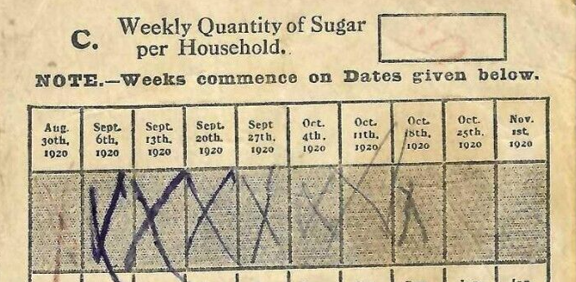
In peacetime, other natural experiments can be conducted. Take for example the UK post-WWII rationing system. For years following the war, sugar was tightly restricted to an average allowance of 8 to 10 ounces (225–280 g) per person per week, equivalent to roughly 32 to 40 grams per day of direct sugar. Remarkably, these wartime restrictions naturally limited consumption to levels that closely align with modern public health targets. The World Health Organization (WHO) strongly recommends reducing the intake of free sugars to less than 10% of total energy intake (roughly 50 grams per day for a standard 2,000 kcal diet), with a conditional recommendation for a further reduction to below 5% (roughly 25 grams per day) for additional health benefits. Post-war rationing effectively enforced a population-level diet that hovered right at the threshold of these contemporary WHO recommendations.
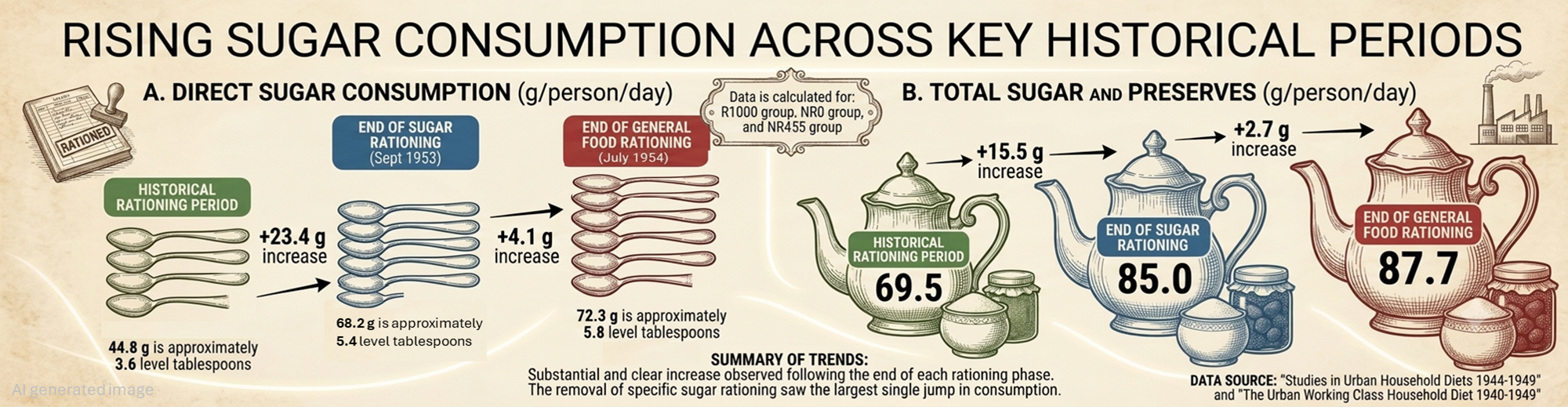
When sugar rationing ended in September 1953, consumption almost doubled, while the change in consumption of other previously rationed foods such as butter was more temperate. This sudden shift in sugar consumption specifically, created a unique historical snapshot for scientists studying early-life nutrition.
A Sweet-tooth, Depression, and a Scientific Disagreement
Our journey into this research began with a surprising pattern we uncovered in a previous study using data from over 180,000 UK Biobank participants (Navratilova et al., 2024). By applying data-driven machine learning to data collected from food preference questionnaires, we identified three distinct dietary profiles, including what we termed a putative "sweet-tooth" group of individuals. People in this sweet-tooth category didn't just prefer sugary foods over all other types, they also exhibited higher systemic inflammation, poorer metabolic markers, and a significantly higher risk of depression and anxiety.
Shortly after, a high-profile study published in Science by Gracner et al. (2024) examined the UK sugar rationing era. The researchers found that adults who experienced early-life sugar rationing (i.e. low to no exposure to sugar) had dramatically lower rates of Type 2 diabetes and hypertension. However, they also concluded that early-life sugar exposure had no meaningful association with mental health outcomes such as depression.
We were intrigued.
When we took a closer look at Gracner et al.'s methodology, we identified a critical vulnerability: their depression outcome relied on self-reported recall of the exact age participants remembered first feeling depressed. Asking older adults to accurately recall the precise year of their first depressive episode is prone to recall bias.
Could a flawed measurement be masking a true connection between early nutrition and adult mental health? We set out to test this hypothesis in our new article (Navratilova, Whetton, & Geifman, 2026).
A Deeper Dive into Clinical Records and Missing Pieces
To re-evaluate the relationship accurately, we refined the analytical approach in three critical ways. First, instead of relying on subjective memory, we tracked electronic health, focusing exclusively on formal clinical diagnoses of depression and anxiety, such as those captured by ICD-10 diagnosis codes in hospital records. Second, because early-life nutrition isn't defined by sugar exposure alone, we integrated essential early feeding variables omitted in previous studies—most notably, whether participants were breastfed as infants. Finally, we accounted for later-life habits by incorporating participants' actual adult sugar intake into our survival and hazard ratio models to evaluate whether current dietary practices explained or altered the initial early-life risk.
What We Found
When you swap subjective recall for medical diagnoses, a clearer picture emerges.
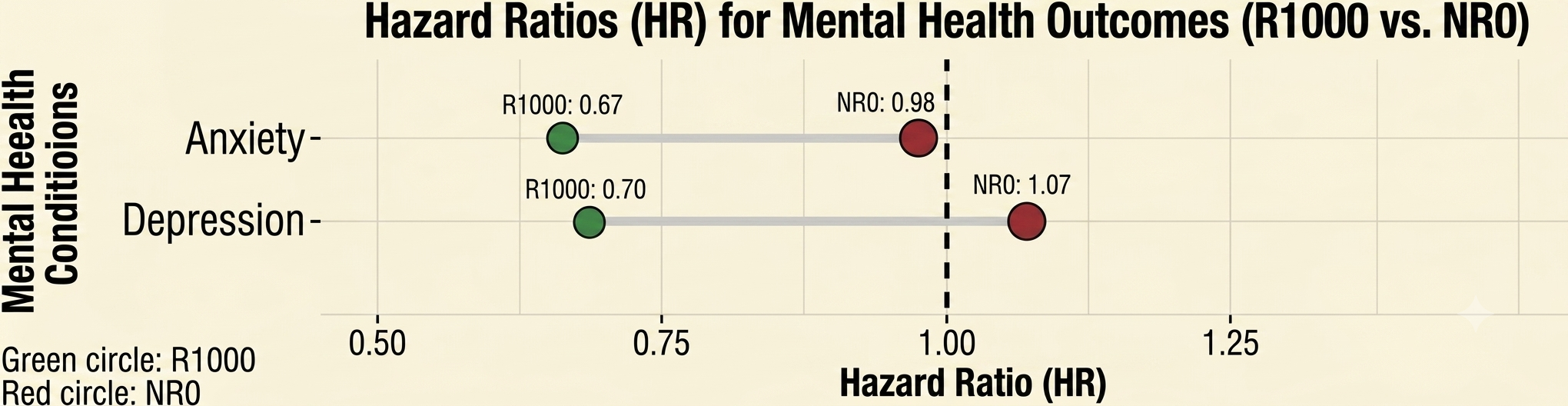
Early-life dietary conditions do indeed show measurable associations with lifetime risk for clinical depression and anxiety disorders. Our hazard ratio analysis highlights a clear protective effect of early-life sugar restriction (R1000) compared to the unexposed reference group (NR455), while the post-sugar-rationing cohort (NR0) showed no such protection. However, the story is nuanced. Later-life sugar consumption acts as a key contributing factor: high sugar intake in adulthood exacerbates the risk established during those crucial first 1000 days.
Why It Matters
Public health advice often focuses almost exclusively on adult choices like eating less sugar and ultra processed foods, exercising more, or managing stress. While adult habits certainly matter, as our data confirms, they act on a biological foundation laid down before we were old enough to choose our own meals. By demonstrating that early-life dietary environments leave lasting imprints on adult psychiatric health, our work highlights two major takeaways. First, methodology matters immensely: how we handle big-data from cohorts such as the UK Biobank, for example, in how health outcomes are defined, dramatically changes the conclusions we draw. Second, early prevention is paramount. Supporting maternal nutrition and healthy infant feeding practices isn't just about preventing childhood obesity or middle-age diabetes, it is a fundamental pillar of lifelong mental healthcare. With respect to food intake, the bottom line remains clear: the first 1000 days echo across a lifetime.
Follow the Topic
-
Translational Psychiatry
This journal focuses on papers that directly study psychiatric disorders and bring new discovery into clinical practice.

Related Collections
With Collections, you can get published faster and increase your visibility.
Moving towards mechanism, causality and novel therapeutic interventions in translational psychiatry: focus on the microbiome-gut-brain axis
Publishing Model: Open Access
Deadline: Nov 15, 2026