The Efficiency Trap: Why All-Polymer Solar Cells Are Quietly Beating Perovskites to Market
Published in Chemistry, Electrical & Electronic Engineering, and Materials
The Efficiency Trap: Why a Single Metric is Misleading
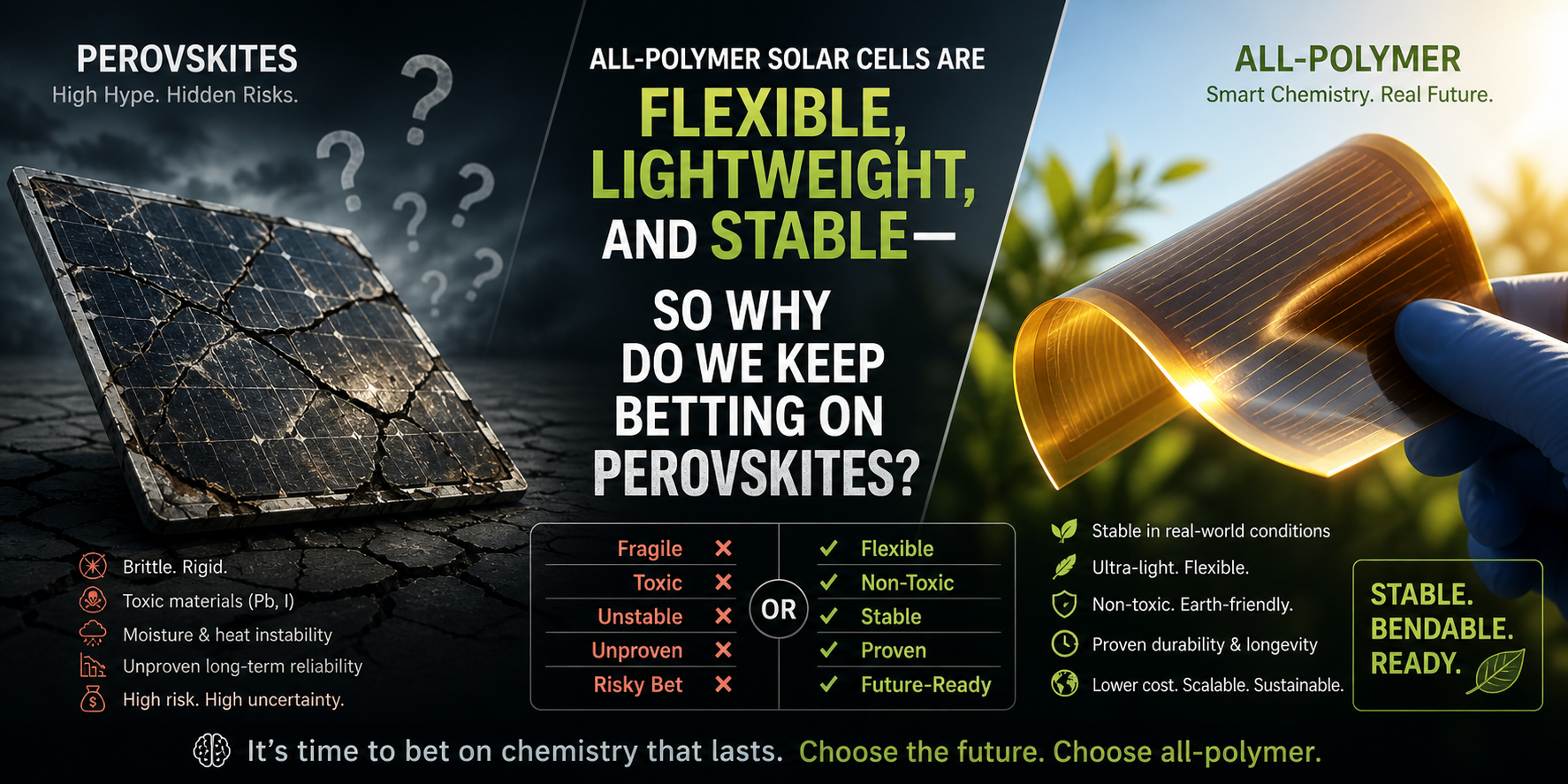
Perovskite solar cells (PSCs) have achieved certified single-junction power conversion efficiencies (PCE) nearing 28%, with tandem configurations exceeding 34%. These headline figures dominate funding calls, high-impact journal covers, and mainstream media.
But efficiency is not the only metric that matters for commercialization—it is simply the easiest one to publish.
All-polymer solar cells (all-PSCs)—composed entirely of polymeric donors and acceptors—are now breaching the critical 20% efficiency barrier. Recent breakthroughs demonstrate >20% PCE fabricated from non-halogenated solvents, maintaining high efficiency even at rapid roll-to-roll coating speeds. The efficiency gap is closing rapidly, yet the academic conversation hasn’t shifted. We are still treating all-PSCs as a low-efficiency curiosity, rather than a commercially viable powerhouse.
Stability: The Criterion That Separates Lab from Life
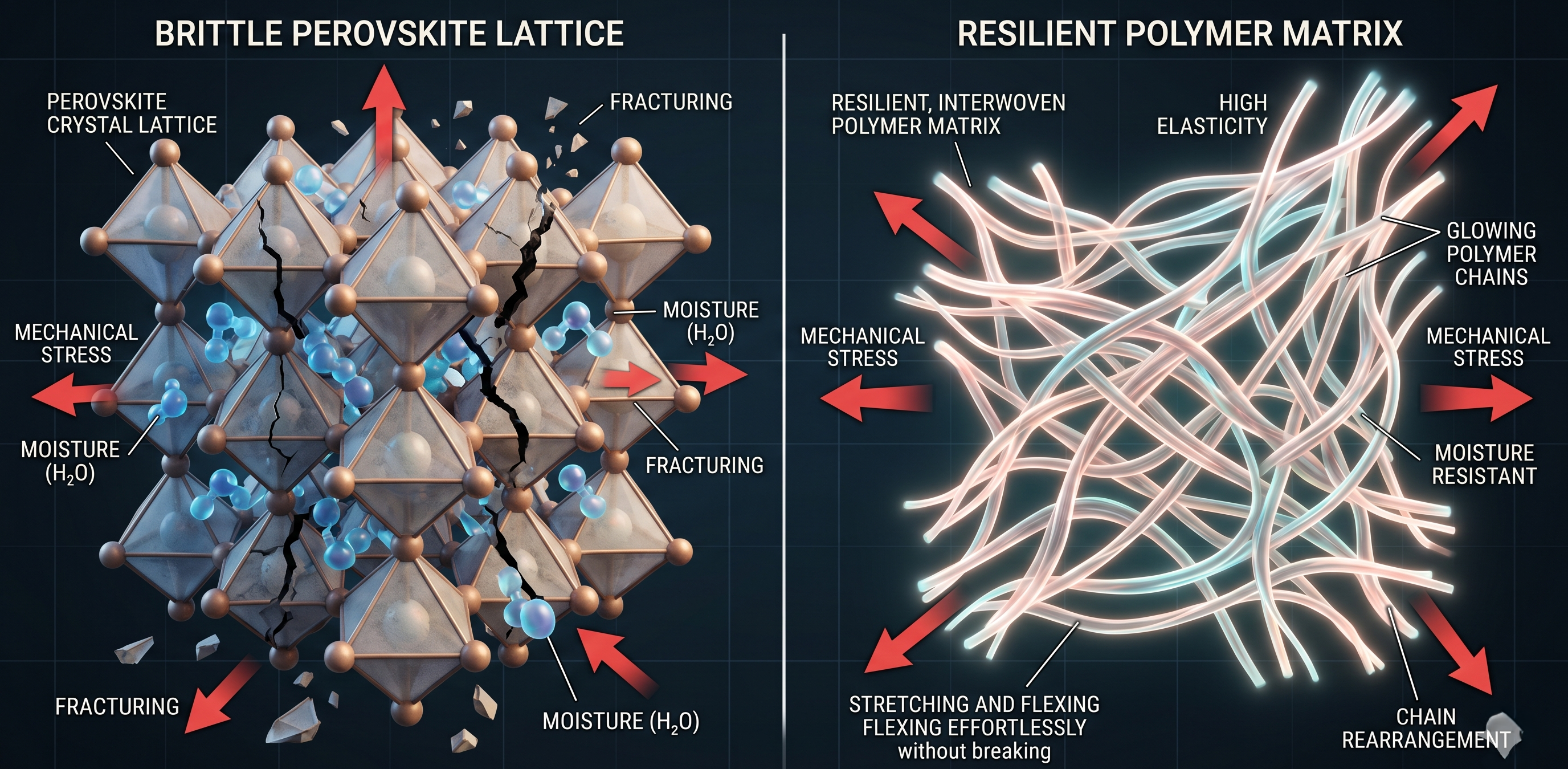
All-polymer systems derive their mechanical durability from the fundamentally entangled, high-molecular-weight nature of polymer chains. They inherently resist crystallization-driven phase segregation—the primary degradation pathway in organic photovoltaics. Recent engineering strategies have produced all-polymer devices that retain 97% of their initial PCE after 2,000 hours in ambient air, and survive 10,000 bending cycles with zero performance loss.
Perovskite stability, by contrast, remains an engineering nightmare. They are notoriously brittle. Environmental stressors—temperature fluctuations, UV light, and humidity—initiate rapid, interconnected degradation pathways. We are spending millions on heroic encapsulation engineering to protect fragile perovskite crystals, while all-polymers offer intrinsic robustness at the molecular level.
The Lead Shadow
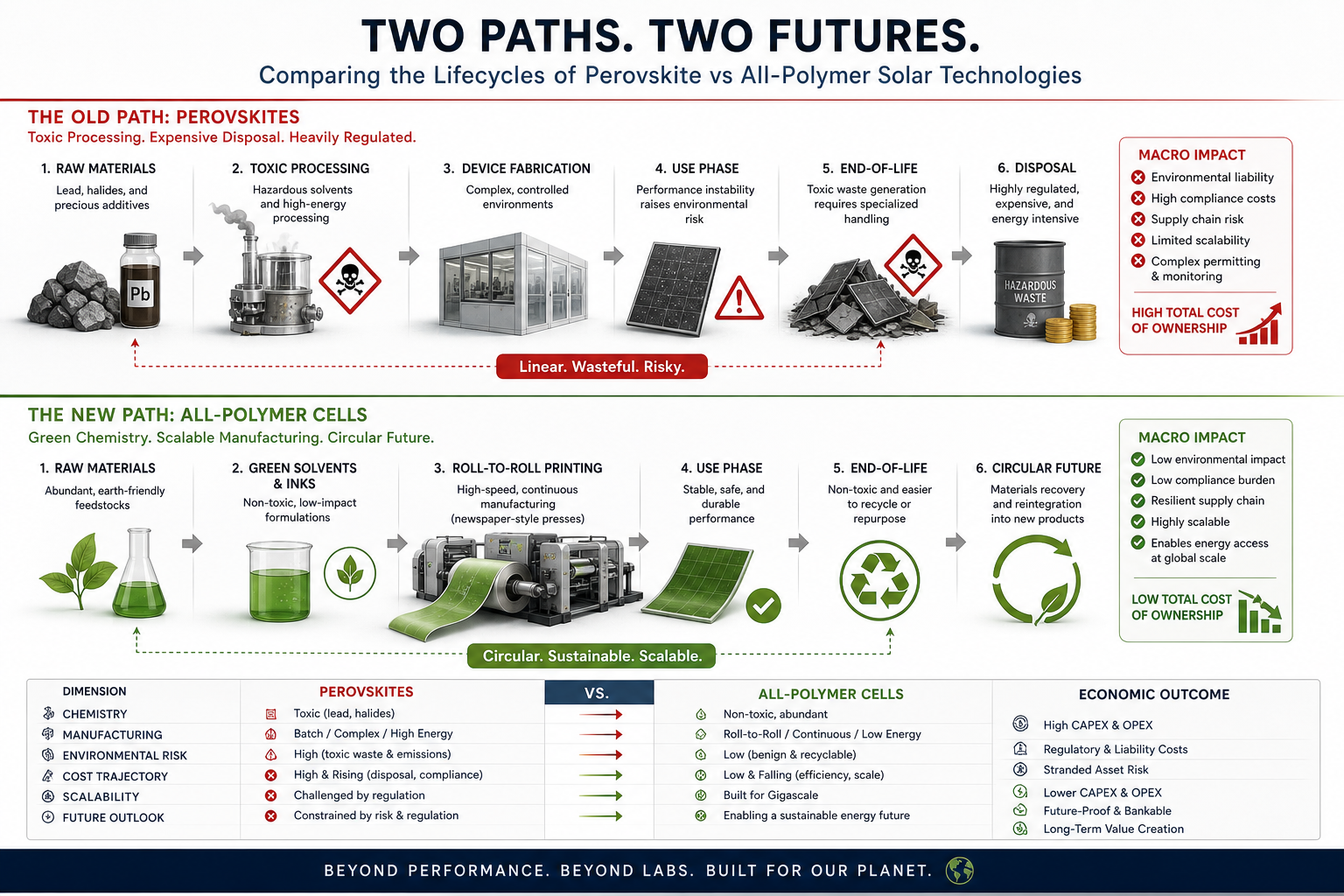
The "elephant in the room" for perovskites is lead (Pb). The most efficient perovskite compositions rely on heavy metals, creating massive regulatory and public-acceptance barriers.
In jurisdictions with strict environmental regulations—like the European Union’s RoHS directive—the path to market for lead-based photovoltaics is legally dubious, regardless of how efficient they are. While lead-free tin-based perovskites exist, they currently trade efficiency for even worse stability.
All-polymer solar cells contain absolutely zero regulated heavy metals. They are processed from solution at low temperatures, dramatically simplifying end-of-life management and regulatory compliance.
The Application Space Where All-Polymers Win
The most compelling argument for all-polymer solar cells is that they are already deployable in application spaces that perovskites simply cannot reach.
-
Building-Integrated Photovoltaics (BIPV): Semitransparent all-polymer modules are actively functioning as energy-generating smart windows, offering simultaneous thermal insulation and visible transparency.
-
Solar Textiles: All-polymer cells are being woven directly into architectural fabrics, generating electricity while providing shade.
-
Wearables: Intrinsically stretchy all-PSC devices with record mechanical robustness are powering conformable biomedical sensors.
These are not speculative concepts; they are peer-reviewed demonstrations exploiting the mechanical properties of entangled polymer chains.
Conclusion:
A Balanced Portfolio Perovskites may eventually overcome their stability and toxicity hurdles to dominate utility-scale solar farms. But for building-integrated, wearable, indoor, and lightweight portable applications, all-polymer solar cells are fundamentally better equipped.
The problem is not that both technologies exist; it is that funding, publication, and policy attention remain overwhelmingly tilted toward the fragile champion, starving a flexible technology platform that is arguably closer to real-world integration.
- To my peers in materials science: Are we underestimating perovskite encapsulation advances, or severely overestimating the market’s willingness to accept toxic, rigid materials when flexible, stable polymers are crossing the 20% threshold? Let's discuss below.

Dr. Akeem Adeyemi Oladipo is a globally recognized Research Professor of Materials and Environmental Chemistry at Eastern Mediterranean University. Ranked among the world's Top 2% Scientists, his expertise bridges nanotechnology, renewable energy, and electro-analytical chemistry. He specializes in advanced materials synthesis for wastewater treatment, highly sensitive electrochemical biosensors, and solar energy conversion. By integrating machine learning and artificial neural networks, his research drives scalable deep-tech innovations in environmental sustainability and energy storage.