The Hidden Groundwater Beneath Our Feet—Revealed in High Resolution
Published in Earth & Environment






Groundwater is the largest liquid source of freshwater on our planet. It provides drinking water for billions of people and supports over 40% of food production worldwide. Yet because it is hidden beneath the surface, changes in groundwater are rarely observed and often overlooked. These changes matter: the sustainability of our food supply depends not only on how much groundwater exists, but also on how deep it is. Water table depth, or how far water is from the surface, can vary by orders of magnitude over short distances, sometimes just tens of meters. Despite this known behavior, we lack large-scale high-resolution groundwater mapping.
AI Fills Critical Gaps in Groundwater Datasets
Previous efforts to understand groundwater at continental to global scales relied on physically-based hydrological models with resolutions coarser than 1 km or on indirect remote sensing products. While these approaches provide valuable insights, the scales of human and natural groundwater systems mismatch those captured by models and remote sensing, leaving data gaps at important scales most relevant for agriculture and local decision making.
In this study, we produced a 1 arcsecond (~ 30 m) resolution water table depth dataset over the contiguous United States using a random forest model based on nearly one million groundwater observations and ten spatially gridded climatological and hydrogeological inputs. This dataset represents our highest resolution estimate of accessible freshwater to date, incorporating groundwater pumping and quantified uncertainty. It reveals, with unprecedented detail, the connections between groundwater and surface water across the United States. The dataset is publicly available via the HydroGEN platform and the HydroData repository, and is ready for use by hydrologists, geochemists, and policymakers in groundwater studies ranging from local to continental scales.
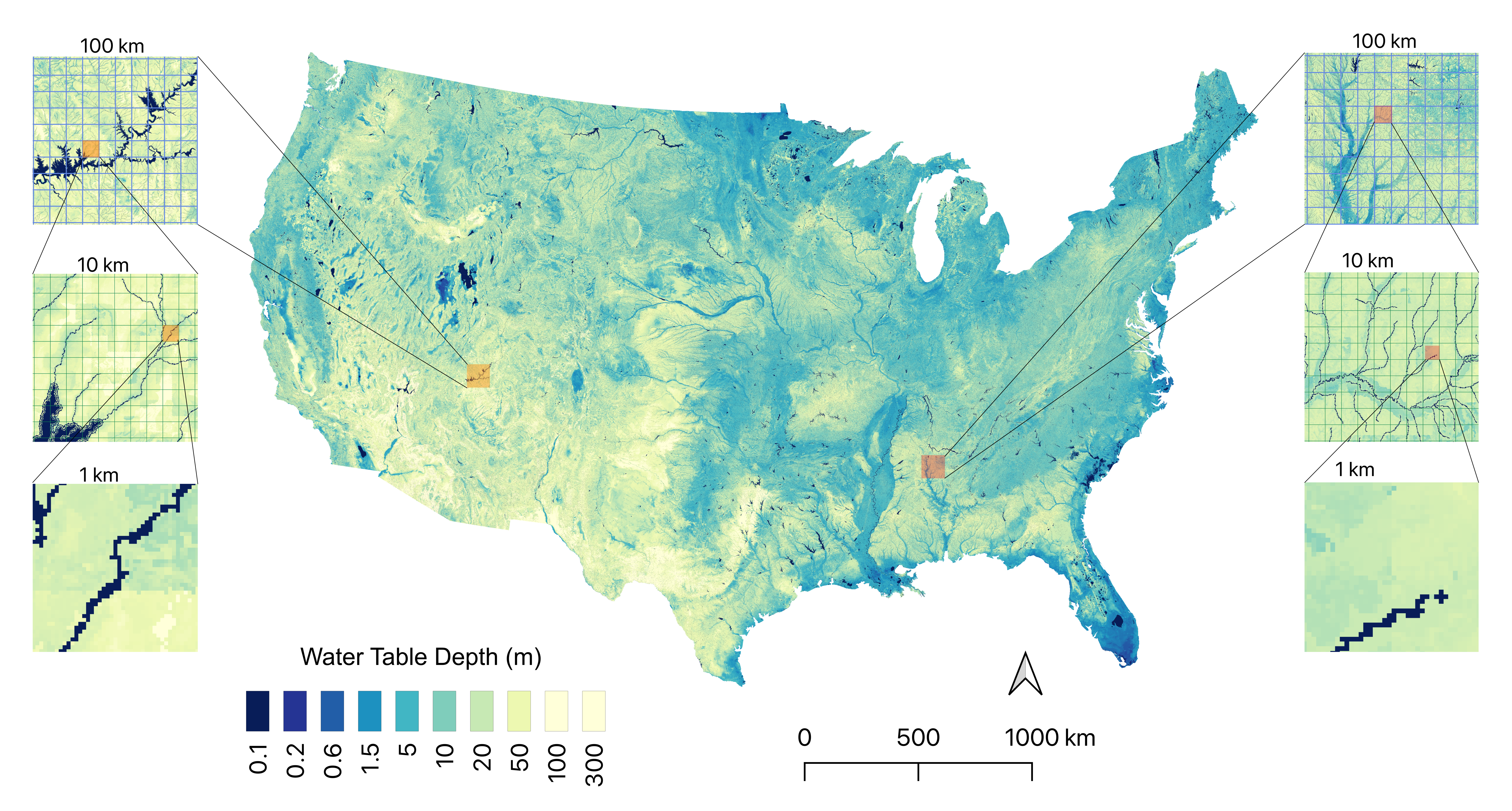
The 1 arcsecond (~ 30 m) water table depth map over the contiguous United States, including zoom-in plots at 100 km, 10 km and 1 km grid cells in the west and east United States (Ma et al, 2025)
Estimates Reveal More Shallow Groundwater Than Previously Suggested
Using this high-resolution dataset, we show that one third of the land area of the United States has water table depths less than 10 m (critical for vegetation interactions) and 15 % of the United States has water shallower than 5 m (important for interactions with surface water). These critical shallow groundwater areas are systematically underestimated at the coarser resolutions provided by remote sensing or global models, leading to missed representation of key processes such as drought resilience, flood risk, climate buffering, and riparian ecosystem dynamics that depend on water table depth.
Pathways to global-scale high-resolution groundwater mapping
Over the past decade, several physically-based groundwater models have been developed at global scales, advancing our understanding of groundwater’s role in the Earth system. Due to computational constraints, running physically-based simulations at resolutions higher than 1 km remains challenging, limiting their ability to capture finer-scale groundwater changes that are important for agriculture and local water management.
This study demonstrates that AI can overcome these traditional computational limitations to produce high-resolution groundwater maps at large scales. In data-rich regions similar to the United States, the workflow can be readily adapted to the study area. In regions with sparse observations, transfer learning can be applied to leverage knowledge from data-rich areas, enabling high-resolution groundwater estimation even in data-scarce domains. Together, these approaches provide a unique opportunity to achieve global-scale high-resolution groundwater mapping, offering critical insights for water management, ecological research, and policy planning.
Follow the Topic
-
Communications Earth & Environment
An open access journal from Nature Portfolio that publishes high-quality research, reviews and commentary in the Earth, environmental and planetary sciences.

Related Collections
With Collections, you can get published faster and increase your visibility.
Ecological resistance and resilience under global change
Publishing Model: Open Access
Deadline: Apr 07, 2027
Hazards in Mountain Regions
Publishing Model: Open Access
Deadline: Nov 02, 2026