The Hydroxyl Radical Myth: Why Carbonate Radicals Actually Drive Real-Water AOPs
Published in Chemistry, Earth & Environment, and Materials


The ·OH Obsession: A Limiting Mindset
The hydroxyl radical is extraordinary. With a redox potential of 2.8 V, its near-indiscriminate reactivity made it the perfect probe for catalyst development and the universal benchmark for process efficiency. For two decades, countless reactor designs and catalyst optimizations have chased a single metric: more ·OH, faster, for longer.
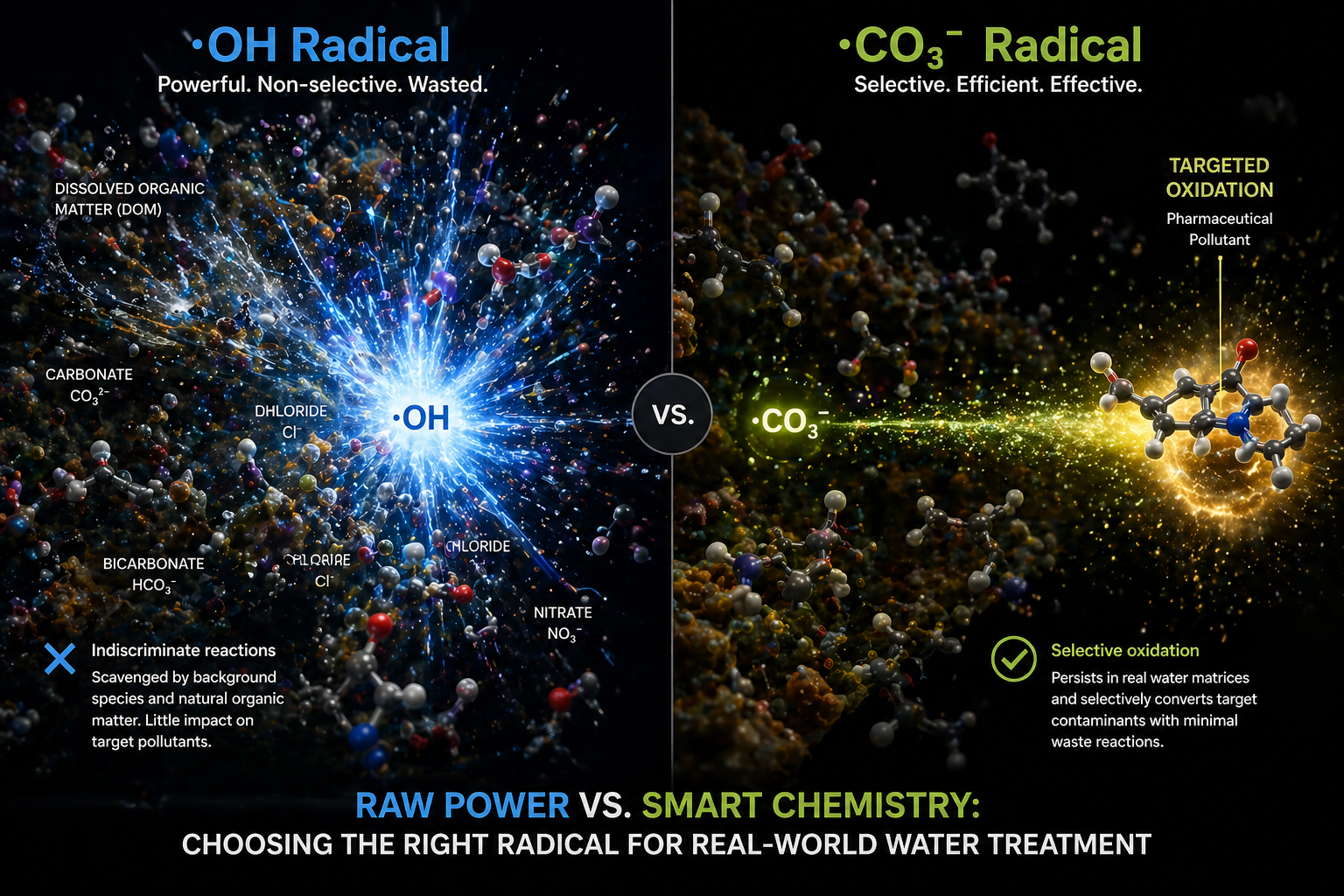
The problem is that this universality comes with a tragic fragility. In real water matrices—surface water, groundwater, wastewater effluent—·OH is scavenged overwhelmingly by ubiquitous dissolved organic matter and inorganic ions, most notably carbonate (CO₃²⁻) and bicarbonate (HCO₃⁻). This causes its half-life to collapse from microseconds to nanoseconds. To compensate, we add more energy, more oxidant, and more catalyst.
This is brute force, not engineering elegance.
Selectivity Over Raw Power
Critically, the scavenging reactions that quench ·OH are not dead ends—they produce a new reactive species: the carbonate radical (·CO₃⁻).
For years, it was dismissed as a secondary, less potent oxidant due to its lower redox potential (1.59–1.78 V). This fundamentally misses the point. Recent comprehensive reviews now evaluate the selectivity of ·CO₃⁻ over raw power, demonstrating that it reacts preferentially with electron-rich moieties, such as phenols, anilines, and many recalcitrant pharmaceuticals.
In complex effluents, ·OH wastes its oxidizing power on harmless background carbon. The milder, longer-lived ·CO₃⁻ survives to find the target pollutants that actually matter. We are moving from a fast, non-selective oxidant that is neutralized immediately, to a persistent one that finishes the job.
What the Data Are Telling Us
A compelling body of mechanistic work now emphasizes the pivotal role of ·CO₃⁻.
Recent Density Functional Theory (DFT) calculations demonstrate that the hydrogen atom abstraction route for certain pharmaceuticals (like sulfamethazine) is actually more kinetically facile for ·CO₃⁻ than for ·OH. The evidence from real water matrices is equally strong:
-
In systems with high alkalinity (>150 mg/L as CaCO₃), carbonate radical pathways can account for 30–70% of degradation for susceptible targets.
-
In UV/persulfate or UV/H₂O₂ AOPs, kinetic models that ignore ·CO₃⁻ pathways consistently underpredict real-world performance.
Most excitingly, recent breakthroughs in piezocatalysis have demonstrated the deliberate, selective generation of carbonate radicals from hydraulic forces, directly targeting phenolic pollutants for polymerization and removal. We are learning to harness this chemistry by design rather than by accident.
From Fate to Function: Radical-Aware Design
No one is arguing we should abandon ·OH. However, the future of intelligent AOP design must evolve from blindly maximizing total radical flux to strategically managing a "radical portfolio." This means we must:
-
Deliberately Design Catalysts: Select catalysts that generate ·CO₃⁻ from the abundant bicarbonate in the water itself, rather than relying on ·OH as a fleeting precursor.
-
Tune Solution Chemistry: Adjust pH, carbonate ratios, and oxidant dosing to shift the radical balance toward the species best suited for the specific matrix.
-
Upgrade Kinetic Models: Develop next-generation models that treat ·CO₃⁻ as a co-primary oxidant from the start, not as a post-hoc corrective factor for a "failed" ·OH process.
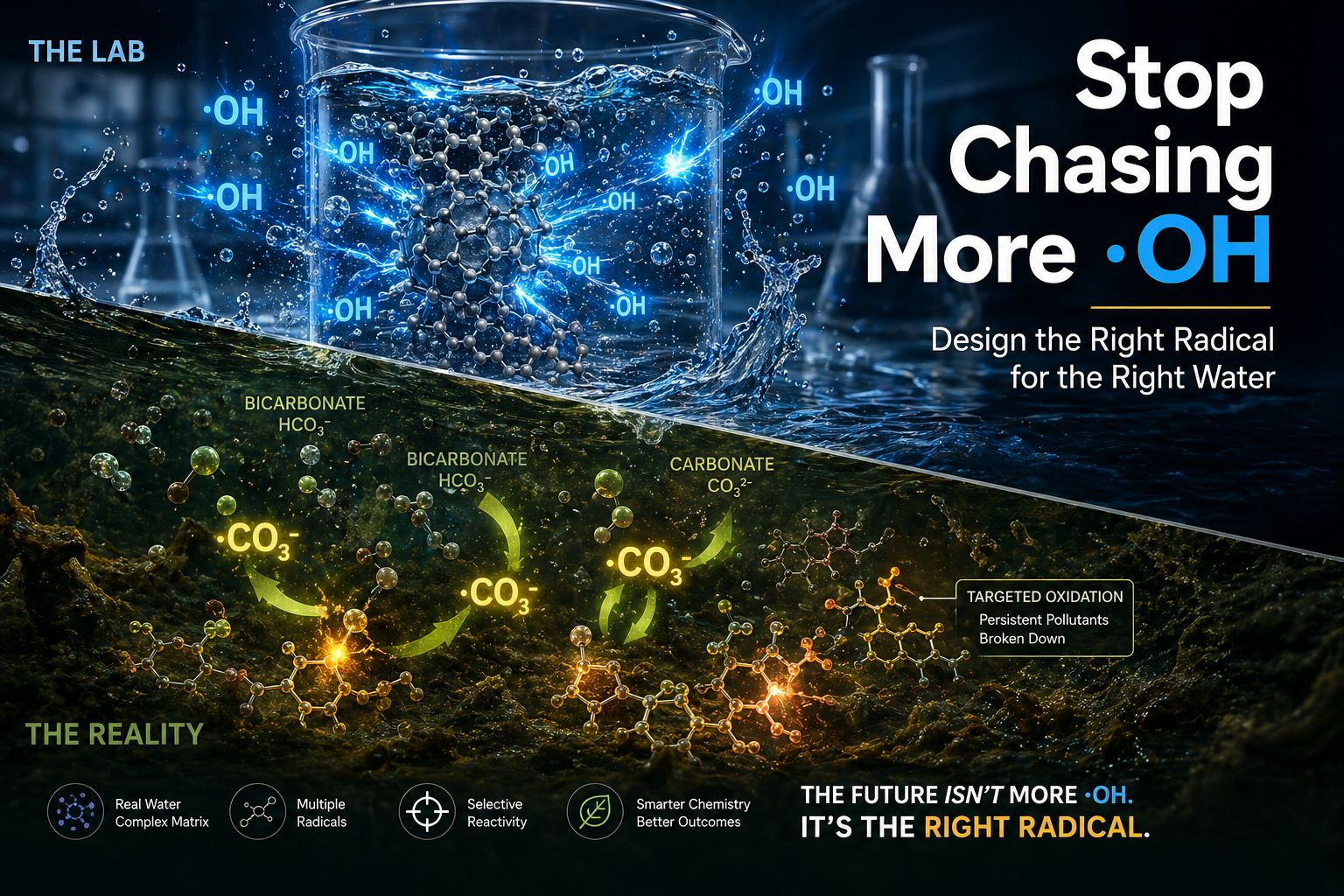
The next leap in AOP innovation will not come from squeezing another 0.1 V out of a new catalyst. It will come from radical-smart process design that asks: "Who is actually doing the oxidation in this water, at this moment?" By empowering the right species for the right matrix—making water treatment smarter and more energy-efficient—we will cross the chasm from laboratory exercise to sustainable, real-world engineering.
Have you modeled radical speciation in your own reactor with real water? Did your scavenging probes tell you a different story? Let’s move the conversation from radical mythology to radical engineering.

Dr. Akeem Adeyemi Oladipo is a globally recognized Research Professor of Materials and Environmental Chemistry at Eastern Mediterranean University. Ranked among the world's Top 2% Scientists, his expertise bridges nanotechnology, renewable energy, and electro-analytical chemistry. He specializes in advanced materials synthesis for wastewater treatment, highly sensitive electrochemical biosensors, and solar energy conversion. By integrating machine learning and artificial neural networks, his research drives scalable deep-tech innovations in environmental sustainability and energy storage.