The impact of autoimmune co-morbidities in AQP4-NMOSD and MOGAD.

Aquaporin-4 neuromyelitis optica spectrum disorder (AQP4-NMOSD) and myelin oligodendrocyte glycoprotein antibody disease (MOGAD) can present similarly to Multiple Sclerosis (MS) but presents with unique therapeutic and prognostic challenges.
Like

Share this post

Choose a social network to share with, or copy the URL to share elsewhere

This is a representation of how your post may appear on social media. The actual post will vary between social networks

Explore the Research

SpringerLink
SpringerLink SpringerLink

The impact of autoimmune comorbidities on the onset attack recovery in adults with AQP4-NMOSD and MOGAD - Journal of Neurology

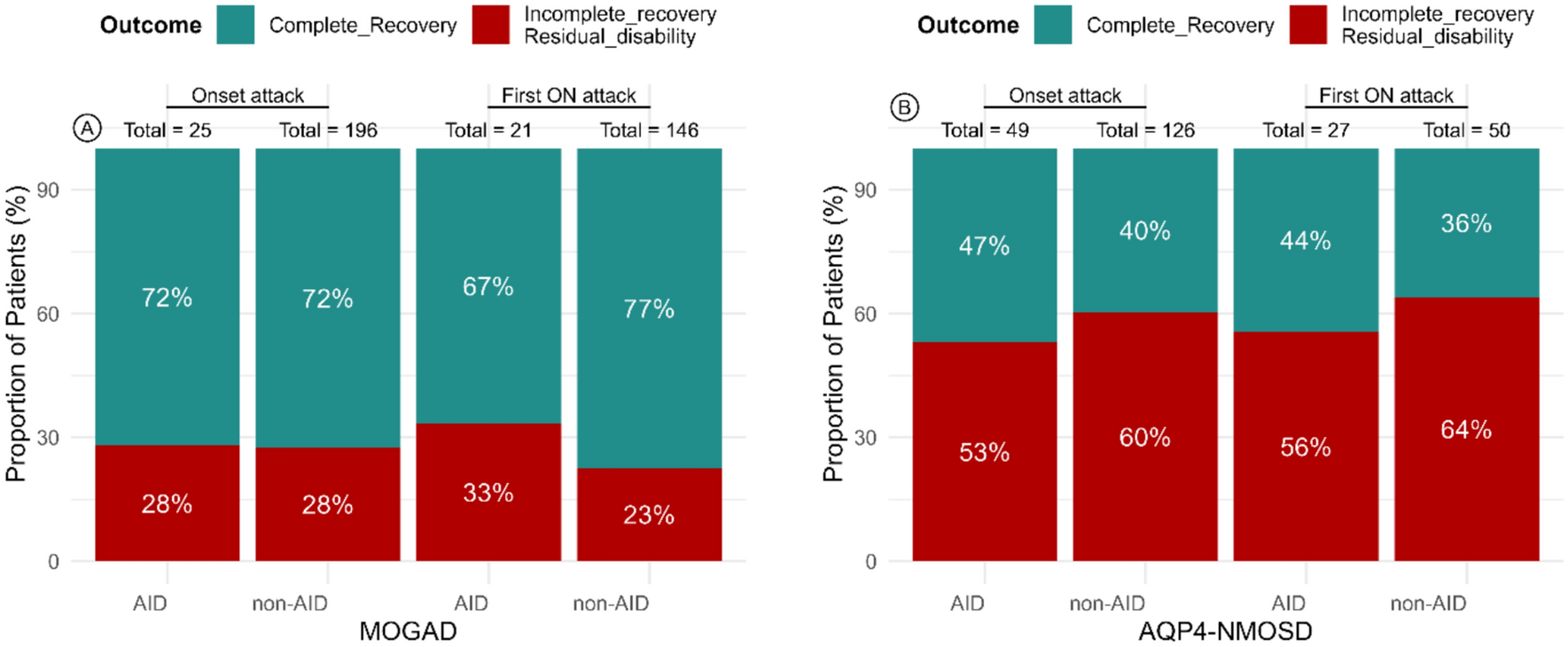
Background Aquaporin-4 neuromyelitis optica spectrum disorder (AQP4-NMOSD) often coexists with other autoimmune diseases (AIDs), whereas such comorbidities are less common in myelin oligodendrocyte glycoprotein antibody disease (MOGAD). This study investigates the impact of additional AIDs on early relapse recovery and disability in patients with AQP4-NMOSD and MOGAD. Methods This retrospective study included patients aged > 16 years with AQP4-NMOSD (n = 175) or MOGAD (n = 221), who were followed at a nationally commissioned Oxford service and categorized based on the presence of at least one AID. Outcomes included recovery from the onset attack, visual recovery after the first optic neuritis (ON) attack (≥ 6 months post attack), time to first relapse and time to death. Incomplete visual recovery was defined as visual acuity worse than LogMAR 0.1. Optical coherence tomography (OCT) assessed retinal nerve fiber layer thickness and ganglion cell-inner plexiform layer volume in a subset. Results In the AQP4-NMOSD cohort, 28% (n = 49) had at least one AID, compared to 11.3% (n = 25) in the MOGAD cohort (p < 0.001), with thyroid disease constituting the majority of these cases in both groups. In MOGAD, the median age of first attack was significantly higher in the AID group (46 years; IQR: 35–56) than in the non-AID group (35 years; IQR: 28–47) (p = 0.004), a difference that was not observed in the AQP4-NMOSD cohort. In both the AQP4-NMOSD (n = 175) and the MOGAD (n = 221) cohorts, age was a significant predictor of outcome in univariate analyses (AQP4-NMOSD: OR = 0.96 per year, 95% CI: 0.94–0.98, p < 0.001; MOGAD: OR = 0.97 per year, 95% CI: 0.94–0.99, p = 0.008). No significant differences were observed in clinical or visual recovery rates between AID and non-AID patients in either cohort. There were no statistically significant differences observed between AID and non-AID cohorts for clinical or visual recovery outcomes. Similarly, AID status did not influence time to relapse (AQP4-NMOSD: HR = 1.0, 95% CI: 0.63–1.58, p = 0.99; MOGAD: HR = 0.78, 95% CI: 0.40–1.52, p = 0.47) or time to death (AQP4-NMOSD: HR = 0.5, 95% CI: 0.18–1.36, p = 0.28). OCT analysis revealed no significant differences in retinal parameters between AID and non-AID groups in both cohorts. Conclusions Additional autoimmune diseases are unlikely to significantly affect clinical or visual outcomes in early attacks in patients with AQP4-NMOSD and MOGAD.

Aquaporin-4 neuromyelitis optica spectrum disorder (AQP4-NMOSD) and myelin oligodendrocyte glycoprotein antibody disease (MOGAD) are rare but serious autoimmune conditions that affect the central nervous system. While both can cause severe neurological damage, AQP4-NMOSD is known to frequently occur alongside other autoimmune diseases, while this association is not commonly reported in MOGAD. 

There is a critical gap in understanding how these autoimmune diseases affect recovery from attacks or relapses.

The study question was simple , does having another autoimmune disease make early recovery or relapse worse in AQP4-NMOSD or MOGAD?

To answer this, we examined approximately 400 patients at the University of Oxford, comparing those with and without additional autoimmune conditions, tracking recovery from initial attacks which included visual outcomes after an episode of optic neuritis. We were also interested if autoimmune diseases affected time to having the next clinical relapse. 

Additionally, we also reviewed retinal imaging in the form of optical coherence tomography to assess for any additional structural damage to the ocular system. 

Our results are summarised as follows : 

  • Co-morbid autoimmune diseases were common in AQP4-NMOSD (28%) but less so in MOGAD (11%).

  • Thyroid disease was the most frequent coexisting condition in both groups.

  • Age was a consistent predictor of recovery , with older patients tended to have worse outcome. 

  • Visual recovery, motor recovery and relapse timing were not significantly different between patients with and without additional autoimmune diseases.

  • Retinal imaging showed no added damage in those with comorbid AIDs.

This was an interesting study as it benefits the medical community by providing additional understanding to both clinicians and patients, that having  another autoimmune disease does not appear to worsen early outcomes in AQP4-NMOSD or MOGAD.

This research work has provided further insight into cases of autoimmune overlap, and contributes to our ability to counsel patients better especially in multi-disciplinary clinical settings.

Article linked and referenced: Samadzadeh S, Chan F, Francis A, Sani L, Paul F, Asgari N, Leite MI, Geraldes R, Palace J. The impact of autoimmune comorbidities on the onset attack recovery in adults with AQP4-NMOSD and MOGAD. J Neurol. 2025 Jun 10;272(7):453. doi: 10.1007/s00415-025-13180-3. PMID: 40495001; PMCID: PMC12152089.https

https://pubmed.ncbi.nlm.nih.gov/40495001/

Please sign in or register for FREE

If you are a registered user on Research Communities by Springer Nature, please sign in