The Missing Link for Transforming Academic Excellence into Practical, Scalable Solutions
Published in Sustainability, Biomedical Research, and Business & Management

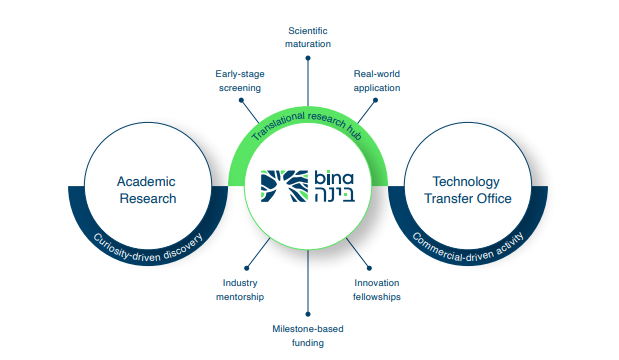




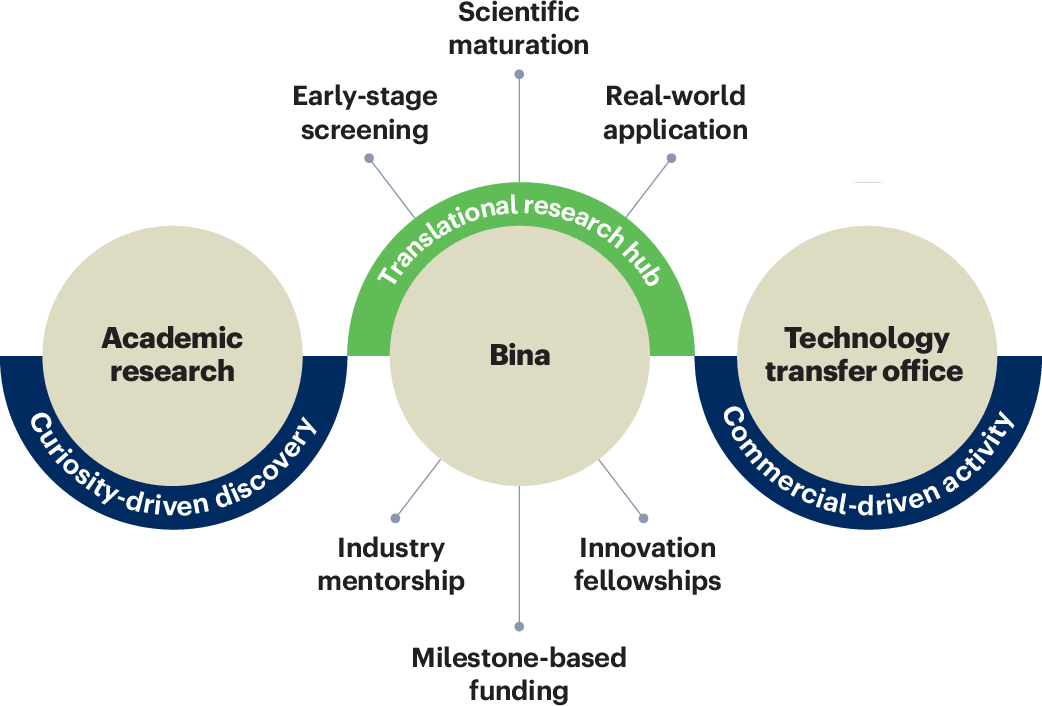
At the Weizmann Institute of Science, this question became the driving force behind the creation of a new translational research and innovation unit, Bina (Hebrew for “wisdom”), an acronym for Bridge. Innovate. Nurture. Advance. Breakthrough discoveries are not in short supply at the Institute, which has a long-standing legacy of scientific excellence and was recently ranked 6th globally in the Leiden Ranking for research quality.
Yet, ideas and research insights require additional support to progress beyond their initial curiosity-driven stage, as they are premature to enter traditional technology transfer pathways. The result is a gap between the “Eureka” moment of discovery and the point at which real-world impact can begin. This gap does not reflect a lack of scientific excellence, but rather the absence of a structured pathway to guide early-stage ideas toward application.
For Prof. Irit Sagi, former Vice President for Technology Transfer and Innovation, this challenge was experienced firsthand and ultimately drove her together with Dr. Sharon Fireman, head of Bina, to the creation of a new institutional framework specifically designed to steer excellent research toward real-world applications.
Building a New Bridge for Innovation
Turning this vision into reality was not a straightforward process. Bina functions as an innovation engine, and unlike traditional research programs or technology transfer mechanisms, there was no existing model to follow.
We set out to build Bina as a new layer within the academic landscape, one that would operate between discovery and application, while preserving the institute’s core culture of fundamental scientific research for the future of humanity.
This required us to define not only what Bina would do, but how it would function. We chose to work alongside researchers at early stages of their innovation projects, speaking the scientific language, and helping to promote ideas toward application, while fostering a translational research community. This meant creating an institutional support system that combined deep scientific insight, project-based thinking, an industry mentor network and tailored innovation training.
The process was iterative: we continuously adapted our selection criteria and evaluation metrics, refining how we collaborate with researchers and external partners to ensure every project had a clear path forward.
At each step, our aim was to support scientific maturation without constraining scientific creativity.
A Dual-Track Model for Translation
We structured our “Nurture Program”, around a bottom-up approach, in which new projects originate from the researchers.
In parallel, we developed a complementary top-down approach. In this case, the Bina team identifies independently or together with external partners such as companies and medical centers, key challenges or unmet needs, and works with researchers to shape new scientific solutions.
In all cases, the Bina team, together with external consultants, supports these efforts by helping to define a focused workplan with appropriate controls, enabling discoveries to reach a robust proof-of-concept that can later be transferred to the technology transfer office for commercialization.
Importantly, progress depends not only on scientific advancement, but on defining the right workplan and success criteria, understanding market needs and potential, establishing budgets, providing milestone-based funding, offering ongoing mentoring, including connecting the right expertise at the right time, whether from clinicians, industry partners or service providers.
Cultivating an Applicative Ecosystem
Beyond creating a tailored platform for advancing translational research projects in the institute, we recognized the need to build a community. Bina was designed not only to support ideas, but also to encourage scientists and embed translational thinking within the scientific environment itself.
This led to the development of three dedicated training programs for PhD students, postdoctoral fellows and staff scientists, designed to extend the translational science knowledge and bring Bina closer to the “production floor” of research, where ideas are generated, broadening engagement across the institute and streamlining the unit’s project pipeline.
In one case, the Innovation Fellowship inspired a PhD student to combine novel antimicrobial peptides with established expertise in malaria parasite biology from a neighboring lab. The result is a cross-disciplinary research collaboration delivering novel therapeutic candidates for malaria treatment, currently in advanced stages and under evaluation by a malaria-focused not-for-profit organization.
Experiences like this highlight that training could do more than support translation, it can foster creativity and generate entirely new scientific directions.
Novel Solutions through Collaboration
Bina acts as a collaborative interface- identifying opportunities, bringing together the right scientific and professional experts, and enabling collaborations that would not naturally occur within traditional academic structures. Some examples include:
- Medicine & Hydrology: A clinical need for treating lymphedema became the starting point for an interdisciplinary effort that Bina helped initiate - connecting clinicians, engineers, and experts in hydrology. Together, they developed a novel drainage device that progressed through preclinical validation and first-in-human studies, ultimately evolving into a startup, named Sub-Q bionics.
- Agriculture & Sustainability: To address the environmental burden of soil solarization - which relies on the harmful use of ~2.5 million metric tons of plastic mulch annually - Bina brought together researchers from different scientific domains to rethink the problem. This collaboration led to the development of a potential platform that transforms agricultural waste into a sustainable, high-value alternative.
These outcomes reflect a broader principle: innovation is often not limited by ideas, but by the lack of structured opportunities for connection. By actively building networks and facilitating collaboration across disciplines, Bina enables solutions that extend beyond the boundaries of any single field.
Impact, catalyzed
Introducing a framework that operates alongside researchers, combined with embedding a translational mindset, enables unlocking pathways that would otherwise remain unexplored.
In just five years, we have examined over 165 research projects, with 82 receiving funding and mentorship, and so far, 20 successfully transitioning to the technology transfer and commercialization stage.
The experience of building Bina suggests that supporting translation requires rethinking how innovation and collaboration are nurtured within academic environments. Importantly, this approach does not replace traditional research or technology transfer, but complements them, adding a critical layer between discovery and application.
Our model is not just a local success; it is reproducible and scalable, showing how research institutions can bridge the gap between curiosity and industrial implementation - without losing their academic soul.
Follow the Topic
-
Nature Biotechnology
A monthly journal covering the science and business of biotechnology, with new concepts in technology/methodology of relevance to the biological, biomedical, agricultural and environmental sciences.
What are SDG Topics?
An introduction to Sustainable Development Goals (SDGs) Topics and their role in highlighting sustainable development research.
Continue reading announcement


Please sign in or register for FREE
If you are a registered user on Research Communities by Springer Nature, please sign in