The overlooked threat of democratic neutrality in the USA
Published in Statistics and Law, Politics & International Studies





Do Americans Support Democracy?
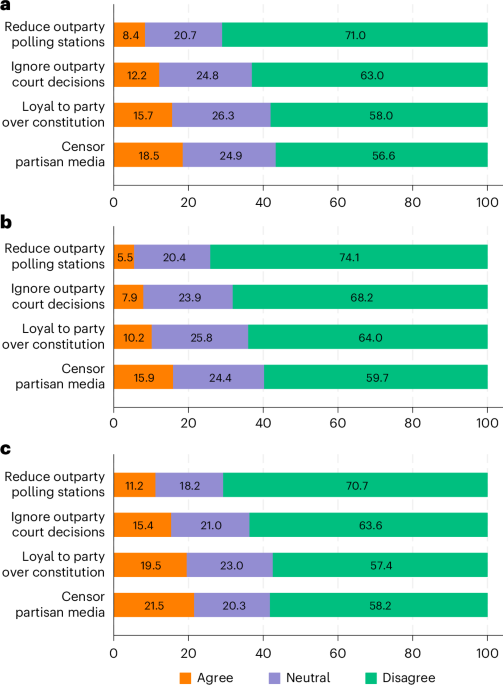
There is something reassuring about survey findings showing that most Americans do not openly support undemocratic practices. At a moment when concerns about democratic backsliding have become increasingly common, those results can seem like grounds for cautious optimism. If only a small minority of people endorse actions like ignoring court rulings, restricting polling places in areas that support political opponents, or censoring hostile media, then perhaps public support for democracy is more resilient than many fear.
But that reassuring picture sits uneasily alongside another reality. Politicians who challenge election results, attack institutional checks, or threaten rivals do not always pay a clear political price. In some cases, they continue to attract substantial support and even electoral success. This tension was the starting point for our research. If explicit support for undemocratic practices is truly rare, why do candidates who engage in such practices remain politically viable, and even successful?
Understanding Democratic Neutrality
Our answer began with a response option on many surveys that is easy to overlook: “neither agree nor disagree.”
In many studies, that midpoint response is treated as unremarkable. Researchers often group it together with responses that oppose undemocratic practices, assuming that anyone who does not explicitly support those practices is effectively on the pro-democracy side. At first glance, that assumption seems reasonable. But the more we thought about it, the less convincing it became. Not supporting something is not the same as opposing it. When the subject is democracy, that distinction may have significant weight.
This intuition prompted us to study what we call “democratic neutrality”—that is, neutrality toward undemocratic practices: not endorsing them, but not rejecting them either. What initially looked like a mundane survey category turned out to capture a much more complicated set of attitudes.
As we explored this idea further, we realized that neutral responses could reflect a range of underlying orientations. Some people may simply feel uncertain about the issue. Others may feel genuinely indifferent toward politics. Still others may feel conflicted or ambivalent, seeing arguments on both sides. And in some cases, neutrality may reflect a conditional mindset, the sense that whether something is acceptable depends on the circumstances. In other words, neutrality is not necessarily empty. It can reflect uncertainty, disengagement, ambivalence, or conditional tolerance. Each of these orientations carries different implications for how citizens think about democratic norms.
At one point in the project, we asked respondents who had chosen the midpoint to explain what they meant. Their answers reinforced the idea that neutrality is rarely meaningless. Some of them described feeling unsure or insufficiently informed to take a position. Others said their views depended on the situation. Some expressed frustration or detachment from politics altogether. These responses helped clarify an important point: selecting the midpoint in a survey asking about undemocratic practices is not simply a technical detail of questionnaire design. It may capture a distinct way of relating to politics.
That insight also reshaped the direction of our research. Earlier versions of the project focused more narrowly on what we called “democratic indifference.” But through further analysis, and the peer review process, we came to see that, indeed, indifference was only one part of the story. The broader concept of “democratic neutrality” better captured the variety of attitudes that could lie behind a neutral response.
Why Does Neutrality Matter?
Once we began thinking about neutrality as a meaningful political orientation, another question emerged: Does neutrality matter in practice?
In many democracies, the stability of democratic norms depends not only on whether citizens support them in principle but also on whether they hold leaders who violate them accountable. If voters care deeply about democratic rules, politicians who break those rules should face electoral consequences.
But what happens if a large share of the public does not clearly oppose those violations?
Our findings suggest that democratic neutrality may help explain why anti-democratic behavior does not always provoke a strong backlash—despite the fact that few Americans explicitly endorse such undemocratic practices. People who clearly oppose violations of democratic norms tend to react negatively when politicians endorse them. But people who feel neutral toward those practices do not respond in the same way. For them, a candidate’s stance on democratic norms does not appear to meaningfully change their level of support for the candidate.
Our Findings and Next Steps
The implication of our findings is subtle yet important. The greatest threat to democracy in the US may not come only from the relatively small minority of Americans who openly support undemocratic actions. It may instead primarily come from a much larger group that does not oppose those actions strongly enough to punish them politically.
Democratic erosion does not necessarily require widespread enthusiasm for authoritarianism. Sometimes it only requires something that feels safe and socially acceptable—uncertainty, ambivalence, disengagement, or conditional tolerance that allows anti-democratic behavior to pass without consequence.
Many readers may be most interested in what lies ahead. There is still much we do not understand about democratic neutrality: what produces it, how stable it is over time, and whether political leaders help create it or simply exploit it. Future research will need to explore these questions with more data and new approaches. But one thing already seems clear: In studies of public opinion, the response “neither agree nor disagree” is often treated as an unremarkable middle ground. Our findings suggest it may be anything but.
Follow the Topic
-
Nature Human Behaviour
Drawing from a broad spectrum of social, biological, health, and physical science disciplines, this journal publishes research of outstanding significance into any aspect of individual or collective human behaviour.

Related Collections
With Collections, you can get published faster and increase your visibility.
Digital Media and Mental Health
Publishing Model: Hybrid
Deadline: Oct 30, 2026
Basic Psychological Needs and Well-Being
Publishing Model: Hybrid
Deadline: Nov 27, 2026

