The Pristine Bead Myth: Why Weathered Microplastics Are Completely Different Toxins
Published in Chemistry, Earth & Environment, and Ecology & Evolution
The Ecotoxicology Flaw
Open almost any high-impact paper evaluating microplastic toxicity in aquatic organisms, and you will likely find the same experimental design: organisms exposed to perfectly spherical, smooth, unweathered polystyrene (PS) or polyethylene (PE) micro-beads purchased directly from a chemical supplier.
These pristine beads yield clean, reproducible laboratory data. They allow for precise size control and easy fluorescence tracking in cell assays.
There is only one problem: Pristine, spherical micro-beads do not exist in nature.
By relying on pristine supplier beads, the ecotoxicology community has created an artificial testing environment. We are drawing sweeping conclusions about global ecological risks based on idealized particles that bear zero resemblance to the weathered, chemically complex microplastics found in real oceans, rivers, and soils.
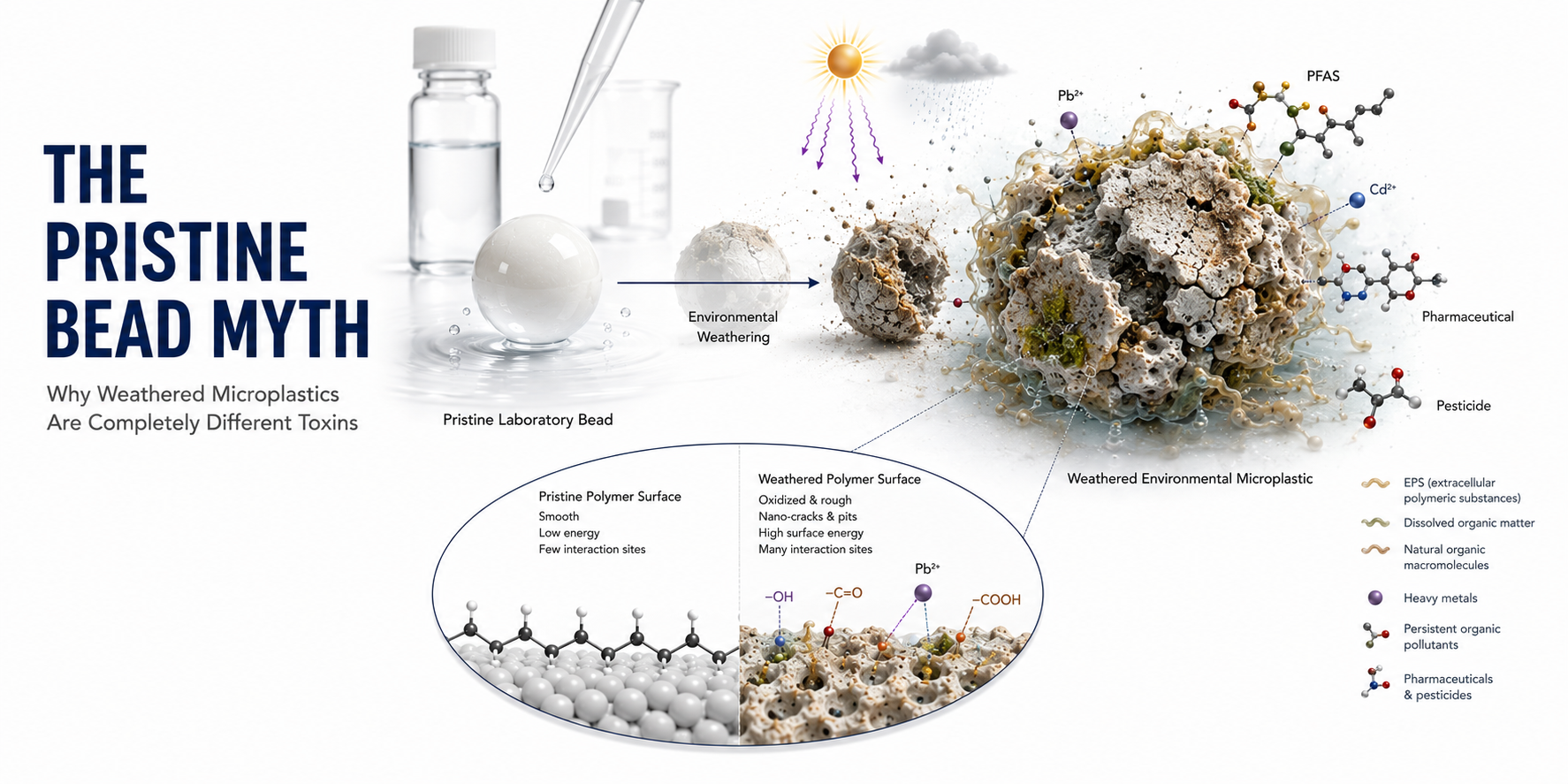
Pristine vs. Weathered: A Completely Different Toxic Profile When a plastic particle undergoes months or years of environmental weathering (solar photo-oxidation, bio-fouling, and mechanical shear), its biological toxicity changes fundamentally:
| Property | Pristine Lab Beads | Real-World Weathered Particles |
| Morphology | Perfectly smooth, spherical | Irregular, sharp-edged, porous |
| Surface Chemistry | Hydrophobic, unfunctionalized | Oxygenated (high -COOH, -OH), charged |
| Sorption Load | None (clean surface) | Pre-loaded with heavy metals, PFAS, POPs |
| Biological Coating | Bare surface | Covered in a dynamic, living "Eco-Corona" |
The Trojan Horse Mechanism & The Eco-Corona
In real aquatic systems, weathered microplastics undergo two rapid transformations that alter cellular uptake:
-
The Trojan Horse Effect: Because solar aging turns microplastics into chemical sponges (as established in our previous work), organisms ingest particles that are pre-loaded with concentrated cocktails of heavy metals and organic toxins. Once inside the acidic environment of a gut or digestive tract, these toxic payloads desorb, causing severe chemical toxicity alongside physical tissue damage as detailed here.
-
The Dynamic Eco-Corona: The moment a weathered, oxygenated particle enters natural water, it absorbs ambient proteins, lipids, and extracellular polymeric substances (EPS), forming a "bio-corona." This eco-corona misleads cellular receptors, promoting endocytosis and allowing nanoplastics to cross biological barriers (including the gut-blood and blood-brain barriers) that pristine beads cannot penetrate.
Testing a pristine bead measures physical obstruction at best. Testing a weathered particle evaluates a complex, bio-interactive chemical delivery system.
Conclusion
It is time to retire the pristine bead methodology. While unweathered spheres were useful for early proof-of-concept studies, continuing to rely on them creates a dangerous illusion of understanding.
If we want ecotoxicology data that actually informs environmental policy and regulatory risk assessments, journals and peer reviewers must demand standardized artificial weathering protocols (e.g., UV/Ozone pre-treatment) for all microplastic toxicity testing.
Should academic journals reject ecotoxicology studies that rely exclusively on pristine commercial spheres without artificial UV/weathering pre-treatment?
#Microplastics #Ecotoxicology #EnvironmentalScience #EcoCorona #TrojanHorseEffect #Toxicology #WaterSafety #SpringerNature

Dr. Akeem Adeyemi Oladipo is a globally recognized Research Professor of Materials and Environmental Chemistry at Eastern Mediterranean University. Ranked among the world's Top 2% Scientists, his expertise bridges nanotechnology, renewable energy, and electro-analytical chemistry. He specializes in advanced materials synthesis for wastewater treatment, highly sensitive electrochemical biosensors, and solar energy conversion. By integrating machine learning and artificial neural networks, his research drives scalable deep-tech innovations in environmental sustainability and energy storage.