The Screenome: Unlocking the New Science of Everyday Life
Published in Healthcare & Nursing, Social Sciences, and Neuroscience


The Final Frontier of Health
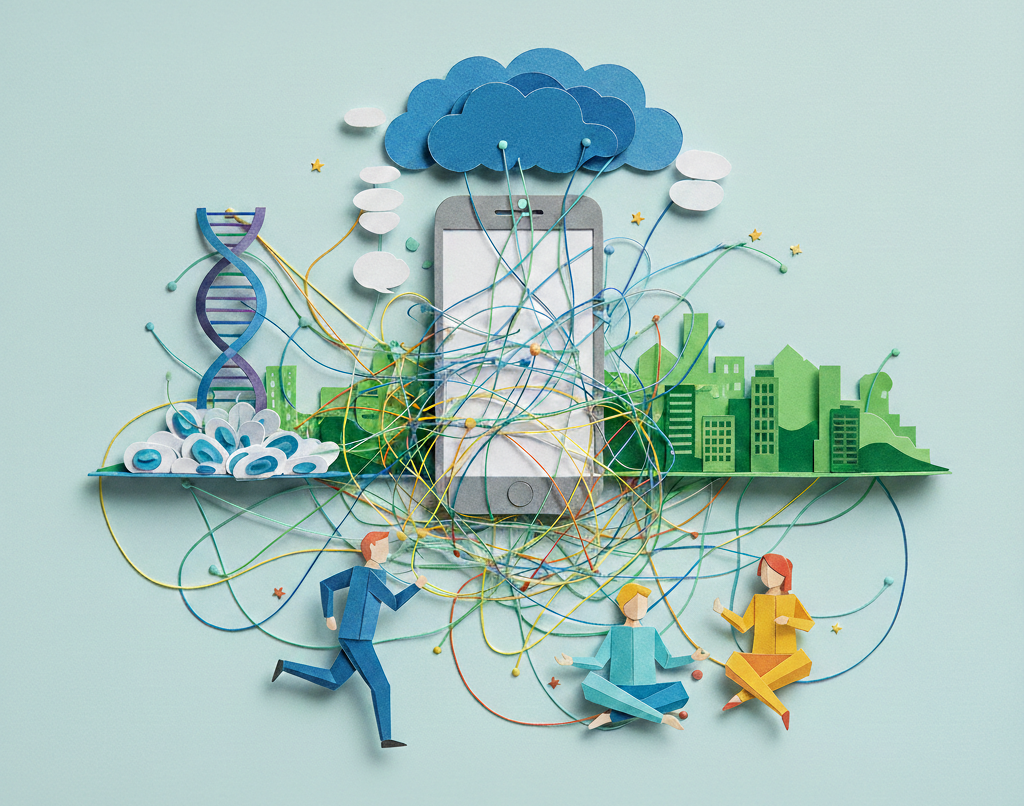
For decades, scientists have been peeling back the layers of what makes us who we are and what keeps us healthy. First came the genome, revealing the risks hidden in our DNA. Then the microbiome showed us that our bodies are not just our own—they’re ecosystems teeming with tiny residents shaping our health in ways we never imagined. More recently, the exposome reminded us that everything around us—the air we breathe, the food we eat, the cities we navigate—leaves a mark on our health. Each discovery has added a new lens to the human story, yet even with all this knowledge, one critical piece remained stubbornly out of reach: our everyday behavior.
Behavior is not just a footnote in health; it is the engine. It is how genetic risk becomes real, how environmental exposures affect us, and how interventions succeed or fail. The ways we move, the rhythms of our attention, the ways we cope, and the ways we connect with others shape mental and physical health long before any symptoms appear. But until recently, capturing this layer of human life in its natural context was nearly impossible. In fact, the challenge has only intensified as our physical and digital lives become increasingly intertwined through mobile devices. Smartphones, now central to daily life, sit at the center of this convergence.
Screenome, the Silent Witness
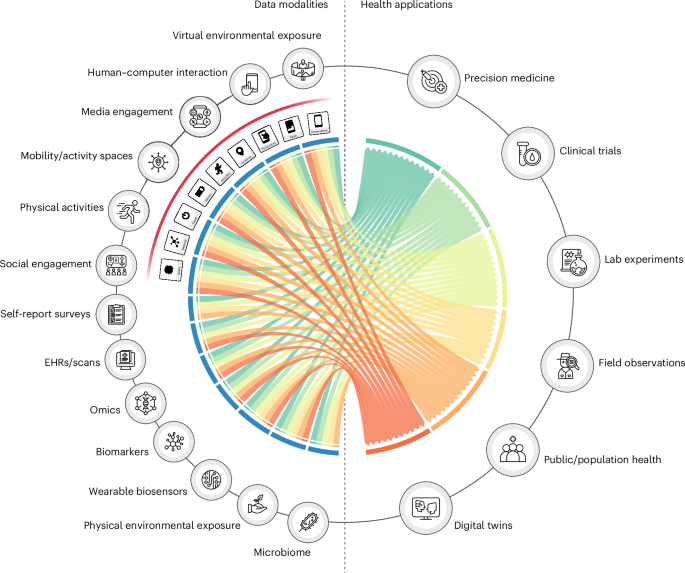
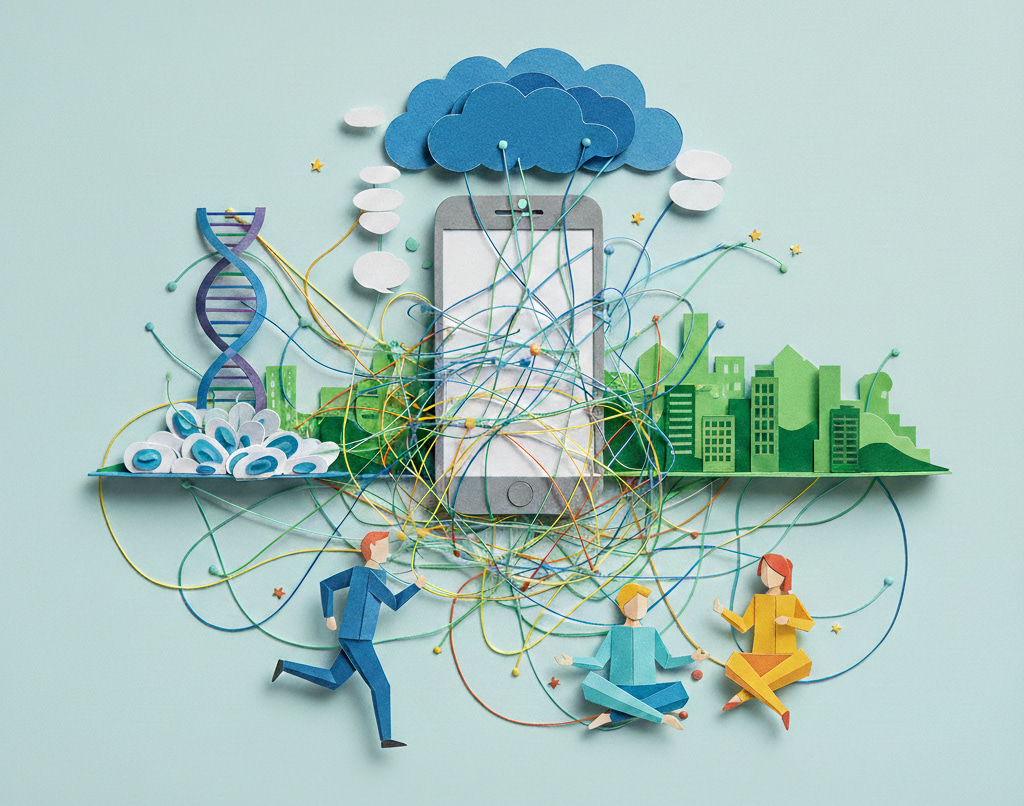
That’s where the Screenome comes in. It takes its name from the fact that while we are busy navigating our lives, a sophisticated array of sensors is sitting right behind that smartphone screen, silently witnessing everything. This is not just a record of the apps you open or a measure of screen time; it is a full set of digital traces—every motion, social interaction, and shift in attention—recording a spectrum of human behavior signals exactly as they happen.
These sensors operate unobtrusively in the background, observing signals that are otherwise invisible to the naked eye. When captured and analyzed, they reveal the routines, rhythms, and priorities that make up our lived experience. Through the screenome, researchers can finally capture the choices that define everyday life directly in the context in which they occur. It is the missing layer in the science of human health: the bridge between our internal biology, our external environment, and the reality of how we live.
The Academic Heartaches
Over the past decade, smartphones have become central to everything we do. While the promise of leveraging these "silent witnesses" is revolutionary, the road to getting there has been paved with what I call "academic heartaches." In the world of research, the dream of using digital traces often collided with a harsh reality. To turn this potential into a new science, researchers have to overcome three massive hurdles: the infrastructure gap, the big data bottleneck, and the complex privacy paradox of the digital age.
The Infrastructure Gap
There is a profound mismatch between the skills required for digital trace research and the traditional training of most health scientists. For decades, the gold standard for a researcher was mastery of study design and statistical inference. Today, that same researcher is suddenly expected to function as a software architect, data engineer, and product designer.
Building the infrastructure to collect digital traces is a continuous battle against the shifting sands of mobile operating systems. In our labs, we often attempt to build research-grade software on shoestring budgets, competing against commercial giants that employ legions of engineers to maintain stability. When an operating system update "silently" throttles background processes or changes permission structures, months of data collection can evaporate overnight. It is a grueling realization: our breakthroughs are only as stable as the next software patch.
The Big Data Bottleneck
This skills gap extends into the management of the data itself. Smartphone trace data does not arrive neatly packaged. The smartphone is a constrained environment where storage, battery life, and thermal limits are the primary currencies. If a research application consumes too many of these resources, participants will quietly and often permanently uninstall it. Managing terabytes of data from a participant’s phone to a secure server requires sophisticated scheduling, compression, and intelligent upload strategies. Without these safeguards, we face the “hard drive problem”: mountains of raw, unstructured data that are expensive to store and nearly impossible to analyze within the computational limits of a standard academic lab.
Ethical Frameworks and the Privacy Paradox
Beyond the technical hurdles lies a complex ethical landscape. The shift from consenting to a survey to consenting to a continuous digital trace represents a seismic change in the researcher-participant relationship. These traces are inherently intimate, capturing private conversations, location, financial anxieties, and late-night vulnerabilities.
A persistent privacy paradox emerges: participants may express strong concerns about privacy in principle, yet willingly share rich traces for the sake of scientific progress. This places the burden squarely on us. We must ensure data is not merely anonymized, but meaningfully protected from re-identification. A data breach here is not just a leak of numbers; it is the potential exposure of one’s entire digital life.
The Screenomics Vision
These challenges reached a breaking point where the "heartaches" of technical failure threatened to stall the entire field. We realized that infrastructure should never be a proprietary advantage or a recurring nightmare; it should be a shared scientific resource. We developed the Stanford Screenomics platform with a vision to move the researcher from the role of "struggling engineer" back to "scientist," thereby accelerating collective discovery and growing the field through a more diverse range of voices.
To achieve this, we released the Stanford Screenomics platform as an open-source framework that “automates the infrastructure,” handling database configuration, server setup, and app compilation through simple drag-and-drop actions. The platform confronts the "big data bottleneck" by managing the "hard drive problem" through adaptive data transfer, on-device preprocessing, and automated standardization. Crucially, efficiency wasn't our only goal; trust was equally vital. We embedded high “ethical standards” into the very architecture of the system with granular consent modules and end-to-end encryption. Because the platform is open-source, its transparency further invites collective scrutiny, strengthening the bond of trust between participants, researchers, and review boards alike.
A New Science of Everyday Life
These advances point toward the emergence of a new science of everyday life. In this paradigm, the screenome is a continuous lens on human behavior.
The screenome, powered by the Screenomics platform, finally completes the picture of human health begun by the genome, expanded by the microbiome, and broadened by the exposome. It provides the missing behavioral blueprint, illuminating the mechanisms by which everyday life drives health and disease. For the first time, we can turn what was once invisible into insight, transforming a field of frustration into a frontier of possibility.
Follow the Topic
-
Nature Health

Nature Health publishes health research across the medical, social and environmental sciences and requires meaningful engagement with research participants and their communities.

Please sign in or register for FREE
If you are a registered user on Research Communities by Springer Nature, please sign in