The Story Behind the Paper: From a Workshop to a Published Fight Against Malaria
Published in Chemistry




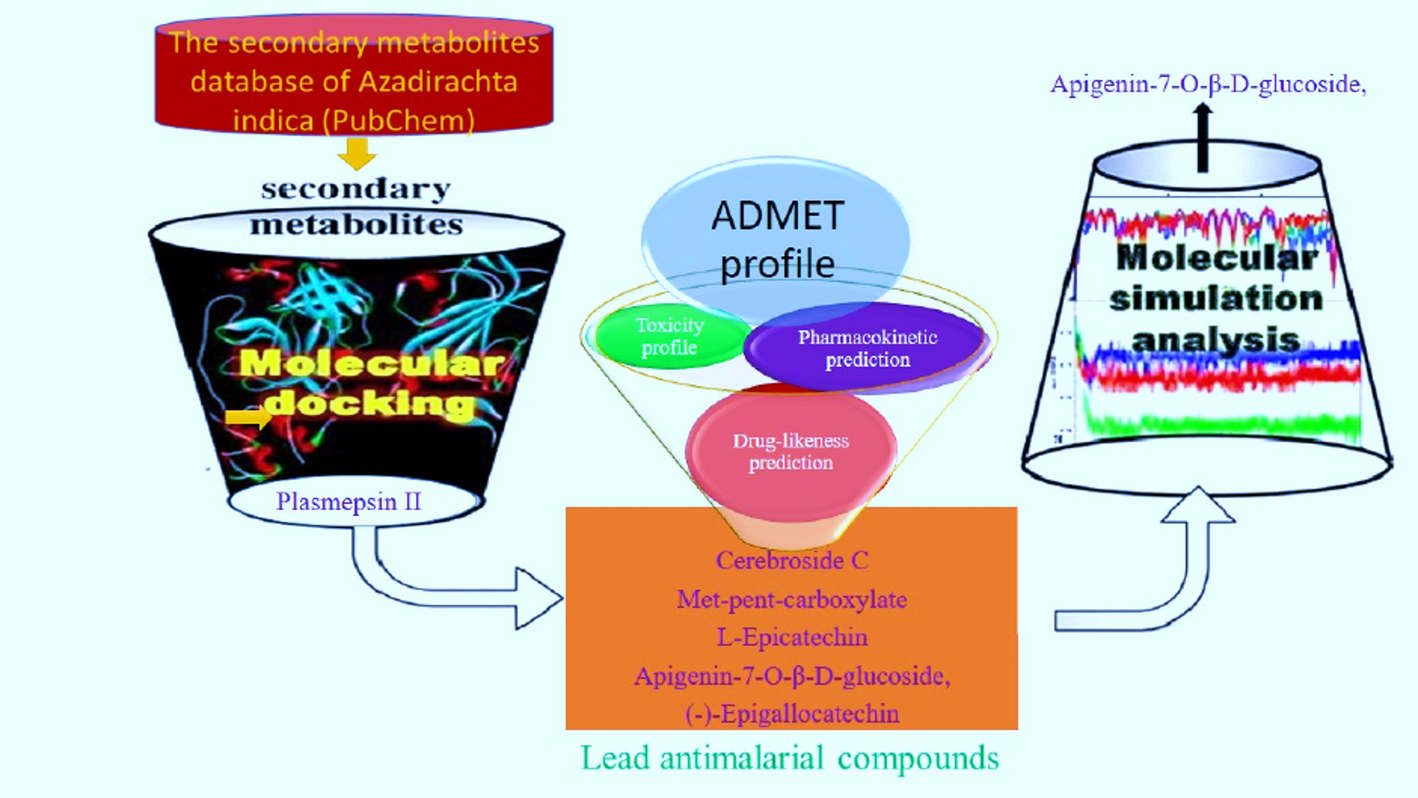

Two years ago, I attended a molecular docking workshop, eager to learn how virtual screening could accelerate the discovery of new drugs. Little did I know that a simple suggestion from the coordinator—"Why don’t you all form a group and continue a project after this?"—would set us on a path leading to a peer-reviewed publication in Discover Chemistry.
Our newly formed team decided to tackle a problem close to home: malaria. In Nigeria, malaria accounts for a staggering burden—30% of childhood deaths, 11% of maternal deaths, and over 60% of clinical visits. With the terrifying rise of artemisinin-resistant Plasmodium falciparum strains, the need for new therapeutic strategies has never been more urgent.
We chose to look for answers in a familiar guardian: the Neem tree (Azadirachta indica). While its traditional uses are well-known, its vast chemical repertoire remained largely unmapped for modern, target-based drug discovery. Our mission was clear: use computational tools to systematically mine neem's 320+ phytochemicals for a specific weapon—an inhibitor of Plasmepsin II, a critical enzyme the malaria parasite uses to digest hemoglobin and survive in our blood.
As the group leader, I witnessed an incredible synergy. We pooled our resources to present initial findings at conferences. Then began the real grind: nights of running docking simulations, analyzing complex pharmacophore models, and tracking the dynamic dance of protein-ligand interactions across 100 nanoseconds of simulation time.
The results were illuminating. Our screen identified Cerebroside C as a potent binder, with the highest predicted affinity. A classic approach might have stopped there. But our deeper analysis revealed a crucial lesson in drug discovery: binding strength alone is not enough.
Through ADMET profiling, we found Cerebroside C would likely have poor bioavailability and be pumped out of cells by P-glycoprotein. Instead, a compound named Apigenin-7-O-β-D-glucoside emerged as the dark horse. It showed strong, stable binding in dynamic simulations, forming a resilient complex with key residues like Asp214 and Tyr77, and—most importantly—it possessed the drug-like properties necessary to potentially become a real medicine.
This research, now published, is more than just a paper. It is a testament to collaborative spirit, from funding our own initial steps to supporting each other through the manuscript process. It highlights the power of computational foresight—using in silico tools to guide the search for therapeutics, saving time and resources. Most importantly, it adds a promising piece to the global puzzle of defeating drug-resistant malaria.
My deepest thanks go to my incredible co-authors and teammates: Garba Dauda, Amina Busola Olorukooba, Iyabo Mobolawa Adebisi, Omobolanie Ibukun Ogundele, Murtala Muhammad Jibril, Aiseosa Kingsley Iqhar, Jamilu Sani, Walter Mdekera Iorjim, Okesola Mary Abiola, Abayomi Emmanuel Adegboyega, and Titilayo Omolara Johnson. This achievement is yours as much as it is mine.
The journey from a workshop idea to a published study reminds us that scientific progress often starts with a simple step: a curious team deciding to work together on a problem that matters.
Read our full open-access story here: https://rdcu.be/eXrW8
DOI: 10.1007/s44371-025-00461-z
#ScienceStory #MalariaResearch #DrugDiscovery #Neem #ComputationalBiology #TeamScience #NigerianResearch #AcademicTwitter #FromWorkshopToPublication

Dr. Dauda Garba is from Nigeria. He is a committed scholar trained at some prestigious national institutions, including Ahmadu Bello University, Zaria, and the Federal University of Technology, Minna. Dr. Garba is a pharmaceutical and medicinal chemist with a keen interest in the use of natural products for the discovery of drugs. His area of expertise is most evident in the use of computational and spectroscopic methods for the isolation, characterization, and biological assessment of phytochemicals.
His area of research addresses critical global health challenges, primarily focusing on malaria through the discovery of novel antimalarial drug candidates. Dr. Garba has made a substantial contribution to the area of expertise by conducting an extensive investigation of Nigerian medicinal plants, particularly those belonging to the genus Globimetula (mistletoe). His scholarly contributions include the isolation and structural elucidation of numerous bioactive compounds, such as prenylated Quercetin, chalcone, triterpene, and novel dihydrostilbenes, and the demonstration of their efficacy through in vivo and in silico studies against Plasmodium species.
A prolific researcher, Dr. Garba has published thirty-five peer-reviewed articles and presented at many international and local conferences. His contributions have been recognized, including the award for Best Oral Presentation award at the 8th International Society for Medicinal Plants and Economic Development (SOMPED) conference in 2024. He is also actively involved in the academic community as a reviewer for several reputable journals, such as Science of Phytochemistry, ChemistrySelect, ChemistryEurope, Modern Chemistry, and Natural Product Research.
Dr. Garba is also involved in education and capacity building, having facilitated workshops on molecular docking and research proposal writing. He is currently a Lecturer II and holds several administrative roles, including Departmental Examiner Officer and Course Coordinator, at the University of Abuja's Faculty of Pharmaceutical Sciences.
Follow the Topic
-
Discover Chemistry
A fully open access, peer-reviewed journal supporting multidisciplinary research and policy developments across all fields of chemistry.

Related Collections
With Collections, you can get published faster and increase your visibility.
Chemistry in Action: Multidisciplinary Approaches in Current Research and Novel Applications
This topical collection aims to highlight the role of Chemistry in multidisciplinary cutting-edge research. Currently, the traditional and siloed research approach is inadequate to solve the complex global challenges. Therefore, a new paradigm of multidisciplinary research is emerging, proposing innovative solutions that address issues from multiple angles by integrating insights from different fields. We call for submissions of papers reporting original Research, Reviews, Perspectives, Comments, Brief Communications, Case Studies, Registered Reports, and Data Notes that integrate chemical concepts and techniques with other fields such as Biology, Medicine, Pharmacy, Physics, Engineering, Environmental Science, Materials Science, and Food Science, among others. This collection is particularly interested in, but not limited to, manuscripts that address:
• Development of new materials with tailored features for specific applications.
• Design and synthesis of molecules for therapeutic or diagnostic purposes.
• Chemical approaches to clean generation and storage of energy.
• Sustainable chemical processes for environmental care and remediation.
• Integration of chemical principles with advanced engineering and fabrication
• Techniques.
Keywords: Materials chemistry, chemical synthesis, chemical engineering, sustainable chemistry, environmental sciences, biochemistry, pharmacy.
Publishing Model: Open Access
Deadline: Oct 31, 2026
Selected Papers from International Conference on Green Chemistry and Sustainable Development
Green chemistry advances sustainable development by enabling innovative chemical processes that minimize toxicity, waste, and resource consumption. The International Conference on Green Chemistry and Sustainable Development brings together scientists, researchers, industry leaders, and policymakers from around the world to share innovations, research findings, and strategies for promoting environmentally friendly chemical practices. The conference focuses on advancing green technologies, reducing environmental impact, providing renewable energy solutions, waste management, and supporting global efforts toward sustainable economic and social development. It serves as a platform for collaboration, education, and the exchange of ideas aimed at building a greener and more sustainable future through responsible scientific practices and sustainable industrial development.
Homepage: https://www.acsfuo.org/abstract
Keywords:Sustainability, Renewable resources, Biodegradable materials, green chemistry, Waste reduction, Renewable energy, Eco-friendly processes
This Collection supports and amplifies research related to SDG 7, SDG 9, SDG 10, SDG 13, and SDG 15.
Publishing Model: Open Access
Deadline: Nov 30, 2026