The Untold Story of Investigating Adolescent Resilience in the Digital Age
Published in Education and Arts & Humanities

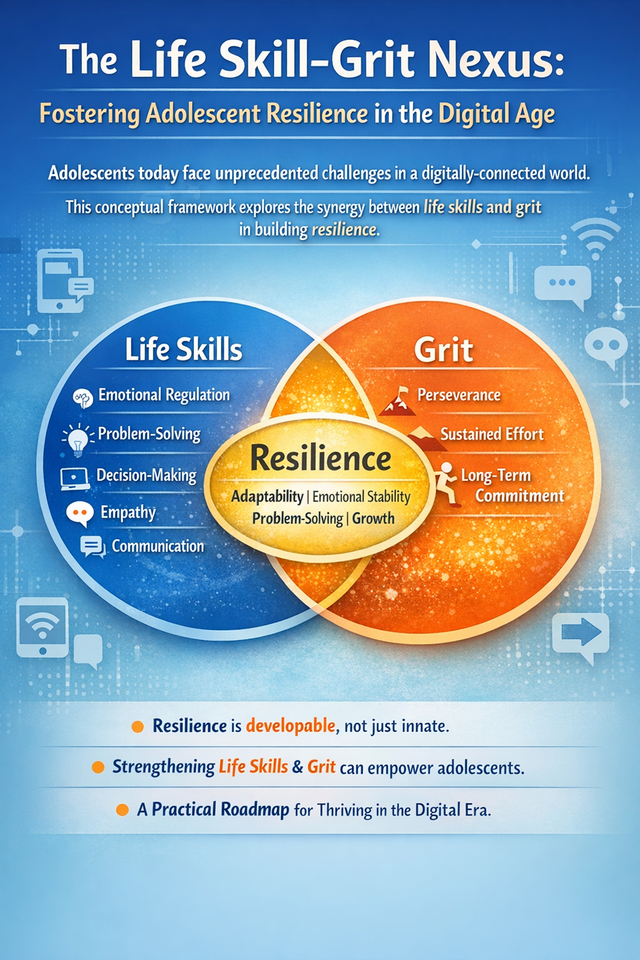



Adolescence is a transformative stage of life marked by rapid emotional, cognitive, and social development. In today’s digital era, however, this journey has become increasingly complex. Constant exposure to social media, online peer interactions, academic pressure, and information overload has reshaped adolescents’ experiences, presenting both opportunities and significant psychological challenges. While much of the existing research focuses on the risks associated with digital engagement, I became deeply interested in a different and more hopeful question: What empowers adolescents to thrive, adapt, and grow resilient in this digitally driven world?
This question became the foundation for developing a new conceptual framework: the Life Skill–Grit Nexus. Life skills such as emotional regulation, decision-making, problem-solving, empathy, interpersonal communication, and coping strategies equip adolescents with essential tools for navigating everyday challenges. Grit, defined as perseverance and sustained passion toward long-term goals, complements these skills by strengthening determination, self-discipline, and resilience in the face of setbacks. I theorized that the dynamic interaction between life skills and grit forms a powerful psychological foundation for building adolescent resilience in the digital age.
The conceptual development of this framework involved an extensive review and synthesis of interdisciplinary literature across educational psychology, developmental psychology, emotional intelligence, resilience theory, and digital well-being studies. Through this integrative process, it became evident that life skills and grit do not operate independently. Instead, they function in synergy: life skills provide adolescents with strategies to understand, manage, and respond to challenges, while grit sustains their motivation and perseverance to continue striving despite difficulties. This conceptual integration led to the formulation of the Life Skill–Grit Nexus Model, which positions resilience as an outcome of their dynamic interplay.
This framework also highlights that resilience is not a fixed or innate trait but a developable capacity. By intentionally cultivating life skills alongside grit, educational systems and families can foster adolescents’ ability to regulate emotions, cope with academic and social stress, navigate online pressures, and maintain psychological well-being. In this sense, the model offers a theoretical roadmap for designing holistic educational interventions that address both emotional competence and motivational strength.
Beyond its theoretical contribution, the Life Skill-Grit Nexus holds important implications for educators, school counselors, parents, and policymakers. It emphasizes the need to move beyond content-driven education toward a more holistic approach that integrates social-emotional learning, character development, and perseverance training. Such an approach is especially critical in preparing adolescents to face the uncertainties, distractions, and emotional challenges inherent in the digital era.
Ultimately, this work represents more than a conceptual exercise it reflects a commitment to understanding and nurturing the inner strengths of young people. By proposing an integrated framework for adolescent resilience, this paper aims to stimulate dialogue, guide future empirical research, and inform educational practice. My hope is that this conceptual model contributes to building supportive ecosystems that empower adolescents not merely to cope, but to thrive with confidence, emotional strength, and purpose in a rapidly evolving digital world.
Follow the Topic
-
Discover Psychology

This is an international, open access journal that publishes research in behavioral sciences and related fields, including health, environment, neuroscience, business, economics, ergonomics, linguistics, and education.
Related Collections
With Collections, you can get published faster and increase your visibility.
Mental Health and SDGs: Examining Interrelationships Between Mental Health and Agenda 2030
Mental health is integral to achieving the Sustainable Development Goals (SDGs), as it intersects with all the global targets for Agenda 2030. The inclusion of mental health within Agenda 2030 reflects its importance for achieving global well-being and equity. However, the complex relationships between mental health and the SDGs are often underexplored. For instance, poor mental health can hinder educational attainment, economic productivity, and resilience to environmental crises, while systemic inequities, climate change, and conflict exacerbate mental health challenges globally.
Despite growing global commitments, the integration of mental health into development agendas remains fragmented. Research is often siloed, focusing on either mental health outcomes or SDG targets, rather than exploring their interdependencies. Furthermore, there is limited understanding of how mental health interventions can accelerate SDG achievements or how progress on the SDGs can promote mental well-being. Addressing these gaps is essential to building inclusive, sustainable communities where mental health and development reinforce one another.
This collection aims to provide a platform for interdisciplinary research that examines the interrelationships between mental health and the SDGs. We welcome studies that investigate how mental health issues influence progress on the SDGs and how development efforts can address mental health disparities. This collection will offer critical insights for policymakers, practitioners, and researchers working to integrate mental health into global development strategies.
Key Themes Include (but are not limited to):
• Mental Health and Overall Health and Well-Being: Exploring mental health as a core component of health and well-being, including the integration of mental health services into primary healthcare.
• Educational Outcomes and Mental Health: Investigating the effects of mental health on learning, school attendance, and academic performance, and vice versa.
• Gender Equality and Mental Health: Examining the mental health implications of gender disparities, violence, and empowerment.
• Climate Change and Mental Health: Assessing the psychological impacts of climate-related events and the role of mental health in building climate resilience.
• Mental Health Inequities and SDG Progress: Exploring how disparities in access to mental health care affect progress on the SDGs, especially for marginalized groups.
• Resilience and Sustainable Development: Identifying protective factors and community-based strategies that enhance mental health and promote sustainable development.
• Digital Innovations and Mental Health in SDG Achievement: Evaluating the role of technology in addressing mental health challenges within development contexts.
• Mental Health Policy and the SDGs: Analyzing policies that integrate mental health into national and international development agendas.
• Youth Mental Health and SDGs: Investigating the intersection of youth mental health with education, employment, and civic participation.
• Intersectionality in Mental Health and SDGs: Exploring how intersecting identities (e.g., age, gender, socio-economic status, ethnicity) influence mental health outcomes and development goals.
Keywords: Mental Health and Sustainable Development Goals; Global Mental Health and SDGs; Mental Health Equity; Climate and Mental Health; Resilience and Well-being; Mental Health Policy and Advocacy; Education and Mental Health; Gender and Mental Health; Vulnerable Populations; Interdisciplinary Development and Mental Health.
This Collection supports and amplifies research related to all the SDGs.
Publishing Model: Open Access
Deadline: Jun 30, 2026
Teacher Mental Health in Educational Settings: Determinants, Protective Factors, and Educational Impact
Teacher mental health has emerged as a critical concern in educational research, particularly as educators face unprecedented challenges in contemporary educational settings. This Collection advances our understanding of teacher mental health by examining its multifaceted nature, determinants, protective mechanisms, and impacts on educational outcomes. We welcome empirical studies, theoretical frameworks, and innovative methodological approaches that investigate the dynamic interplay between teachers' psychological well-being and the educational environment.
The collection invites contributions addressing key areas including: psychological need satisfaction and thwarting in teaching contexts; patterns of occupational stress and burnout; work-related motivation and engagement; protective factors at individual, school, and systemic levels; and the ripple effects of teacher mental health on student outcomes and school climate. We particularly welcome studies examining cultural variations in teacher mental health, innovative intervention approaches, and the impact of recent global challenges on teacher well-being.
We seek submissions employing diverse methodological approaches, including quantitative, qualitative, and mixed-methods designs. Studies featuring advanced statistical techniques such as structural equation modeling, multilevel analysis, or longitudinal designs are especially encouraged, as are cross-cultural investigations that offer comparative perspectives on teacher mental health across different educational contexts.
This collection aims to inform evidence-based practices and policies that enhance both teacher well-being and educational effectiveness. We invite contributions from established researchers and emerging scholars to advance this crucial discourse in educational psychology.
Keywords:Teacher mental health, Psychological well-being, Occupational stress, Teacher burnout, Work motivation, Protective factors, School climate, Student outcomes, Educational psychology, Mental health interventions
Publishing Model: Open Access
Deadline: May 31, 2026



Please sign in or register for FREE
If you are a registered user on Research Communities by Springer Nature, please sign in