Tidal Rivers: Observing the Extent of Ocean Tides in Coastal Rivers
Published in Earth & Environment






The research gap
Satellite observations have vastly expanded our understanding of ocean tides. In 2022, the Surface Water and Ocean Topography (SWOT) satellite was launched, funded by CNES and NASA, and provided a new perspective on the oc
ean surface and inland water systems. Early research has been extremely positive and promising, but a clear avenue of research has opened up about exploring the capabilities of these new measurements to study processes at the interface of oceanography and hydrology. One such process is the aforementioned ocean tides, particularly in the challenging river and estuary regions. Historically, observations of tides within coastal rivers have been limited to tide gauges, which are sparsely distributed.
The findings
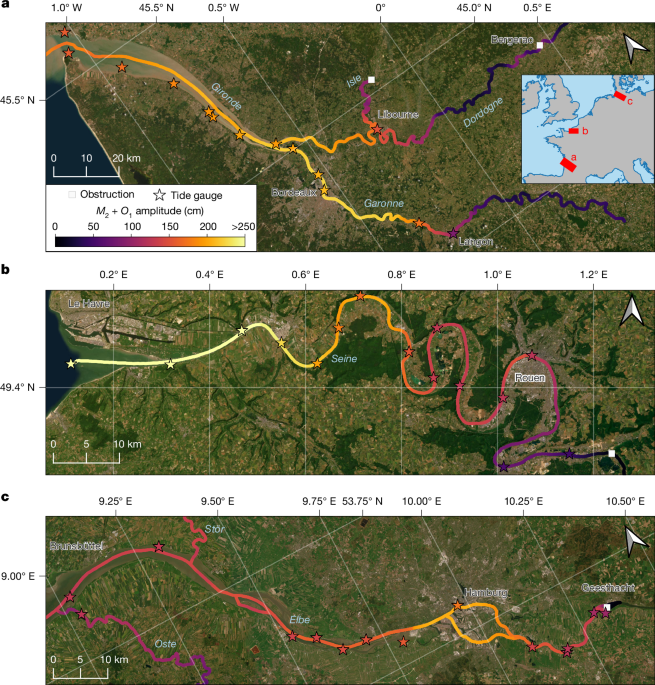
With SWOT, specifically the River products (RiverSP), we analysed every observed coastal river and estimated components of the ocean tide, and derived an algorithm to estimate the tidal extent. Using these estimates, we present the first estimation of tidal amplitudes across the global coastal rivers. This finding in itself is novel, as we have never had such a clear picture of the tidal heights within rivers before. In the global dataset, which is also seen in the select rivers, we observed interesting differences between rivers, with the tide sometimes getting larger in a river and sometimes getting smaller upstream. The ability to derive such key information means we can start to evaluate the impact of extreme events, induced by compound flooding (tides + storm surges), on a river system. In our manuscript, we investigated this within the Congo River system.
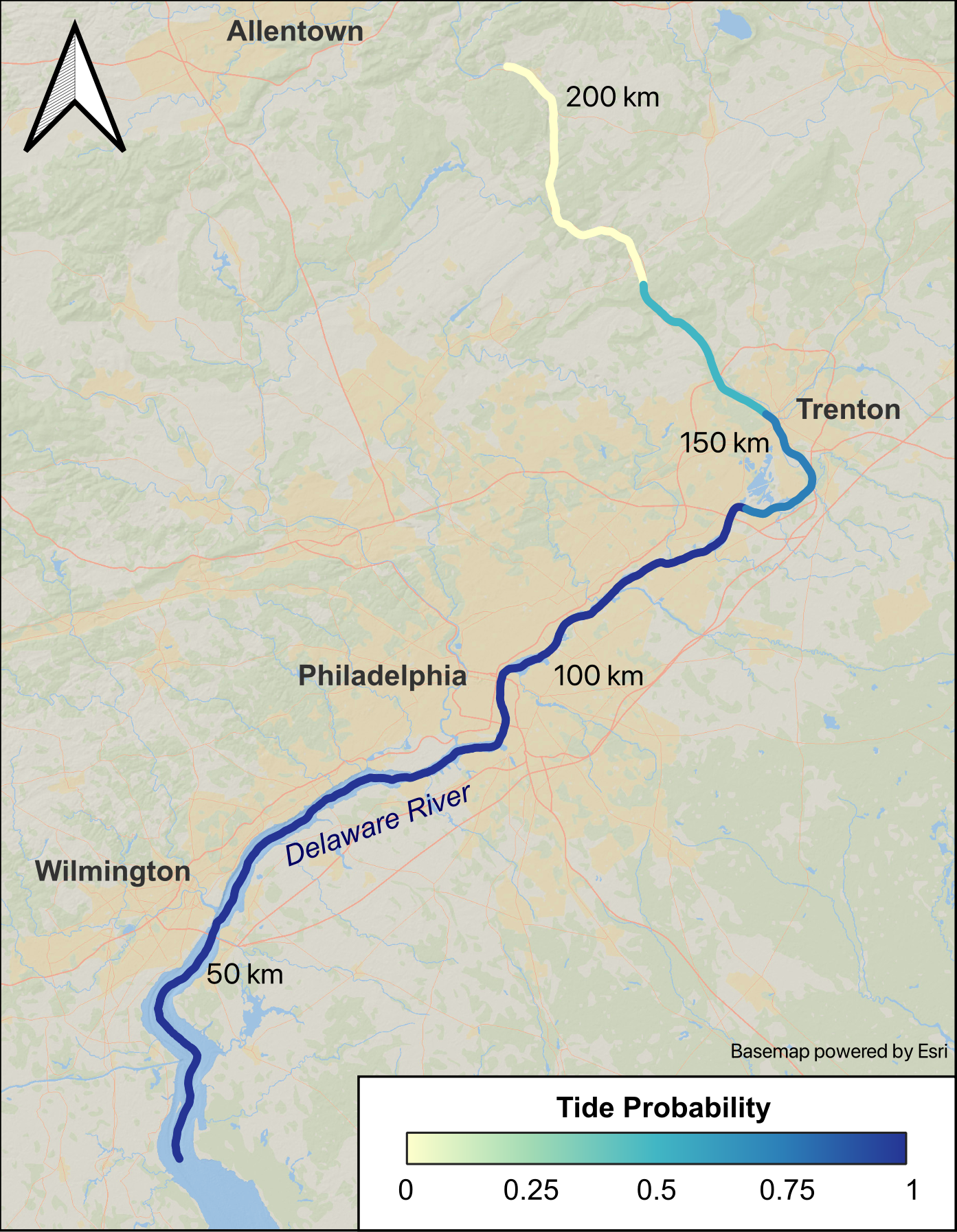
The main finding of our manuscript is the first global atlas of tidal extent (e.g. Delaware shown in Figure 1). The method to do this is described in our manuscript, but to summarize, this is done by combining several factors, including tidal heights and river dynamics. We were able to see regions of vast tidal extent, for example the Amazon river where the tide can propogate 100s of kilometers upstream.
Using these findings, we can start to evaluate the influence tides have on the human population. We discover that 715 million people live within 10 km of a tidal river. Furthermore, we determine that over 110,000 km2 of agriculture land lies within 3 km of a tidally influenced river.
This research has wide-ranging implications across cross-disciplinary science, as well as down to local communities and municipalities. The downstream applications of this will be the improved understanding of crucial processes, such as compound flooding, sea level variability, and saltwater intrusion. Furthermore, improvements to tide models in the coastal zone will affect not only oceanographic and hydrological applications but also geodetic applications, particularly satellite altimetry.
Looking ahead
This manuscript opens the door for a wide range of cross-disciplinary research across the land-ocean continuum. With the continued flying of the SWOT satellite as well as similar planned future missions, this research will continue to grow into studying the fine-scale spatial variability of ocean tides and their interaction with hydrological processes, such as river discharge.
Manuscript:
Hart-Davis M.G., Scherer D., Schwatke C., Sawyer A., Pavelsky T., Ray R.D., Matte P., Dettmering D, Seitz F. 2026. Observing the tidal pulse of rivers from wide-swath satellite altimetry. Nature. https://doi.org/10.1038/s41586-026-10287-z.
Interactive Map: https://dahiti.dgfi.tum.de/en/products/river-tides/map/

Satellite oceanographer at the Technical University of Munich, working on improving our understanding and application of ocean tides
Follow the Topic
-
Nature
A weekly international journal publishing the finest peer-reviewed research in all fields of science and technology on the basis of its originality, importance, interdisciplinary interest, timeliness, accessibility, elegance and surprising conclusions.

Related Collections
With Collections, you can get published faster and increase your visibility.
Carbon Dioxide Removal
Publishing Model: Hybrid
Deadline: Jan 16, 2027


Please sign in or register for FREE
If you are a registered user on Research Communities by Springer Nature, please sign in