To Adapt or Reproduce? How a Fungal Pathogen Uses an Epitranscriptomic Brake to Balance DNA Repair
Published in Chemistry, Biomedical Research, and Agricultural & Food Science

Why is the research valuable?
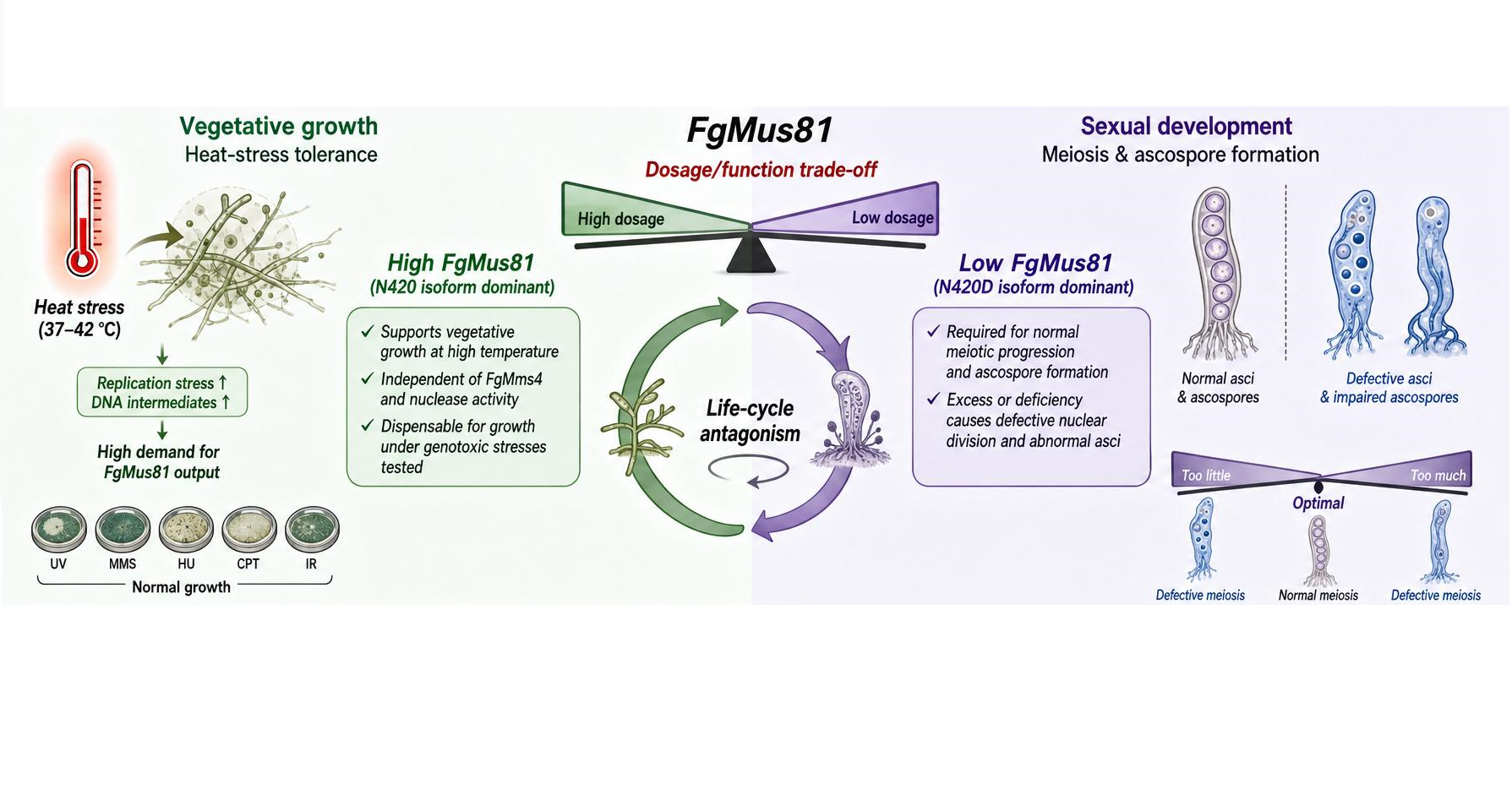
Cells face a constant biological dilemma: how much DNA repair machinery is enough? Homologous recombination (HR) is a high-fidelity pathway essential for fixing double-strand breaks and replication-associated lesions, but its optimal deployment shifts dramatically across an organism's lifecycle. During vegetative growth under environmental stress, high levels of repair factors are required to resolve accumulated DNA structures. Conversely, during meiosis, these same components must be tightly restrained to ensure proper chromosome segregation and prevent the accumulation of toxic recombination intermediates.
Historically, research has viewed pathway choice and genome maintenance through a rigid, mechanism-only lens, typically searching for structural mutations or binary "on/off" genetic switches. However, hardcoding a permanent genomic mutation to optimize one life stage often compromises another, creating a severe evolutionary bottleneck. Our paper addresses this fundamental trade-off. By demonstrating how a fungal pathogen dynamically recalibrates its DNA repair dosage without altering its underlying genetic blueprint, we bridge the gap between structural biochemistry and evolutionary ecology. This provides a new conceptual framework for understanding how eukaryotes navigate conflicting cellular constraints across shifting environments.
What did the authors do?
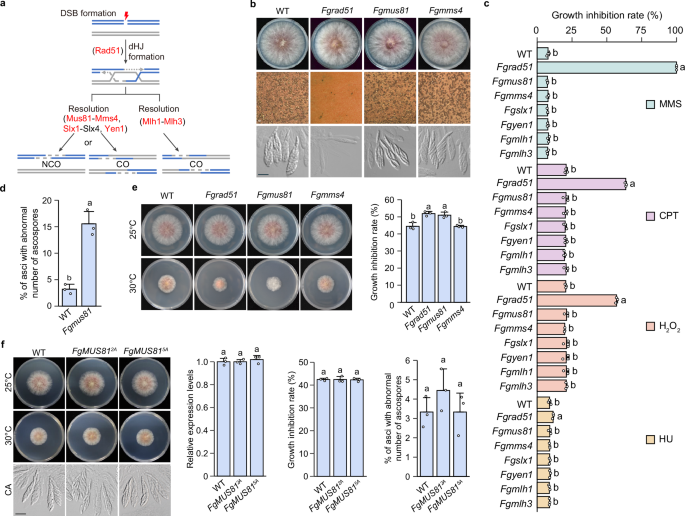
We set out to dissect downstream components of the HR pathway in Fusarium graminearum, the devastating causal agent of Fusarium head blight in cereal crops. When we knocked out the structure-selective endonuclease FgMUS81, we observed two stark, seemingly disconnected defects: the fungus failed to form normal ascospores during sexual reproduction, and its vegetative growth and pigmentation collapsed under heat stress.
The first major surprise came when we evaluated the molecular mechanism. In classical yeast and mammalian models, Mus81 must partner with Mms4 to form an active endonuclease complex that cleaves DNA. However, in F. graminearum, deleting FgMMS4 did not mimic the Fgmus81 defects, and engineering catalytic-dead versions of FgMus81 left the cells entirely unharmed. FgMus81 was operating through a noncanonical mechanism—likely acting as a structural scaffold or tether rather than a traditional active enzyme.
The breakthrough occurred when we examined the transcripts during the sexual stage. We identified a precise, stage-specific A-to-I RNA editing event that recodes a single amino acid (N420D). By tracking protein behavior, we found that this edited isoform is significantly less stable, acting as a post-transcriptional brake that naturally dilutes FgMus81 protein levels during meiosis. When we experimentally forced the expression of the highly stable, pre-edited isoform during meiosis, it triggered severe nuclear division arrest. FgMus81 output, it turned out, is a highly sensitive dosage balancing act: cells require high abundance to survive thermal stress but must stringently throttle it back to complete sexual reproduction.
What are the implications of this study?
Our findings offer an elegant solution to a long-standing evolutionary riddle: why maintain complex, energy-consuming RNA editing machinery when a permanent DNA mutation could achieve the same protein sequence?
By engineering strains locked into either the pre-edited or post-edited genomic state, we exposed the high selective cost of genetic permanence. Hardcoded "edited" strains successfully completed meiosis but failed to tolerate heat stress. Uneditable "pre-edited" strains survived the heat but were rendered reproductively sterile. RNA editing solves this life-cycle trade-off by acting as a single-nucleotide rheostat, granting the fungus the adaptive plasticity to maximize its fitness in response to both internal developmental cues and external thermal challenges.
Looking forward, this discovery exposes a profound regulatory vulnerability in an economically devastating pathogen. Because forcibly discharged ascospores drive seasonal crop epidemics, disrupting this specific epitranscriptomic switch represents a unique leverage point to curb field inoculum output without driving traditional fungicide resistance. More broadly, our comparative analyses across Sordariomycetes reveal that while this editing site is highly conserved, its genomic retention remains dynamically flexible—illustrating how post-transcriptional dosage control actively shapes the evolutionary trajectories of eukaryotic genomes.

Follow the Topic
-
Nature Communications
An open access, multidisciplinary journal dedicated to publishing high-quality research in all areas of the biological, health, physical, chemical and Earth sciences.

Related Collections
With Collections, you can get published faster and increase your visibility.
Women's Health
Publishing Model: Hybrid
Deadline: Ongoing
Biosensing
Publishing Model: Hybrid
Deadline: Jun 30, 2026
Please sign in or register for FREE
If you are a registered user on Research Communities by Springer Nature, please sign in