Today's Recommendation: Surface modification on Zn-based biodegradable metals: recent advances and future perspectives

Lu Zhang, Xin Zhang, Jianwei Dai, Juyi Yang, Zijian Huang, Linyuan Han, Cheng Wang, Zhihai Huang, Chao Guo, Jing Bai, Feng Xue, Paul. K. Chu & Chenglin Chu*
Today's Recommendation: Surface modification on Zn-based biodegradable metals: recent advances and future perspectives

Share this post

Choose a social network to share with, or copy the URL to share elsewhere

This is a representation of how your post may appear on social media. The actual post will vary between social networks

Explore the Research

Springer Nature Singapore
Springer Nature Singapore Springer Nature Singapore

Surface modification on Zn-based biodegradable metals: recent advances and future perspectives

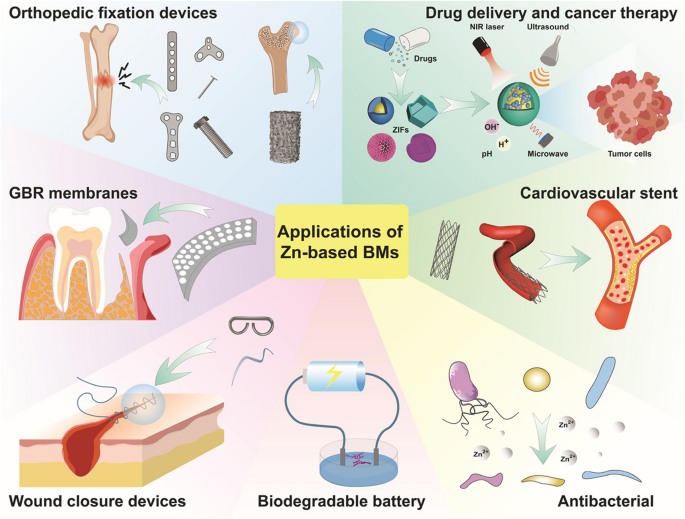
Zinc (Zn) and its alloys have been extensively investigated for orthopedic implants, cardiovascular stents, and gastrointestinal devices due to their favorable biocompatibility, moderate degradation rate, and ability to overcome the limitations of magnesium and iron-based biodegradable metals. Current research on Zn predominantly focuses on alloy design, mechanical enhancement, degradation regulation, and biocompatibility evaluation. However, the clinical translation of Zn remains constrained by adverse reactions such as cytotoxicity, inflammatory response, and bacterial infection. Surface modification is one of the pivotal strategies to address these limitations. Guided by the limitations of Zn alloy substrates, this review comprehensively summarizes the recent advances in surface modification technologies regarding degradation modulation, biocompatibility enhancement, and multifunctional coatings, and sorts out representative achievements and innovative breakthroughs. Based on this, the review discusses and anticipates the limitations and future challenges of current degradable Zn alloys and their surface modification technologies from multiple perspectives, such as multifunctional coatings, mechanical properties, structural design, and the establishment of a standardized evaluation system. It is expected that through reasonable and innovative surface design, the broader development direction and application prospects of zinc alloys in the biomedical field can be explored. This work will help researchers better understand the current research status, opportunities, and challenges of surface modification of degradable Zn alloys, and provide references for the design of personalized medical Zn devices.

Zinc (Zn) and its alloys have been extensively investigated for orthopedic implants, cardiovascular stents, and gastrointestinal devices due to their favorable biocompatibility, moderate degradation rate, and ability to overcome the limitations of magnesium and iron-based biodegradable metals.

Current research on Zn predominantly focuses on alloy design, mechanical enhancement, degradation regulation, and biocompatibility evaluation.

However, the clinical translation of Zn remains constrained by adverse reactions such as cytotoxicity, inflammatory response, and bacterial infection. Surface modification is one of the pivotal strategies to address these limitations. Guided by the limitations of Zn alloy substrates, this review comprehensively summarizes the recent advances in surface modification technologies regarding degradation modulation, biocompatibility enhancement, and multifunctional coatings, and sorts out representative achievements and innovative breakthroughs. Based on this, the review discusses and anticipates the limitations and future challenges of current degradable Zn alloys and their surface modification technologies from multiple perspectives, such as multifunctional coatings, mechanical properties, structural design, and the establishment of a standardized evaluation system.

It is expected that through reasonable and innovative surface design, the broader development direction and application prospects of zinc alloys in the biomedical field can be explored.

This work will help researchers better understand the current research status, opportunities, and challenges of surface modification of degradable Zn alloys, and provide references for the design of personalized medical Zn devices.

Follow the Topic

Metals and Alloys
Physical Sciences > Materials Science > Structural Materials > Metals and Alloys
Biomaterials
Physical Sciences > Materials Science > Biomaterials
Biomedical Materials
Physical Sciences > Chemistry > Materials Chemistry > Biomedical Materials
Corrosion
Physical Sciences > Materials Science > Surfaces, Interfaces and Thin Film > Corrosion
Dental Biomaterials
Life Sciences > Health Sciences > Clinical Medicine > Dentistry > Dental Materials > Dental Biomaterials