

How long had the fragments returned by Chang’e-6 been exposed to cosmic rays, and had they arrived at the landing site altogether or through different impacting events? We wanted to understand how impacts had excavated, mixed and redistributed material within the South Pole–Aitken (SPA) basin, the Moon’s largest and oldest known impact basin. Chang’e-6 returned local volcanic fragments alongside foreign ejecta delivered by impacts. Reconstructing their exposure histories offered a way to investigate the different journeys that had brought them together in the region.
Lunar exposure histories can be investigated through complementary records, including nanometer-sized metallic iron, radiation tracks in minerals and noble-gas isotopes. These records reflect different processes and depth ranges. Aside from these proxies, we turn to cosmic-ray-induced changes in metal stable isotopes, which could well preserve long-term irradiation histories both at and beneath the lunar surface. The challenge was that accumulated stable isotope changes reflect both exposure duration and shielding by overlying material.
The inspiration comes from our previous collaboration with Bailiang Liu on the modelling work on cosmogenic chromium (Cr). In this work, we compared Cr, whose isotope changes mainly reflect the breakup of atomic nuclei by high-energy particles, with samarium (Sm) and hafnium (Hf), which record the capture of lower-energy secondary neutrons. Their contrasting depth responses helped us separate the effect of shielding depth from exposure duration (Fig. 1).
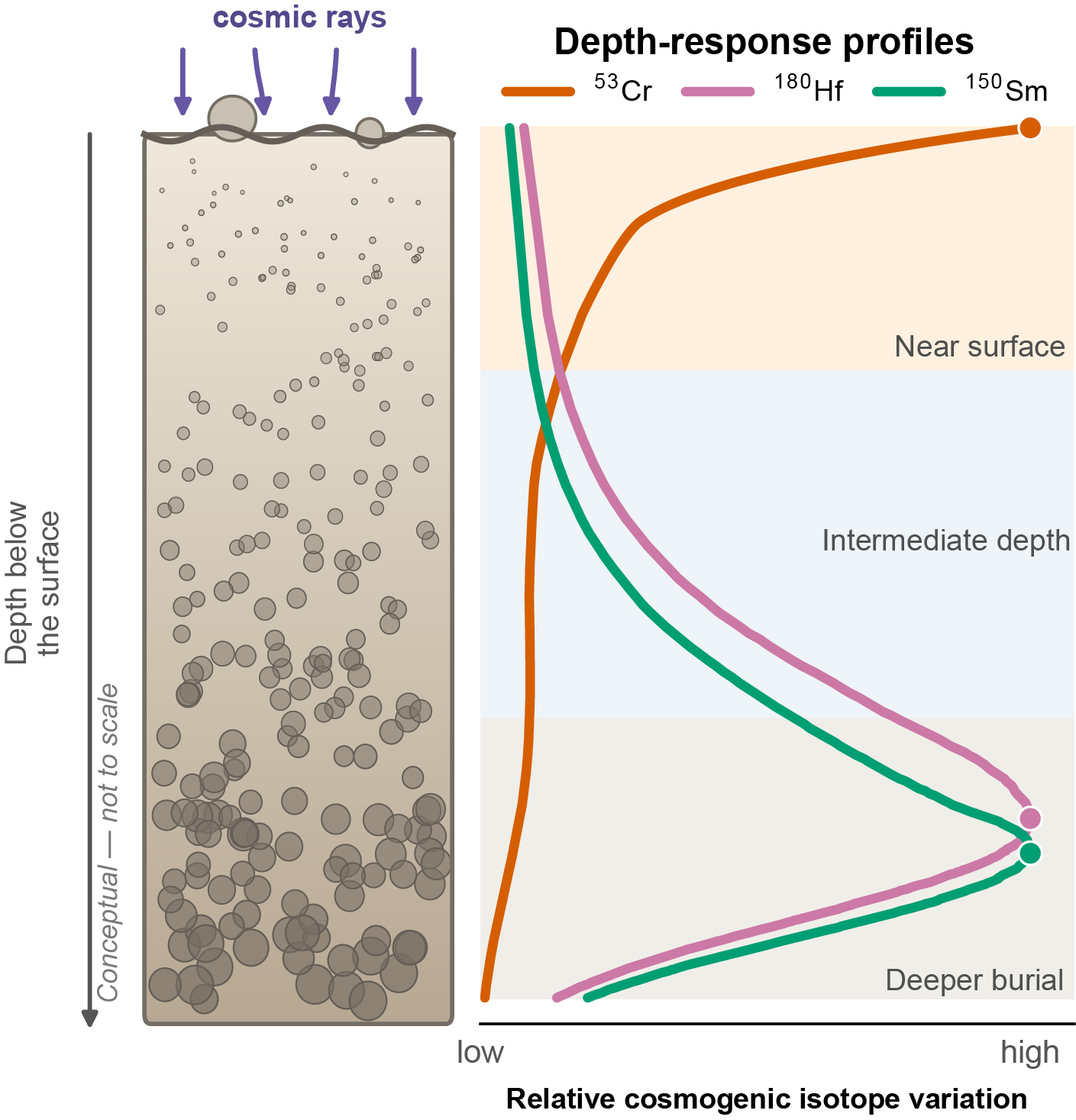
Figure 1 | Schematic illustration of cosmic-ray irradiation on the lunar surface. Different isotopes provide different views of a rock’s cosmic-ray exposure history. As cosmic rays penetrate the lunar surface, they produce different isotopic effects at different depths. 53Cr is most sensitive near the surface, whereas 180Hf and 150Sm respond more strongly at greater shielding depths.
We could now ask how exposure histories varied across the CE-6 returned samples. The soil recorded roughly 500 million years of exposure, while the fragments fell into distinct age groups. These were irradiation ages, not the ages at which the rocks formed.
As we compared the records, something beyond the age differences caught our attention. Most unbrecciated basalt fragments lay close to the predicted Sm–Hf irradiation trend, but breccias and soil often departed from it. The comparison became more intriguing when we added published Apollo measurements and found similar behaviour on the nearside. Most strikingly, KREEP-bearing breccias in both datasets tended to lie above the expected line. KREEP denotes a rock type enriched in potassium (K), rare-earth elements (REE) and phosphorus (P), representing the residual liquid of the lunar magma ocean cooling. The shared direction of the offsets suggested that the samples might have more in common than their chemistry. Our modelling showed that shielding variations alone could not account for the largest offsets. We had set out to compare exposure histories, but now needed to understand what was causing these offsets.
Mixing offered a possible explanation, but not just any mixture would do. The scenario required one component with more Sm relative to Hf (higher Sm/Hf), a longer exposure history and a stronger accumulated cosmic-ray signal. This had to mix with a lower-Sm/Hf component with shorter exposure. Because the components contributed different shares of Sm and Hf, their mixture could fall above the trend even when its ingredients originally lay close to it.
This prompted us to consider what those ingredients might have been. KREEP-bearing Mg-suite rocks, a group of magnesium-rich lunar rocks, could supply the high-Sm/Hf component, while local basalt could supply the other less-exposed component. These materials may have been mixed during impacts from meteorites or micrometeorites.
The three KREEP-bearing fragments gave us another way to investigate this idea. They formed two compositionally distinct groups, with estimated exposure histories of around 200 million years and 420–850 million years. These differences suggested separate episodes of material addition rather than a single shared history. Could we identify the impacts that delivered them? By comparing their chemistry with orbital elemental maps, their chemistry pointed towards two candidate source types in the orbital elemental map: the Mg-rich pyroxene annulus and ancient buried lava plains in the SPA basin’s central region.
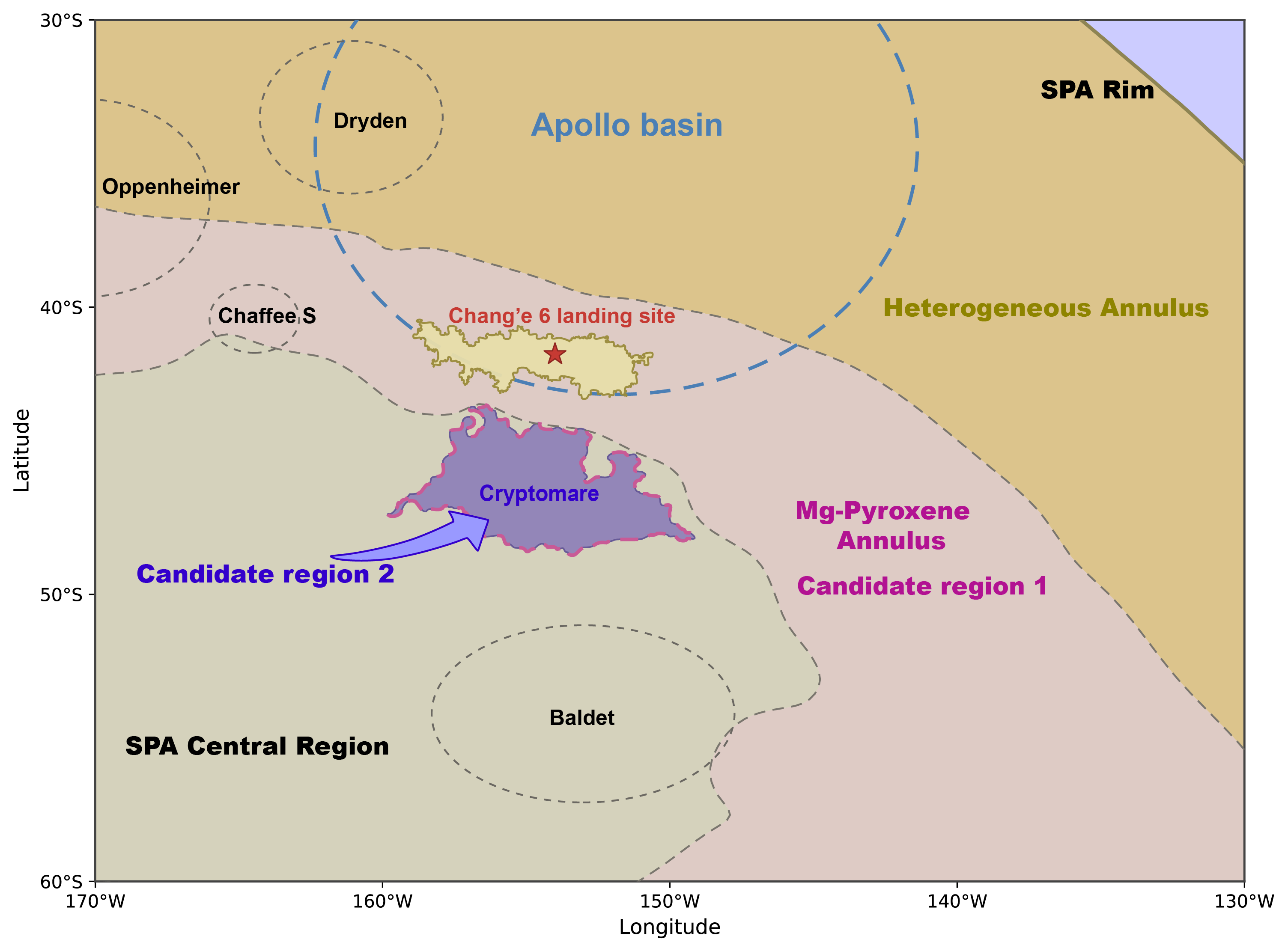
Figure 2 | Schematic illustration of the provenance of KREEP-bearing fragments. By comparing with the orbital elemental map, CE-6 KREEP-bearing clasts with different cosmic-ray exposure ages show different origins: the Mg-rich pyroxene annulus and the ancient buried lava plains (crytomare) in the central region of the SPA basin.
The chemistry offered promising matches, but the timing brought us back to the possibility of recycling. The large candidate craters had model formation ages generally much older than the fragments’ exposure ages. We could not identify a crater combining a suitable age with the size and distance required for direct delivery. Although the fragments’ inherited exposure histories were not precise arrival dates, this mismatch provided additional support for an indirect journey. Older impacts could explain the original sources, while younger impacts re-excavated and redistributed their ejecta.
These findings also connect to a broader question: why are the Moon’s two sides so different? Volcanic plains are far more widespread on the nearside than on the farside. KREEP, once thought to be absent from the lunar farside, inherited its chemical signature from the last liquid left as the Moon’s early magma ocean crystallized. That liquid also concentrated uranium and thorium, whose radioactive decay is thought to have provided a major source of heat for later melting and volcanism. The widespread presence of KREEP-bearing material across SPA suggests that its distribution may be less asymmetric than previously thought. Its preservation in ancient ejecta blankets on both sides of the Moon also provides new evidence for thermal evolution models of the Moon.
What began as a comparison of exposure ages had become an investigation of the provenance and transportation history of the clasts. The isotope patterns and orbital comparison suggest that KREEP-bearing clasts may be more widely distributed within SPA than surface maps reveal. Further comparison with Apollo samples suggests that ancient ejecta blankets could preserve KREEP-bearing material on both sides of the Moon. This shared characteristic hints at a potentially less asymmetric distribution than previously thought and may offer new clues to lunar thermal evolution.

Follow the Topic
-
Nature Communications
An open access, multidisciplinary journal dedicated to publishing high-quality research in all areas of the biological, health, physical, chemical and Earth sciences.

Related Collections
With Collections, you can get published faster and increase your visibility.
Women's Health
Publishing Model: Hybrid
Deadline: Ongoing
Data for AI, AI for Data: cross-disciplinary cleaning, processing and analysis approaches
Publishing Model: Open Access
Deadline: Dec 31, 2026


