Tracing the rhythm of sea level and marine biodiversity in a Cambrian ocean
Published in Earth & Environment


At Xiaweidian in Xishan, near Beijing, groups of rock layers form cycles about two meters thick, nested within packages about eight meters thick (Figure 1). These patterns offered a clue to the passage of time in an ancient sea. Our study, Coupled sea-level and biodiversity dynamics during the Cambrian SPICE event, connects that rock record with changes in the animals living on the seafloor.
Around 494 million years ago, the oceans experienced a major disturbance in the carbon cycle. Geologists call it SPICE, short for the Steptoean Positive Carbon Isotope Excursion. The event coincided with widespread evidence of oxygen-poor waters and changes in marine communities. Reconstructing its history means asking both what happened in the ocean and how sediment preserved the evidence.
Reading time in a rock face
River erosion and railway excavation exposed the Xiaweidian succession, where we measured about 181 meters of strata. The repeating layers led us to test an orbital interpretation. Changes in Earth's orbit affect the distribution of sunlight and can influence climate and sediment delivery to the sea.
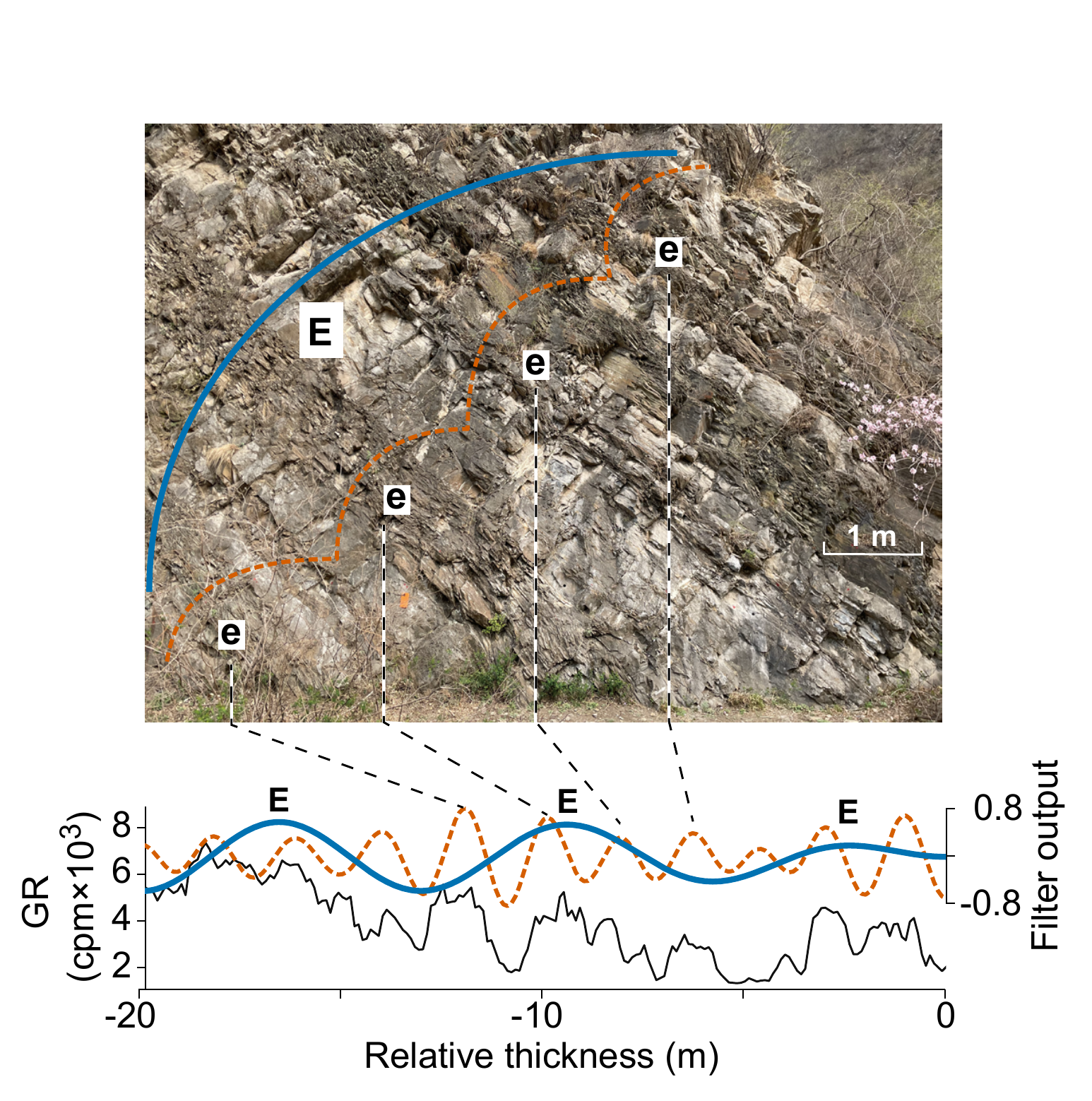
Figure 1 | Cycles visible in a Cambrian rock face. In the Zhangxia Formation at Xiaweidian, cycles about two meters thick (orange, e) are nested within larger packages about eight meters thick (blue, E). The lower curves show corresponding gamma-ray rhythms and filtered components.
We tested this interpretation using closely spaced measurements of natural gamma radiation and aluminum content, which help track material supplied from land. Comparing the two records helped us assess the proposed orbital rhythms and changes in sediment accumulation.
We used the roughly 405,000-year cycle in the shape of Earth's orbit to estimate the time represented by the layers. This approach, called astrochronology, let us convert rock thickness into elapsed time. We anchored the chronology to the adopted age of the Cambrian–Ordovician boundary. Using that chronology and the preferred endpoint, we estimate that SPICE lasted about 2.2 million years at Xiaweidian.
Why did our carbon-isotope curve look different?
Carbon comes in lighter and heavier stable forms, called isotopes. Their relative proportions in limestone can reveal changes in the ancient carbon cycle. Many SPICE records show a pronounced increase in the heavier isotope followed by a broad plateau. The Xiaweidian record had a smaller peak and lacked that prolonged plateau.
This difference raised a practical question: how much reflected the ocean's history, and how much reflected the way sediment recorded it?
The same thickness of rock can represent very different lengths of time. Sediment may accumulate quickly, slow down, or be removed by erosion. Our earlier stochastic sedimentation study explored how uneven accumulation affects the preservation of orbital rhythms. Here, we applied that perspective to a carbon-cycle event.
We fed an idealized SPICE-like signal into a model with variable sediment accumulation. The simulated records could compress the rise and broaden the decline, resembling aspects of the measured curve (Figure 2). Geochemical evidence also suggested later alteration of the limestone. The modeling provides a plausible preservation scenario for the measured curve.
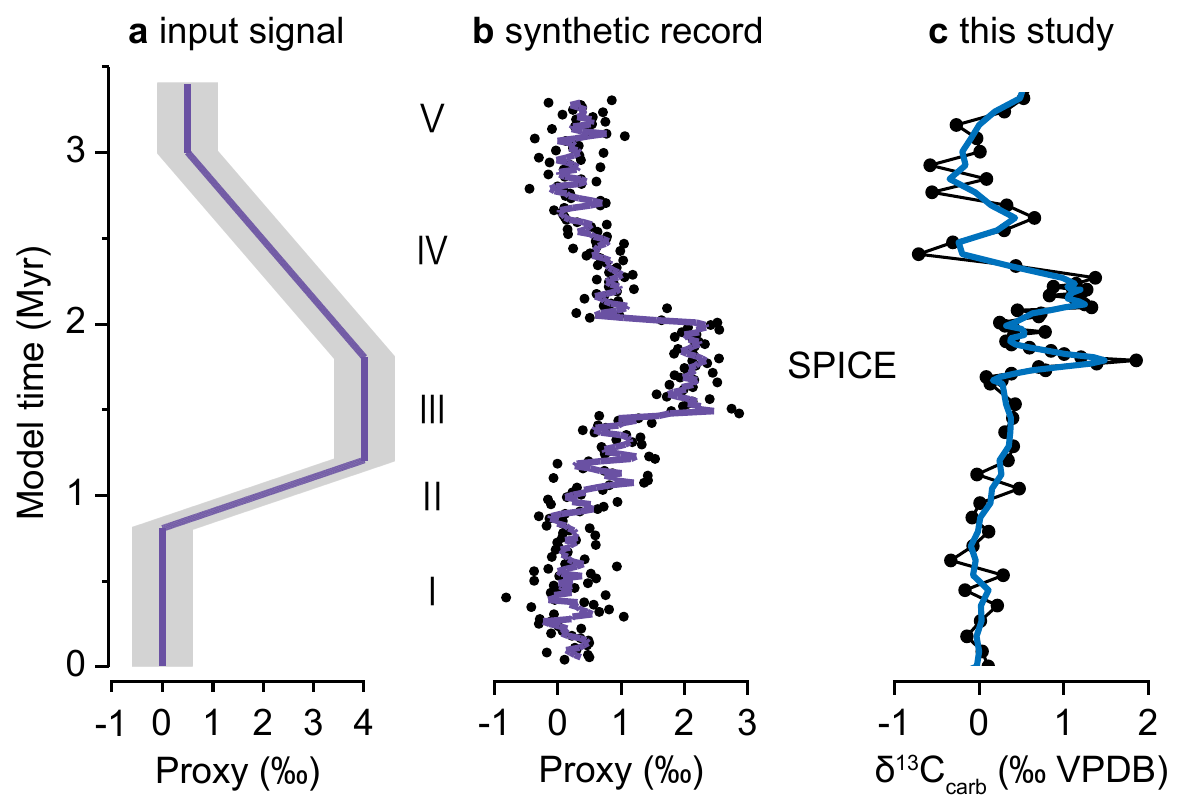
Figure 2 | How sedimentation can reshape a signal. a: an idealized SPICE-like carbon-isotope signal. b: a synthetic record generated by variable sediment accumulation. c: measurements from Xiaweidian.
Bringing fossils onto the same timeline
The biological record came from a much wider area. Our collaborators assembled published fossil occurrences across the North China Block. After checking species names and stratigraphic information, the dataset contained 307 sections and 2,152 marine species.
These records allowed us to track species richness, the number of different species present through time. We focused on bottom-dwelling, or benthic, animals, including trilobites and brachiopods.
The environmental and fossil records had independently constructed chronologies, so comparing them required careful alignment. Bringing together paleontological, sedimentary, and geochemical expertise made this comparison possible. Together, these records connect a local environmental history with a regional view of marine species richness.
A shared rhythm in an ancient sea
Variability in the sedimentary record not explained by orbital cycles provided an indirect estimate of relative sea-level change. Its broad pattern agreed with the regional history inferred from sedimentary successions. A recurring rhythm of about two million years appeared in the environmental records and benthic richness (lower panel of Figure 3). This rhythm is consistent with long-period orbital variations influenced by gravitational interactions between Earth and Mars.
Two prominent declines in richness accompanied rapid sea-level falls. A falling sea can reduce shallow marine habitats and change circulation, nutrient delivery, and oxygen conditions. These processes provide a plausible environmental explanation for the observed association.
Under our adopted chronology and alignment, the best fit placed the sea-level change proxy about 70,000 years ahead of the benthic richness record. This nominal offset compares processed proxy records; uncertainty in their chronologies and processing affects its magnitude and direction.
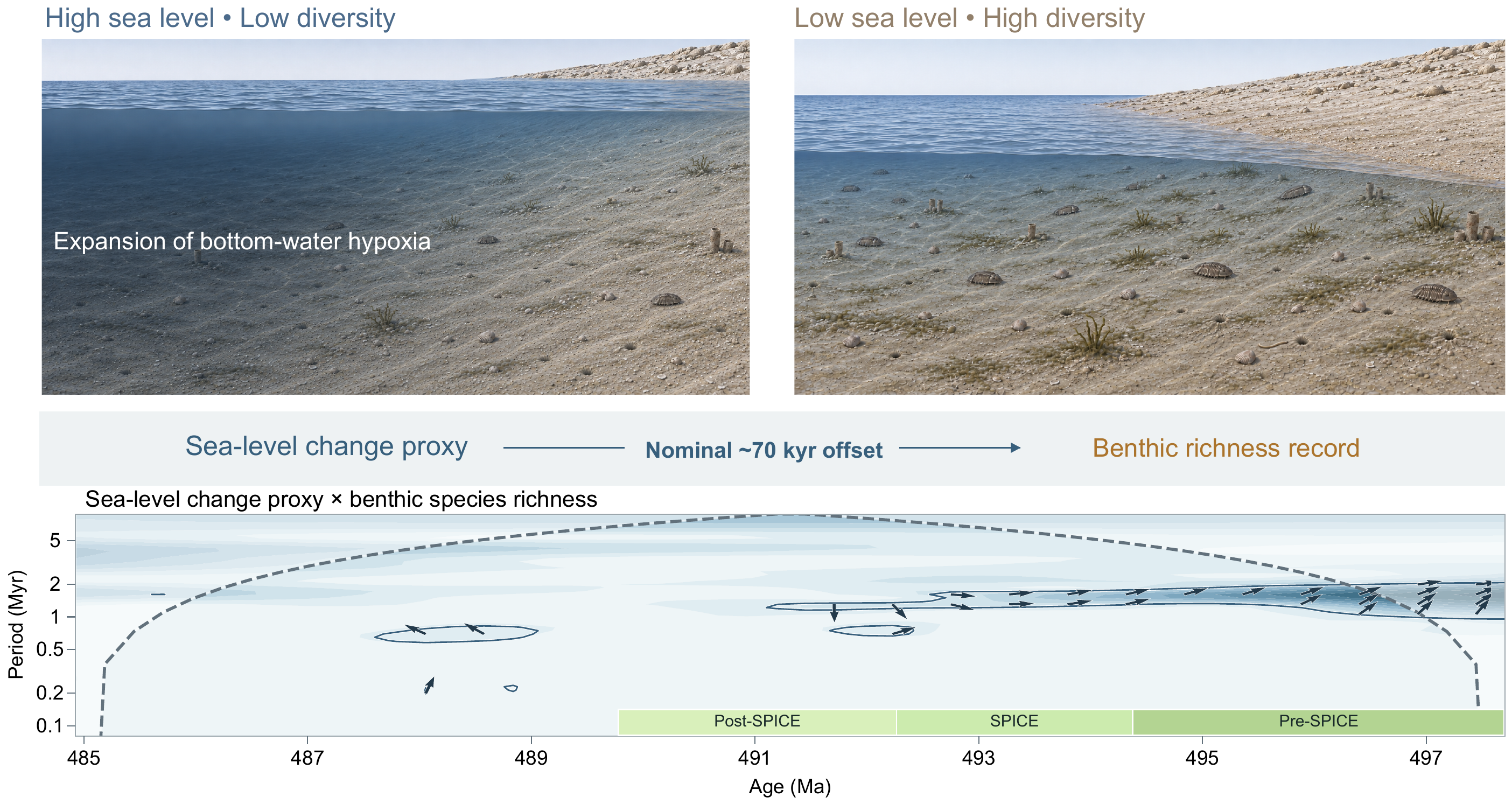
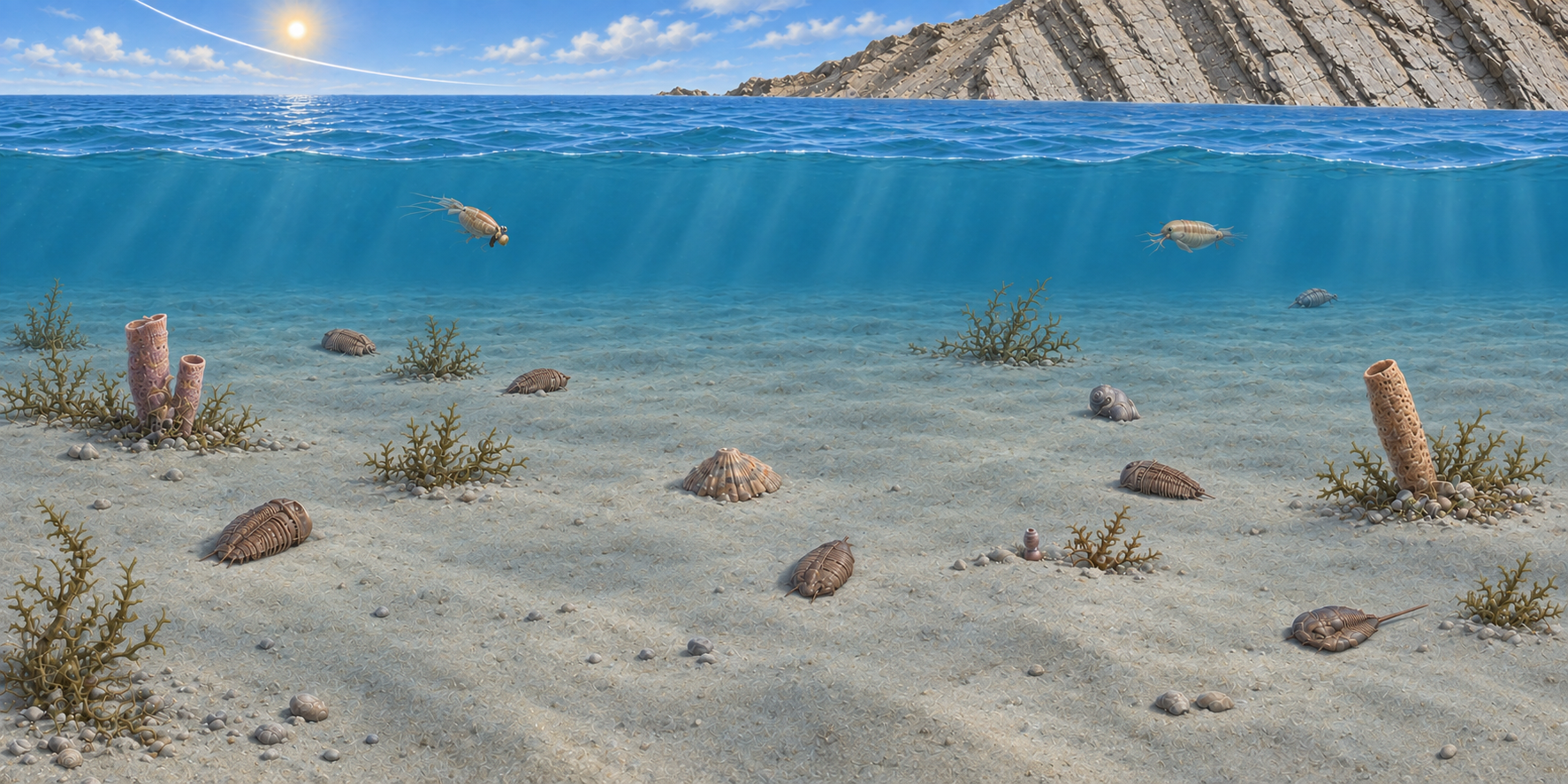
Figure 3 | Marine conditions and shared rhythms. Upper: schematic seafloor scenes illustrating contrasting sea-level and oxygen conditions. Lower: cross-wavelet analysis of the sea-level change proxy and benthic richness, which compares their shared rhythms through time.
Comparisons with other regions, together with independent evidence of oxygen conditions, offer a way to test how widely the North China pattern occurred. They can help identify which environmental changes best explain the losses of marine species.
Follow the Topic
-
Nature Communications
An open access, multidisciplinary journal dedicated to publishing high-quality research in all areas of the biological, health, physical, chemical and Earth sciences.

Related Collections
With Collections, you can get published faster and increase your visibility.
Women's Health
Publishing Model: Hybrid
Deadline: Ongoing
Healthy Aging
Publishing Model: Open Access
Deadline: Dec 31, 2026