Unmasking the Drivers of Africa’s Rising Heat Extremes
Published in Earth & Environment


https://link.springer.com/article/10.1007/s44292-025-00043-9
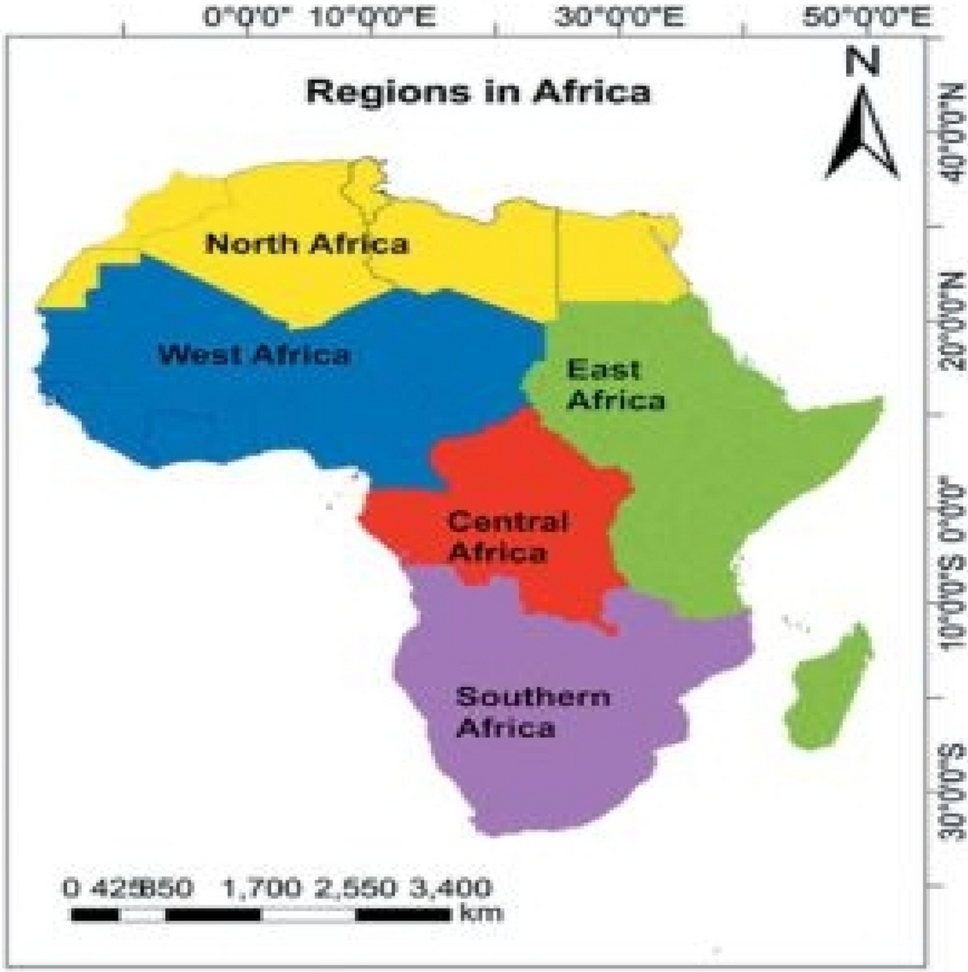
Our study investigates how multiple climate drivers greenhouse gases, aerosols, natural, and solar factors shape Africa’s rising temperature extremes from 1960 to 2100. Using CMIP6 climate models and reanalysis data, we found that greenhouse gases are the dominant cause of warming, contributing over 100% to extreme heat trends, while aerosols slightly offset this effect through regional cooling. North and West Africa are projected to experience the most severe increases in hot days and nights, with warm night frequency rising by up to 80% under high-emission scenarios. The findings highlight that even under low-emission pathways, Africa will still face significant warming impacts on agriculture, water, and health. Urgent mitigation and region-specific adaptation strategies are needed to reduce future heat risks and build resilience across the continent.

Follow the Topic
-
Discover Atmosphere
This is a fully open access, peer-reviewed journal that supports multidisciplinary research and policy developments across the fields of atmospheric and climate science.

Related Collections
With Collections, you can get published faster and increase your visibility.
Characteristics of Extreme Weather and Climate Events in Changing Environment
This Collection focuses on recent advances in understanding the changing frequency, intensity, spatial distribution, and impacts of extreme weather and climate events. Contributions addressing heatwaves, extreme rainfall, droughts, cyclones, convective storms, and atmospheric variability using observations, satellite remote sensing, reanalysis, modeling, and geospatial approaches are encouraged. Studies highlighting climate change influences, risk assessment, prediction, and adaptation strategies are particularly welcome.
Keywords: Extreme weather; Climate change; Heatwaves; Extreme rainfall; Floods; Droughts; Cyclones; Convective storms; Atmospheric variability; Remote sensing; Satellite meteorology; Reanalysis; Climate extremes; Geospatial analysis; Risk assessment; Monsoon variability
Publishing Model: Open Access
Deadline: Mar 05, 2027
Advancing Precipitation Processes: Synergizing Observations, Modeling, and Machine/Deep Learning Techniques
Precipitation is a fundamental component of the Earth's water cycle, influencing weather patterns, climate variability, ecosystems, agriculture, and water resource management. Understanding the underlying processes of precipitation formation, distribution, and intensity is crucial for addressing challenges such as extreme weather events, flood forecasting, drought mitigation, and climate change adaptation. Traditional approaches relying on observational data and numerical modeling have provided significant insights, yet persistent uncertainties remain due to the complex interactions between atmospheric dynamics, thermodynamics, and microphysical processes.
In recent years, advancements in machine learning (ML) and deep learning (DL) techniques have opened new avenues for enhancing our understanding of precipitation processes. These data-driven methods can integrate vast datasets from satellite observations, ground-based radars, weather stations, and high-resolution models to uncover patterns, improve predictions, and refine parameterizations that are difficult to capture through conventional physics-based approaches alone. This Special Issue aims to bring together cutting-edge research that bridges observational studies, numerical modeling, and ML/DL methodologies to advance the science of precipitation. We seek contributions that explore innovative integrations of these approaches to better characterize precipitation mechanisms, from cloud microphysics to large-scale atmospheric circulation.
By fostering interdisciplinary collaboration, this collection will highlight novel techniques, datasets, and findings that contribute to more accurate forecasting, risk assessment, and policy-making in a changing climate.
We welcome original research articles, review papers, case studies, and methodological advancements related to the following themes (but not limited to):
• Observational analyses of precipitation processes using remote sensing, in-situ measurements, or reanalysis datasets.
• Numerical modeling of precipitation, including improvements in parameterization schemes for convection, cloud-resolving models, and ensemble simulations.
• Applications of ML/DL for precipitation nowcasting, downscaling, bias correction, or pattern recognition in observational and modeled data.
• Hybrid approaches combining physics-based models with ML/DL for enhanced simulation and prediction of extreme precipitation events.
• Studies on the impacts of climate change on precipitation processes using integrated observational-modeling-ML frameworks.
• Validation and uncertainty quantification in precipitation studies across scales, from local to global.
• Societal and environmental implications, such as hydrological modeling, disaster risk reduction, and water resource planning informed by these approaches.
Publishing Model: Open Access
Deadline: Nov 17, 2026