Unraveling the functional dark matter in phage genomes with HIDEN-SEQ
Published in Microbiology, Cell & Molecular Biology, and Genetics & Genomics


Phages are attracting high attention across both fundamental and applied research, including as potential therapeutics against antibiotic-resistant pathogens. However, we still know surprisingly little about how phages work. When you look at almost any phage genome, most genes have no known biological function. This is true even for T4, one of the best-studied model phages, where nearly half of the genes remain uncharacterized despite decades of research1. Working in a lab with access to a large and diverse collection of phages, we constantly encountered phages with intriguing phenotypes across different bacterial hosts and growth conditions. The difficult part was therefore not finding interesting biology but having a more straightforward and systematic way to uncover the genetic basis of it.
In bacteria, this problem is routinely addressed by transposon-insertion sequencing (TnSeq), which quantifies the fitness of many thousands of transposon mutants simultaneously to identify essential and dispensable genes based on whether they tolerate insertions under specific conditions2. Despite the revolutionary impact of TnSeq on bacterial genetics, no adaptation for bacteriophages had been available even though phages have many more uncharacterized genes. This project therefore started with a simple question: Can we build a TnSeq approach for phages? From the beginning, our goal was to develop a genome-wide approach that could be readily applied across diverse phages to accelerate the functional characterization of phage genes.
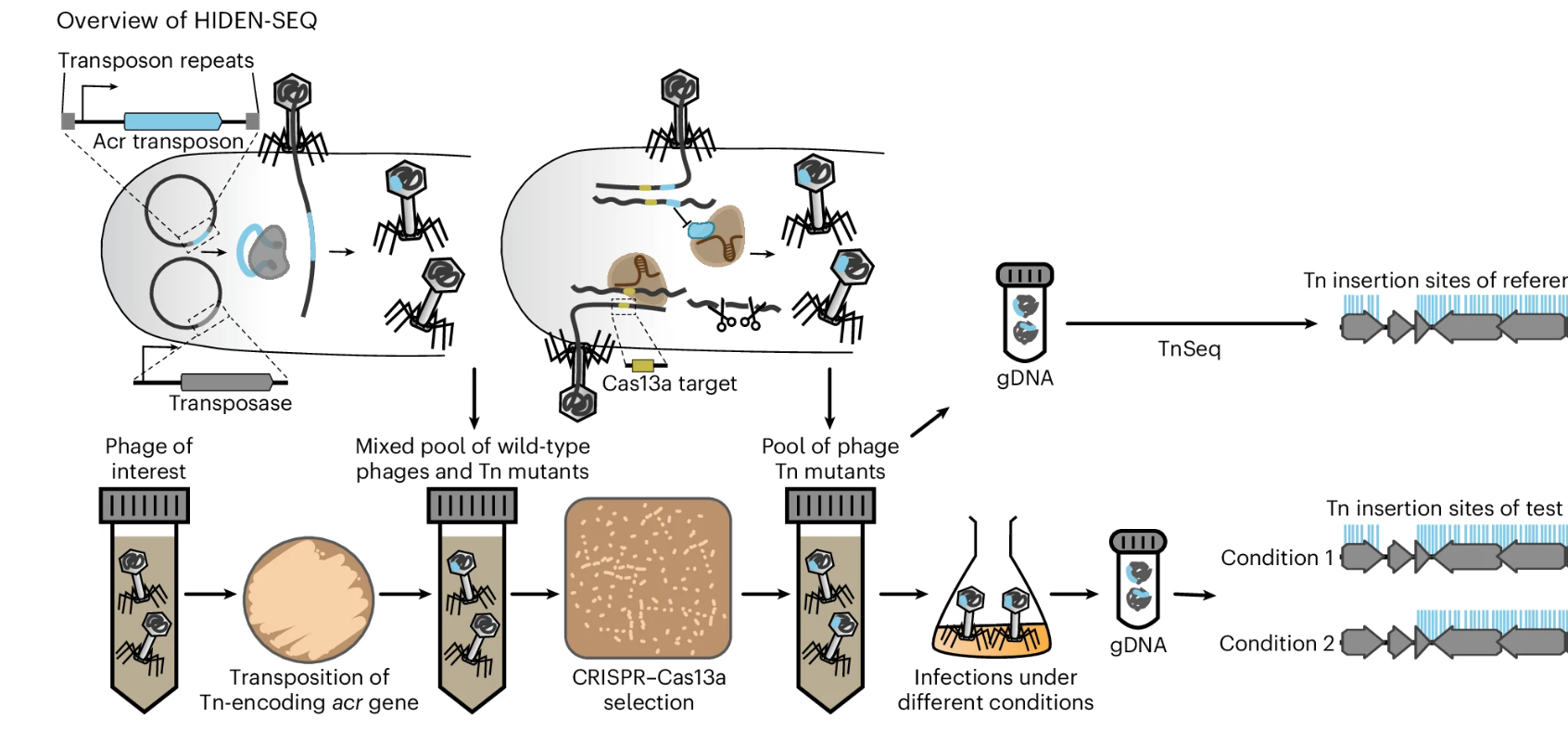
We knew that transposons can, in principle, jump into a phage genome during virulent infection of a bacterial host3. But after such an experiment, these viral transposon mutants are vastly outnumbered by wildtype phages that have not acquired the transposon. The real challenge was therefore not only to generate transposon mutants, but also to specifically select for them with high efficacy. Our solution for this problem was to place an anti-CRISPR (acr) gene inside the transposon which enabled us to use a CRISPR-Cas system for selection. The logic is simple: The bacterial host would express a CRISPR-Cas machinery directed against the target phage, so the parental wildtype phages without the transposon would be eliminated while those that had acquired the transposon would be protected by the anti-CRISPR. In a way, the experiment becomes a game of hide-and-seek: CRISPR-Cas searching for the phage and the anti-CRISPR allowing the phage to hide. This ultimately inspired the name HIDEN-SEQ (hidden Acr-enabled transposon-insertion sequencing).
We chose CRISPR-Cas13a for selection because it targets RNA transcripts and not DNA, allowing it to bypass genome protection strategies encoded by many phages. Previous work had shown that the LbuCas13a system efficiently restricts a broad range of Escherichia coli phages4. Our problem with it was that, at the time, no anti-CRISPR was known for LbuCas13a. We therefore turned to another variant called LseCas13a for which an anti-CRISPR had already been identified5. While we were setting up LseCas13a in E. coli, the project suddenly gained another possible route forward because a preprint came out describing de novo designed anti-CRISPR proteins against LbuCas13a6. This enabled us to switch between both systems and their inhibitors depending on the empirical efficacy of tested crRNAs for each phage and Cas13a variant.
Before attempting to generate a transposon mutant library, we wanted to first answer two questions using our benchmark model phage T4: Can our selected transposon jump into the viral genome? And, if it does, would the transposon-encoded anti-CRISPR be sufficient to protect the mutant phage from CRISPR-Cas13a? Our test experiment gave exactly the result we had hoped for: The wildtype T4 phage was efficiently eliminated by CRISPR-Cas13a and plaques were recovered only for the condition with transposition and a matching anti-CRISPR on the transposon. Whole-genome sequencing of several recovered viral clones confirmed that each one contained a unique transposon insertion in the T4 genome. Compared to what came later, this was still a rather modest success, but it was an important milestone for us because it showed that all individual components of HIDEN-SEQ worked together exactly as intended. For the first time, it felt like this idea might actually work! That gave us the confidence to generate the first HIDEN-SEQ library of phage T4.
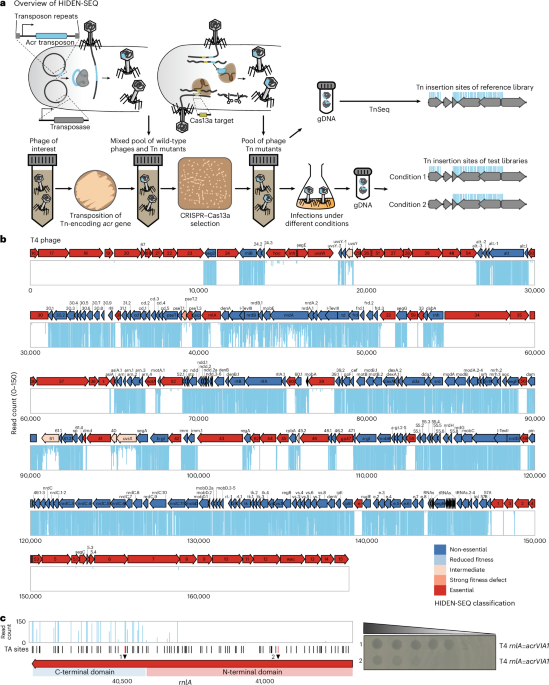
Our expectations were modest. This was not only the first phage transposon library we had ever generated but also the first time we wanted to sequence all transposon insertions in the library and not just single insertions of individual clones. We were not even sure the experiment had worked technically, let alone whether it would reveal meaningful biology. At best, we hoped the sequencing data would tell us which part of the technology needed further optimization. However, after loading our data into the TRANSIT tool7 (used for quick visualization), the pattern was immediately striking: The detected transposon insertions in our library were spread out across the T4 genome but showed obvious patterns that matched specific genes.
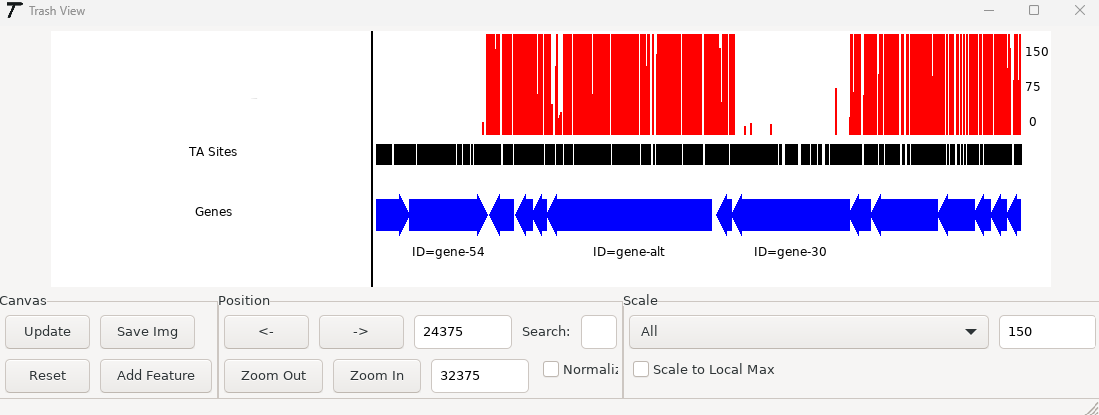
We still had no idea how well the library would match the biology, but it was clear that the experiment had worked. Even before running any statistical analyses, it was obvious that our first library could already distinguish genes that tolerated disruption from those that did not. To understand the observed pattern, we consulted the most comprehensive review of the T4 genome and began comparing it with our T4 HIDEN-SEQ map gene by gene1. Intriguingly, the agreement with the literature was remarkable. Within a single experiment, we had reproduced the gene essentiality map of phage T4 that had taken several generations of scientists and the work of numerous laboratories to assemble. Looking back, perhaps the nicest surprise is that this very first transposon insertion library of T4 accompanied us throughout the entire project and even made it to Figure 1 of the final paper.
From that point on, we knew we had a powerful tool in our hands and started extending it to other phages. One of the first things we noticed from these libraries was that many phage genes appeared to be dispensable under standard laboratory conditions. This suggested that their functions were likely to become visible only in specific biological context, and HIDEN-SEQ finally gave us the tool to explore this systematically. Applying HIDEN-SEQ across different phages and conditions led us to discover previously unknown gene functions, including several genes involved in overcoming bacterial defenses. More broadly, these experiments demonstrated how phage TnSeq libraries enable phage phenotypes to be linked to underlying genes at scale. Looking ahead, we are excited to see how phage TnSeq approaches will help bring the function of many more phage genes to light!
References
- Miller, E. S. et al. Bacteriophage T4 Genome. Microbiol. Mol. Biol. Rev. 67, 86–156 (2003).
- Cain, A. K. et al. A decade of advances in transposon-insertion sequencing. Nat. Rev. Genet. 21, 526–540 (2020).
- Woodworth, D. L. & Kreuzer, K. N. A system of transposon mutagenesis for bacteriophage T4. Mol. Microbiol. 6, 1289–1296 (1992).
- Adler, B. A. et al. Broad-spectrum CRISPR-Cas13a enables efficient phage genome editing. Nat. Microbiol. 7, 1967–1979 (2022).
- Meeske, A. J. et al. A phage-encoded anti-CRISPR enables complete evasion of type VI-A CRISPR-Cas immunity. Science 369, 54–59 (2020).
- Taveneau, C. et al. De novo design of potent CRISPR–Cas13 inhibitors. Nat. Chem. Biol. 1–9 (2026) doi:10.1038/s41589-025-02136-3.
- DeJesus, M. A., Ambadipudi, C., Baker, R., Sassetti, C. & Ioerger, T. R. TRANSIT - A Software Tool for Himar1 TnSeq Analysis. PLoS Comput. Biol. 11, e1004401 (2015).
Follow the Topic
-
Nature Microbiology
An online-only monthly journal interested in all aspects of microorganisms, be it their evolution, physiology and cell biology; their interactions with each other, with a host or with an environment; or their societal significance.