Unveiling the “Hidden Carbon Pump” in Low-Latitude Oceans
Published in Earth & Environment






An unexpected discovery
For years, oceanographers studying the mixed layer pump—a key mechanism transporting organic carbon from surface to deep ocean—have focused on high-latitude oceans. The textbook narrative was simple: strong seasonal mixing in polar regions drives carbon export, while tropical and subtropical oceans, lacking dramatic seasonal changes, contribute negligibly through this pathway.
But while analyzing BGC-Argo float data from low latitudes, we noticed something that didn’t fit: significant seasonal variations in mixed layer depth, even in regions we expected to be stable. This raised an intriguing question: could low-latitude oceans also support a significant mixed layer pump?
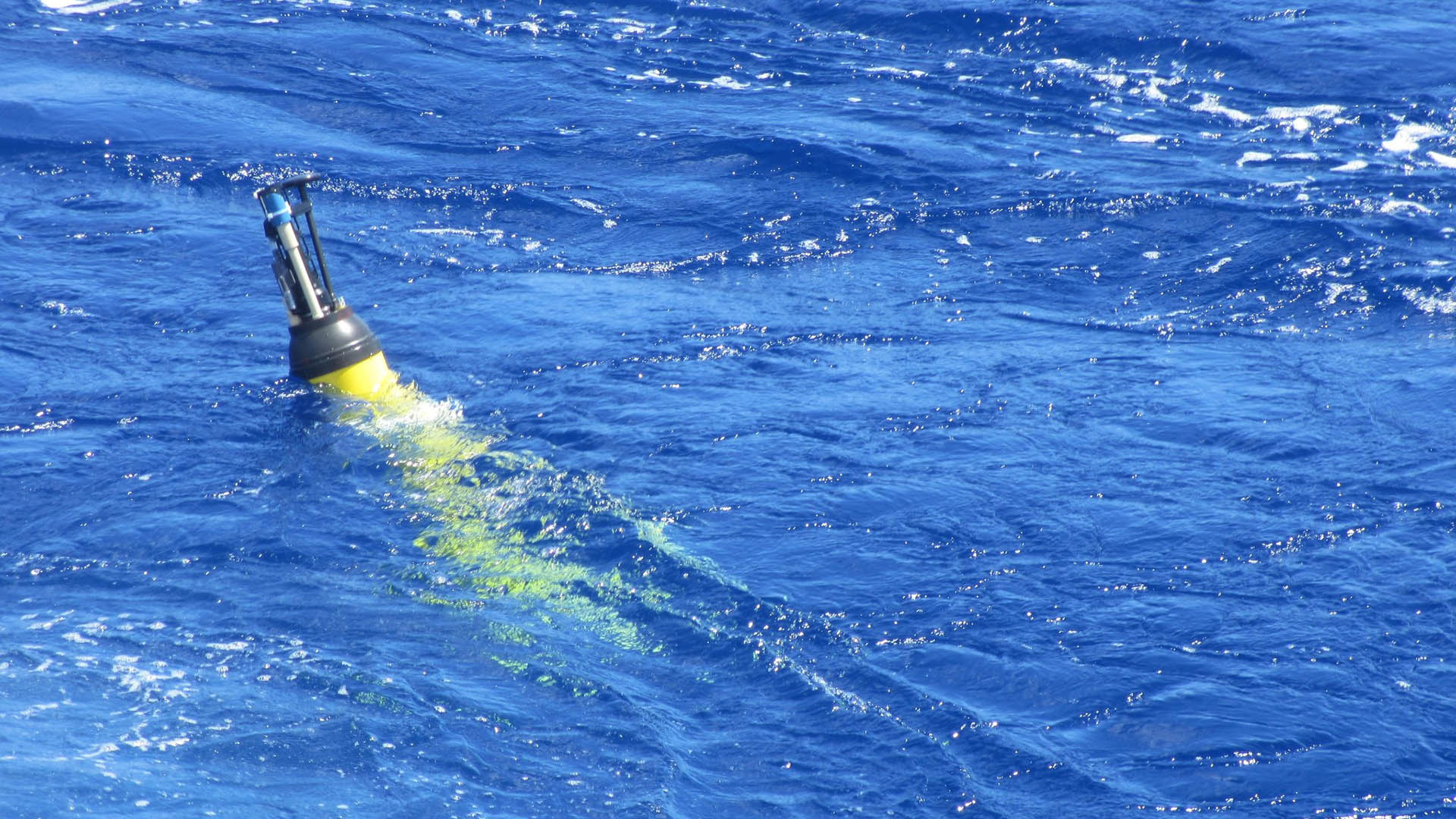
Finding from 26 floating robots
To find out, we compiled data from 26 BGC-Argo floats spanning 37 float-years of continuous observation across low-latitude oceans (35°N to 35°S). These autonomous robots dive every 10 days to measure particulate organic carbon and nitrate—observations that ship-based surveys simply cannot capture continuously.
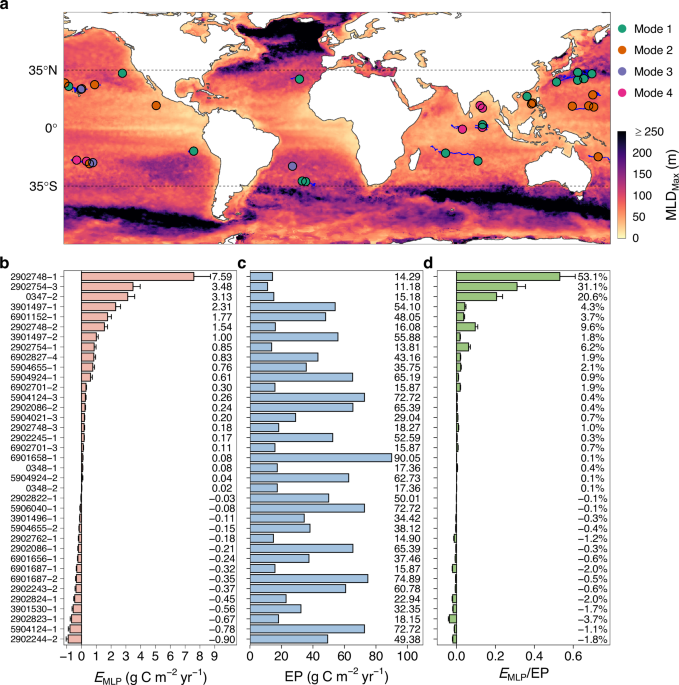
Our float-based estimates showed mixed layer pump carbon export (EMLP) ranging from −0.9 to 7.6 g C m-2 yr-1, accounting for −3% to 53% of total organic carbon export (Fig. 1). While generally lower than high-latitude values, some regions showed substantial contributions.
To scale up from point measurements, we developed a robust regression model and applied it globally. The results: basin-integrated climatological EMLP for low-latitude oceans is 0.07 ± 0.02 Pg C yr-1.
More importantly, we found that 44% of low-latitude regions had been underestimated in previous studies. The total underestimation reaches 0.03 Pg C yr-1—equivalent to 75% of previous low-latitude EMLP estimates.
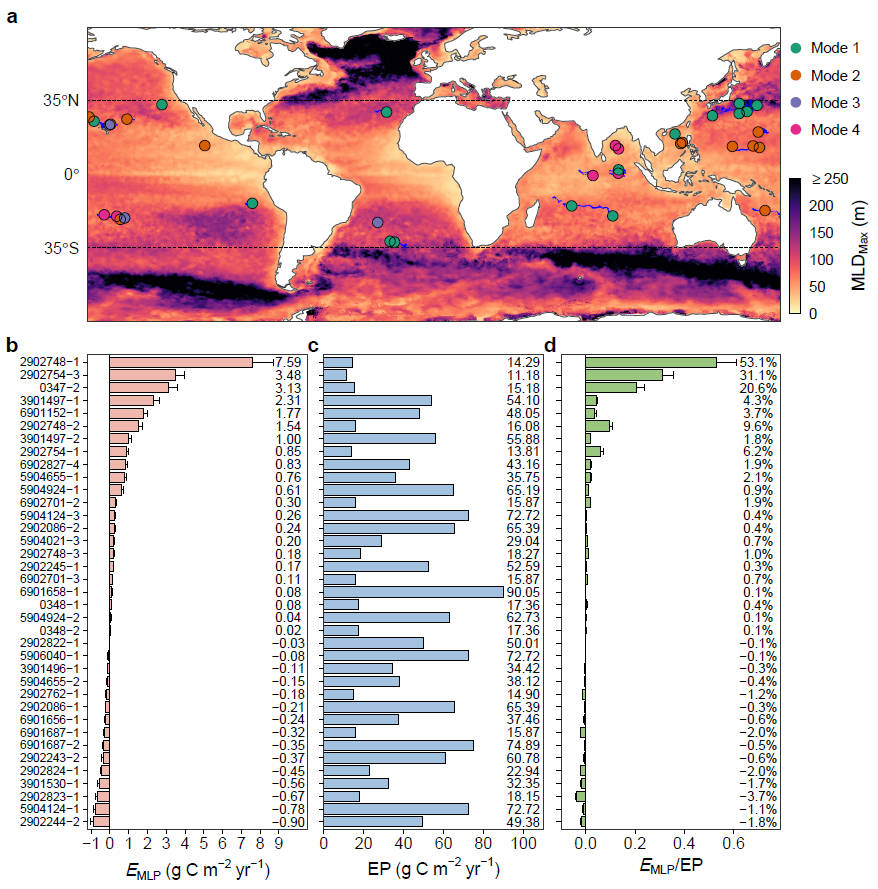
Fig. 1 Seasonal mixed layer pump (MLP) in low-latitude oceans. a Map of trajectories of 37 float-year observations. Dots indicate the median positions of each float-year, with different colors indicating distinct MLP export modes. The background color represents the annual maximum mixed layer depth (MLDMax, mean of 2016–2020) (available from E.U. Copernicus Marine Environment Monitoring Service, https://doi.org/10.48670/moi-00052 
 ). b Carbon export by the seasonal MLP (EMLP) for each float-year observation. c Total carbon export from the euphotic zone (EP). d Relative contribution of EMLP to total export production (EMLP/EP). Error bars in b and d represent 1 s.d. propagated from parameter uncertainties.
Why it matters
An export flux of 0.07 Pg C yr-1 may appear modest when compared with high-latitude carbon export. But in oligotrophic low-latitude oceans covering vast areas of our planet, even modest carbon inputs to the twilight zone are crucial for supporting mesopelagic ecosystems.
More critically, systematically underestimating carbon export pathways leads to systematic errors in our understanding of the global carbon cycle. As we refine climate models and predict future ocean carbon uptake, we need to account for all mechanisms—including those we once thought negligible.
Follow the Topic
-
Nature Communications
An open access, multidisciplinary journal dedicated to publishing high-quality research in all areas of the biological, health, physical, chemical and Earth sciences.

Related Collections
With Collections, you can get published faster and increase your visibility.
Women's Health
Publishing Model: Hybrid
Deadline: Ongoing
Tumor Microenvironment Crosstalk and Therapeutic Implications
Publishing Model: Hybrid
Deadline: Nov 02, 2026