Unveiling the Magic: Who Is Calling Back the Indian Ocea Equatorial Undercurrent?
Published in Earth & Environment

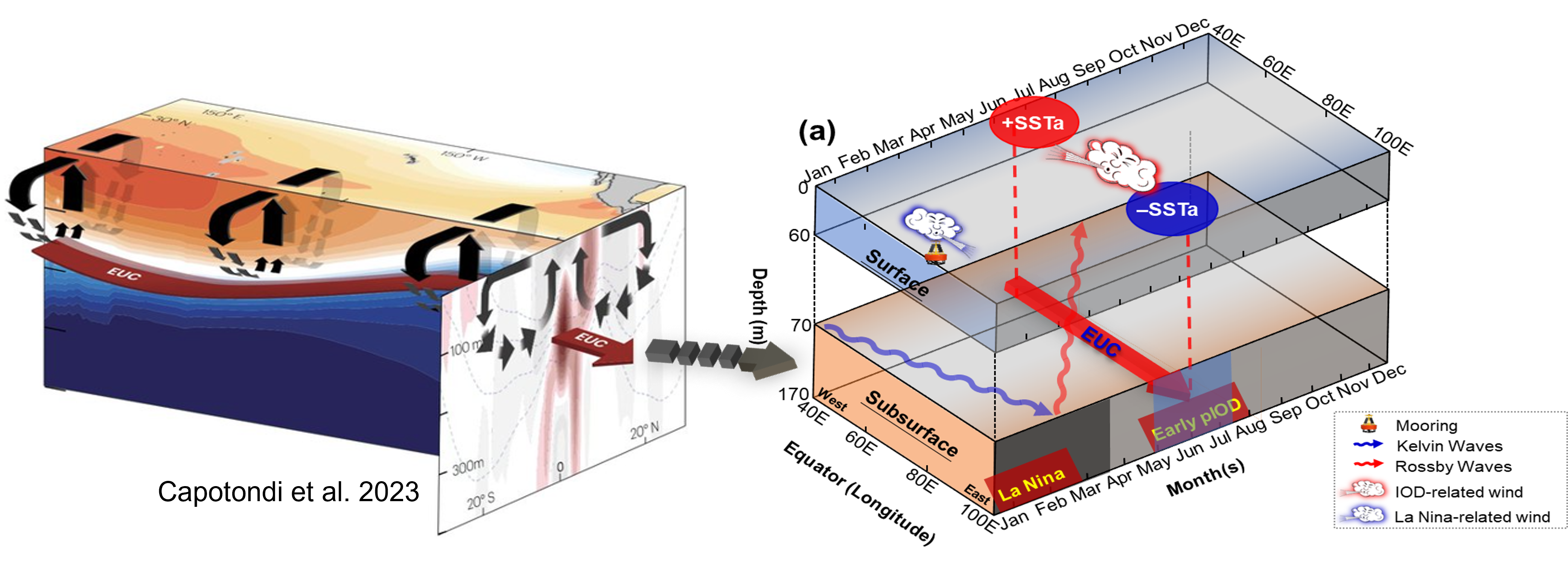

The Equatorial Undercurrent (EUC) is a concealed “submarine expressway” flowing within the tropical ocean’s thermocline, running eastward along the equator. Though only a few hundred kilometers wide, it can transport massive volumes of seawater at speeds of 0.5-1 m/s, with a volume transport comparable to the famed Florida Current. Serving as a vital conduit for the exchange of heat, salt, and nutrients in the tropics, the EUC exerts a profound influence on regional and even global circulation, climate, and ecosystems.
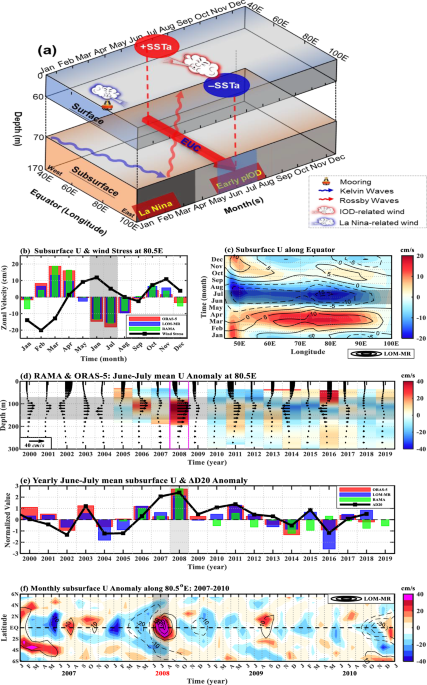
In the Pacific and Atlantic Oceans, the EUC flows almost year-round. In contrast, the Indian Ocean EUC is a master of “stealth”, appearing only in certain seasons—typically in early boreal spring and again in autumn. This unique transient behavior has long puzzled scientists: only monsoon controls the EUC’s “on-stage timing”?
A recent study from the South China Sea Institute of Oceanology, Chinese Academy of Sciences, has uncovered the answer: the disappearance and reappearance of the Indian Ocean EUC are not random events but are governed by a dual regulatory mechanism. The researchers found that when a positive Indian Ocean Dipole (pIOD) develops and matures in summer, the air-sea coupling intensifies, effectively issuing a “recall order” that brings back the EUC, which would otherwise vanish in that season.
Even more surprising, such summer re-emergence EUC events are often linked to La Niña events in the preceding winter. Acting as a hidden “magician”, La Niña triggers equatorial basin-scale ocean waves, which—through the subtle pathway of “basin propagation → boundary reflection → return propagation”—quietly store and transfer energy to the following summer, enabling the EUC’s unexpected return.
Under global warming, this magical cycle of disappearance and reappearance in the Indian Ocean EUC may occur more frequently, with potentially far-reaching impacts on the tropical climate system and marine ecosystems.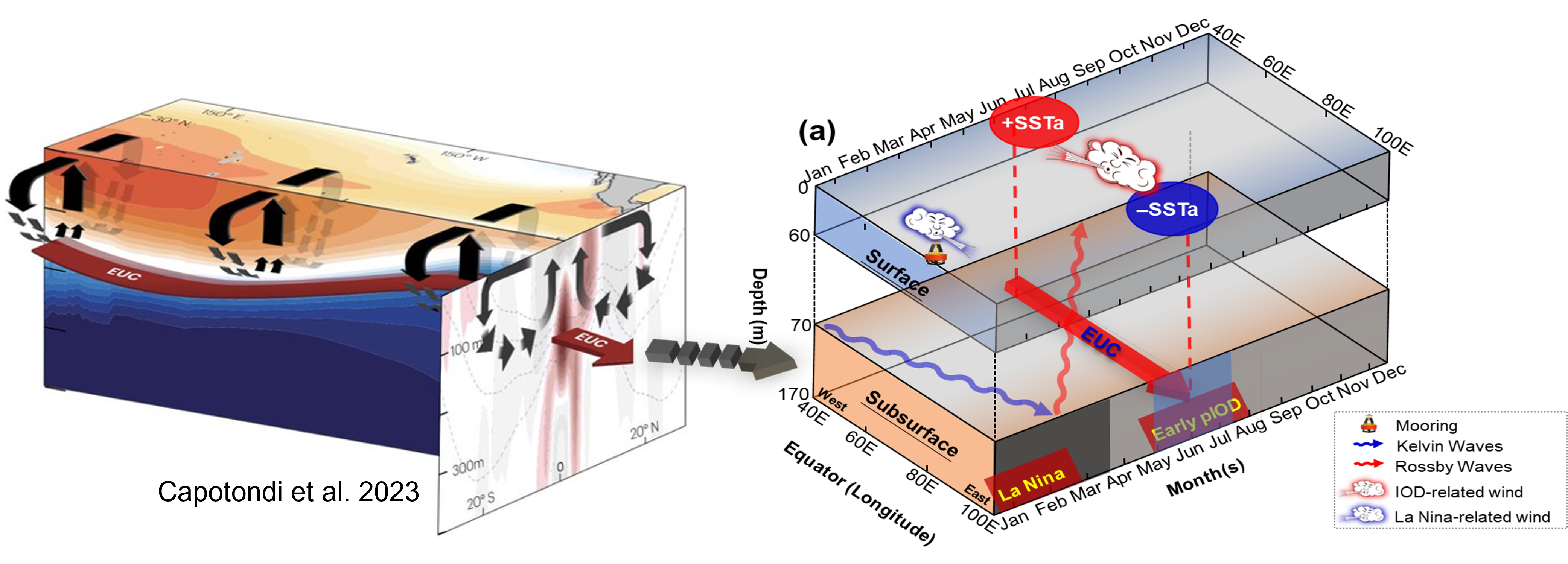
Follow the Topic
-
Communications Earth & Environment
An open access journal from Nature Portfolio that publishes high-quality research, reviews and commentary in the Earth, environmental and planetary sciences.

Related Collections
With Collections, you can get published faster and increase your visibility.
High-resolution modeling for Earth system
Publishing Model: Open Access
Deadline: Feb 07, 2027
Soil microbiomes and carbon sequestration under global change
Publishing Model: Hybrid
Deadline: Mar 18, 2027