Can stratospheric nudging improve surface predictability? Insights from the 2019 Southern Hemisphere sudden stratospheric warming
Published in Earth & Environment







A rare Southern Hemisphere stratospheric event
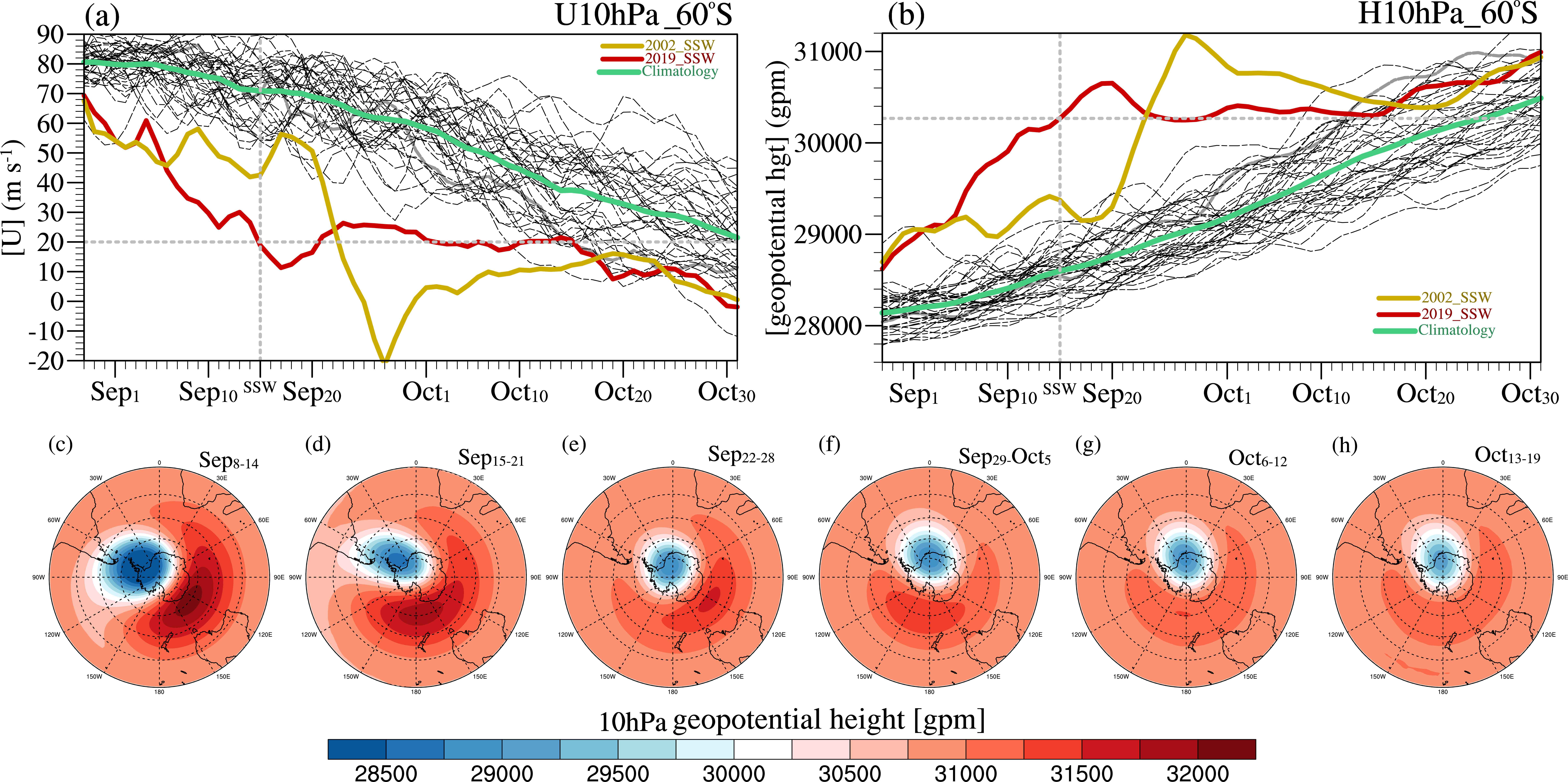
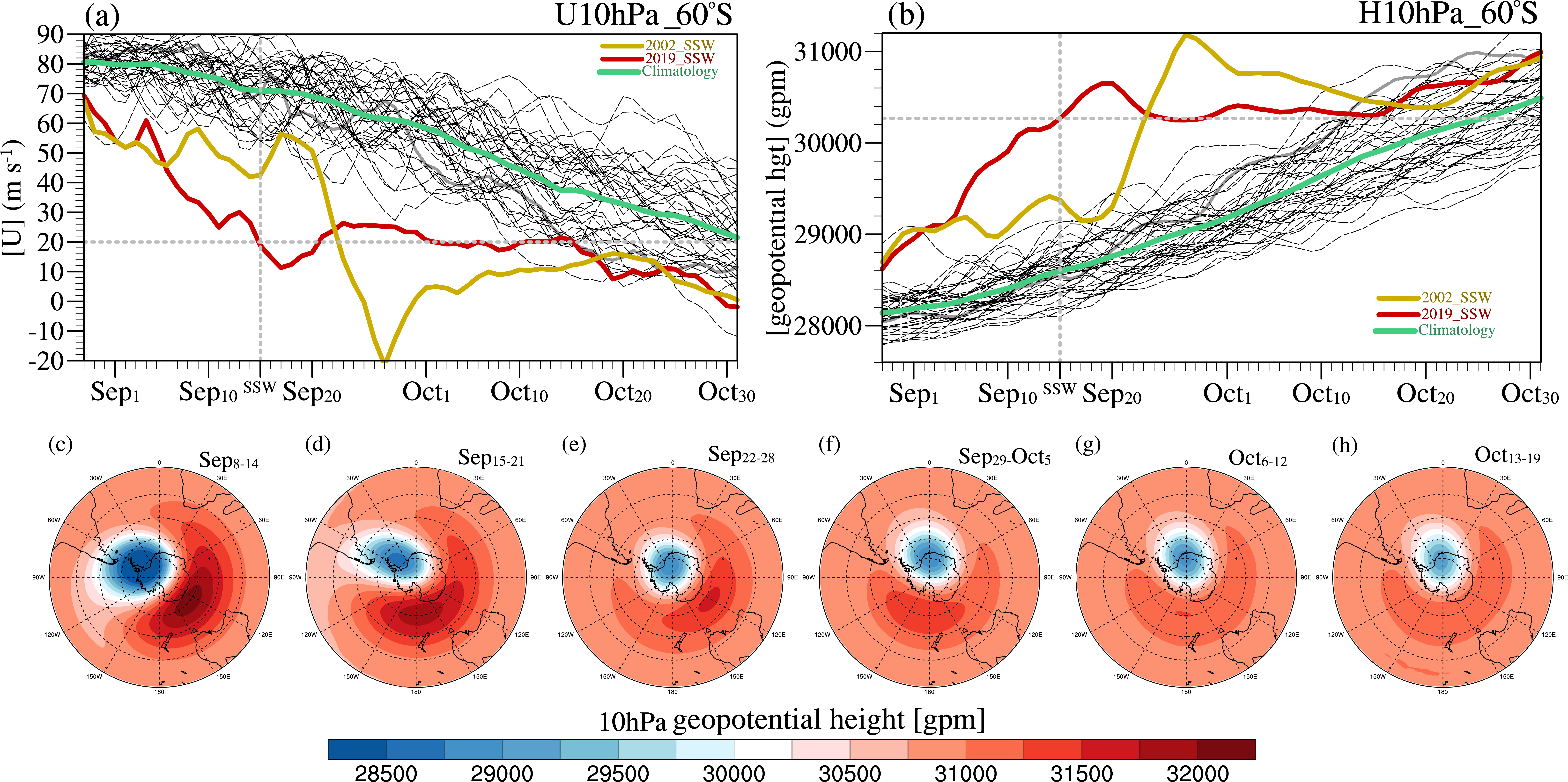
Sudden stratospheric warmings (SSWs) are well known in the Northern Hemisphere, but they are much rarer in the Southern Hemisphere. The 2019 event was therefore exceptional. Although classified as a “minor” SSW, the magnitude of the wind deceleration in the Antarctic stratosphere was comparable to some major Northern Hemisphere events (Figure 1).
This event was also unusual in its timing and persistence. The polar vortex weakened dramatically in mid-September and remained anomalous for several weeks, followed by an earlier-than-usual final warming. At the same time, Australia experienced extreme hot and dry conditions during spring, which later contributed to the devastating 2019–2020 wildfire season.
These concurrent anomalies raise an important question: how much of the surface signal was actually driven by the stratosphere?
 |
|
Figure. 1. Stratospheric circulation anomalies during the 2019 minor SSW. During the 2019 SSW, the Antarctic polar vortex is significantly weakened, accompanied by clear elongation and westward displacement, leading to a pronounced zonally asymmetric structure. |
The attribution challenge
Answering this question is not straightforward. The Australian climate during spring 2019 was influenced by multiple factors, including a strong Indian Ocean Dipole and background variability. In standard forecast systems, all components of the atmosphere evolve freely, making it difficult to isolate the specific role of the stratosphere.
Even when models simulate the SSW, they may not accurately reproduce its timing or structure. As a result, differences in surface forecasts may reflect both stratospheric errors and unrelated tropospheric variability. This makes it challenging to determine whether the stratosphere actively contributed to surface predictability or simply co-varied with it.
To address this, a more controlled experimental framework is required.
Using SNAPSI to isolate the stratospheric signal
The SNAPSI (Stratospheric Nudging and Predictable Surface Impacts) project was designed to tackle exactly this problem. It provides coordinated multi-model experiments with large ensemble sizes and consistent initialization strategies.
A key feature of SNAPSI is the use of stratospheric nudging. In these experiments, the zonal-mean wind and temperature in the stratosphere are relaxed toward observations, while the troposphere evolves freely. This allows us to constrain the stratospheric state while still permitting internal variability in the lower atmosphere.
By comparing these nudged simulations with standard free-running forecasts, we can directly assess how sensitive surface predictions are to the stratospheric conditions. In other words, SNAPSI enables a quantitative estimate of the stratospheric contribution to surface climate.
Improved representation of the 2019 SSW
When we examine forecasts initialized after the onset of the 2019 SSW, a clear difference emerges between the free and nudged simulations. In the free runs, many models underestimate the persistence and magnitude of the stratospheric anomalies. In particular, the negative Southern Annular Mode (SAM) signal in the stratosphere is often too weak and does not propagate downward realistically.
In contrast, the nudged simulations capture the observed stratospheric evolution much more accurately. The persistent negative SAM signal in the stratosphere is maintained and subsequently descends into the troposphere, consistent with reanalysis. As a result, the timing and magnitude of the tropospheric SAM are better represented.
This improvement provides a more realistic large-scale circulation background for assessing surface impacts.
Impacts on Australian surface conditions
The improved stratospheric representation in the nudged experiments leads to clear differences in surface climate over Australia. In particular, the nudged simulations show stronger warm and dry anomalies over eastern Australia, consistent with observations.

These anomalies are linked to changes in the large-scale circulation. The negative SAM phase enhances high-pressure conditions over Australia, suppressing precipitation and favoring hot and dry weather (Figure 2). In addition, zonally asymmetric variations in the stratosphere—associated with the displaced polar vortex—further modulate the regional circulation and precipitation patterns.
As a result, the nudged simulations produce rainfall and temperature patterns that are closer to observations than those in the free runs. This indicates that an improved representation of the stratosphere leads directly to improved surface forecasts in this case.
 |
|
Figure. 2. Observed and forecasted t2m anomalies. (b1–i1) Free-running forecasts. (b2–i2) Symmetric stratospheric signal. (d3, e3) Asymmetric stratospheric signal. The symmetric signal induces warm anomalies over eastern Australia. These anomalies are further enhanced when models capture the westward displacement of the polar vortex. |
Quantifying the stratospheric contribution
A key advantage of the SNAPSI framework is that it allows us to move beyond qualitative interpretation and quantify the stratospheric impact. By comparing the nudged and control simulations, we estimate that the stratospheric state contributed substantially to the surface anomalies during this event.
This is further supported by the analysis of wildfire weather risk. Using the Hot Dry Windy (HDW) index, we find that constraining the stratosphere increases the simulated risk of extreme wildfire conditions over eastern and southern Australia. The Fraction Attributable Risk analysis suggests that the stratosphere contributed up to around 30% of the increased wildfire weather risk during this period.
These results provide direct evidence that the 2019 SSW played an active role in shaping surface climate, rather than being a passive or coincidental feature.
What does this mean for prediction?
Our results highlight the importance of accurately representing the stratosphere in subseasonal prediction systems. Even when the troposphere is initialized realistically, errors in the stratosphere can lead to significant uncertainty in surface forecasts.
The SNAPSI experiments demonstrate that constraining the stratosphere can improve the simulation of large-scale circulation and, in turn, surface climate. This suggests that better observations, data assimilation, and model representation of the stratosphere could enhance forecast skill, particularly for extreme events.
More broadly, the 2019 SSW provides a clear example of how stratospheric variability can influence surface predictability in the Southern Hemisphere. By using coordinated experiments to isolate this effect, we can better understand—and ultimately improve—the role of the stratosphere in climate prediction.
For details, refer to:
Feng, K., Rao, J.*, Garfinkel, C.I. et al. Can stratospheric nudging improve surface predictability? Insights from the 2019 Southern Hemisphere sudden stratospheric warming. npj Clim Atmos Sci 8, 353 (2025). https://doi.org/10.1038/s41612-025-01234-2
Follow the Topic
-
npj Climate and Atmospheric Science
This journal is dedicated to publishing research on topics such as climate dynamics and variability, weather and climate prediction, climate change, weather extremes, air pollution, atmospheric chemistry, the hydrological cycle and atmosphere-ocean and -land interactions.

Related Collections
With Collections, you can get published faster and increase your visibility.
Atmosphere-Biosphere Interactions
Publishing Model: Open Access
Deadline: Oct 31, 2026
AI-Driven Innovation in Atmospheric Chemistry and Composition–Climate Interactions
Publishing Model: Open Access
Deadline: Oct 31, 2026

