Wearable Electronics for Precision Diagnosis Through Advanced Manufacturing and Integration
Published in Healthcare & Nursing, Bioengineering & Biotechnology, and Materials
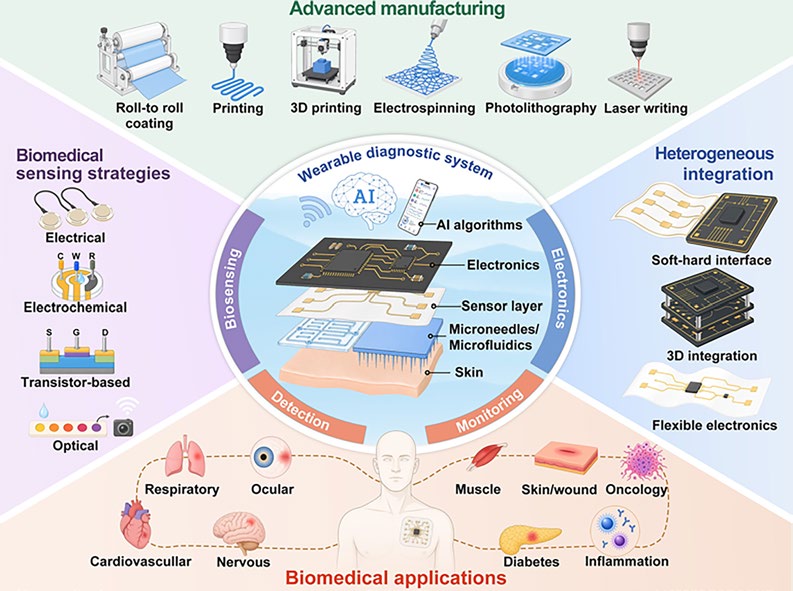

As chronic diseases continue to pose major global health challenges, conventional medical diagnosis remains largely dependent on intermittent measurements taken in clinical settings, making it difficult to capture dynamic physiological changes and detect early signs of disease. Researchers from the University of South China, Technion–Israel Institute of Technology, and Sun Yat-Sen University have reviewed recent advances in wearable electronics, highlighting how advanced manufacturing, heterogeneous integration, multimodal sensing, and artificial intelligence (AI) are transforming wearable devices into promising platforms for continuous, personalized precision diagnosis.
Why This Technology Matters
Traditional diagnostic approaches often provide only snapshots of an individual’s health, potentially overlooking subtle changes that develop between clinical visits. Wearable diagnostic systems address this limitation by continuously monitoring physiological signals and molecular biomarkers directly on the body. By combining information from different sensing modalities and tracking changes against personalized physiological baselines, these systems can help identify abnormalities earlier, improve disease risk assessment, and support more individualized healthcare decisions.
Innovative Design and Mechanism
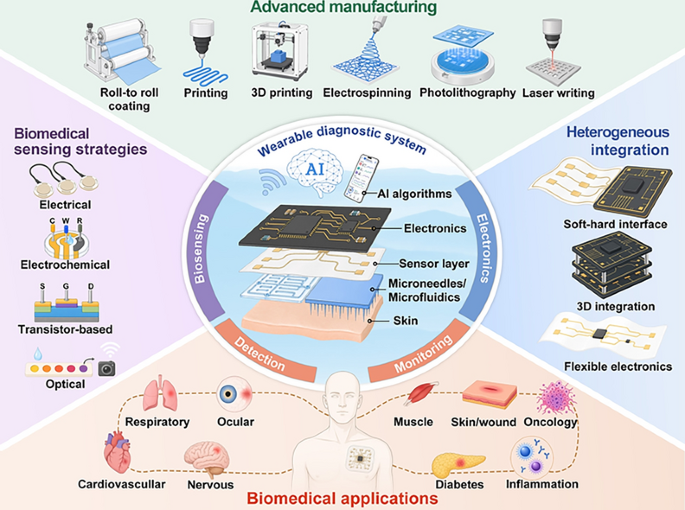
The review examines four major sensing strategies: electrical, electrochemical, transistor-based, and optical sensing. Each offers distinct advantages, from recording electrophysiological activity and monitoring physical changes to detecting metabolites, proteins, hormones, and other molecular biomarkers in sweat, saliva, tears, interstitial fluid, and other biological samples. Advanced manufacturing techniques—including printing, coating, photolithography, three-dimensional fabrication, and laser writing—enable the precise construction of flexible sensing components. Heterogeneous integration then combines sensors, electronic circuits, power supplies, and wireless communication into compact, skin-conformal systems. AI-enabled algorithms process these complex data streams, extract meaningful features, identify abnormal patterns, and support real-time interpretation.
Outstanding Performance
The reviewed wearable platforms demonstrate broad potential across neurological, cardiovascular, respiratory, ocular, musculoskeletal, oncological, diabetic, and inflammatory conditions. By integrating multiple signals rather than relying on a single biomarker, these systems can provide a more comprehensive picture of physiological status. Examples discussed in the review include wearable platforms for cardiac monitoring, continuous biochemical analysis, and disease-associated biomarker detection. Some AI-assisted devices can also distinguish clinically relevant patterns from background physiological activity, illustrating how wearable electronics can progress beyond simple data collection toward intelligent health assessment.
Applications and Future Outlook
Despite these advances, several challenges must be addressed before widespread clinical adoption. Long-term sensor stability, motion artifacts, biofouling, signal drift, interference from complex biological samples, and differences between individual users can compromise measurement reliability. Integrating flexible sensing materials with rigid electronic components while maintaining low power consumption and dependable wireless communication also remains difficult. Future progress will require scalable manufacturing, robust biointerfaces, improved multimodal data fusion, and AI models validated across diverse populations and real-world conditions. Ultimately, the convergence of advanced manufacturing and intelligent data analysis could help establish wearable electronics as accessible tools for early disease detection, longitudinal health monitoring, and personalized medical management.

Editor of Nano-Micro Letters, which is an Open-Access, peer-reviewed journal reported papers that have at least one dimension ranging from a few sub-nanometers to a few hundreds of micrometers. The journal is published by Springer Nature and indexed by SCI, EI, SCOPUS, Pubmed, etc. The 2025 JCR Impact Factor is 38.5. The 2025 CiteScore is 58.9.
Follow the Topic
-
Nano-Micro Letters
Nano-Micro Letters is a peer-reviewed, international, interdisciplinary and open-access journal that focus on science, experiments, engineering, technologies and applications of nano- or microscale structure and system in physics, chemistry, biology, material science, and pharmacy.