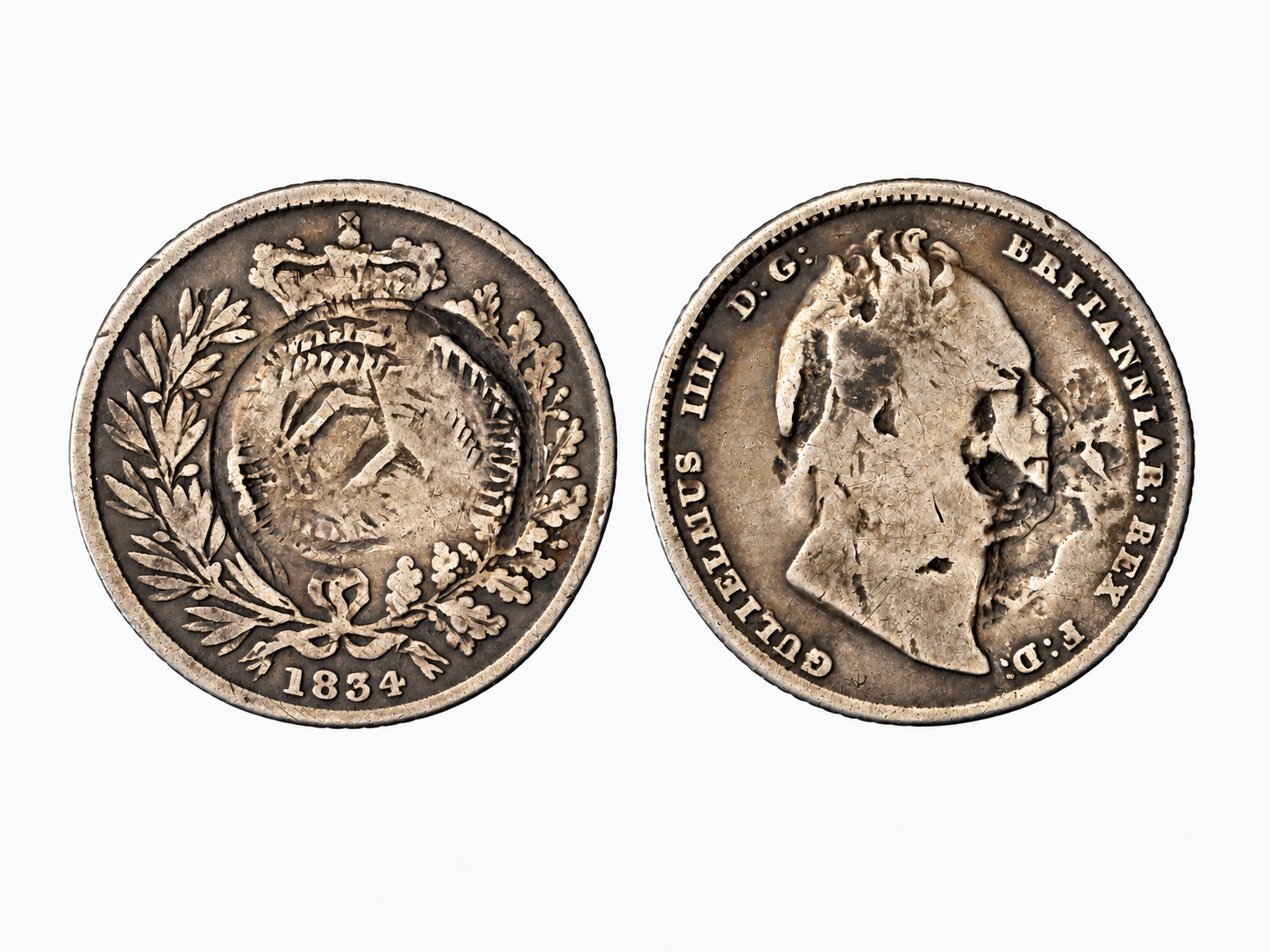
What happened to this 1834 sixpence? From visual uncertainty to physical evidence
Published in Social Sciences, Materials, and Computational Sciences

Explore the Research
 Nature Publishing Group
Laboratory investigation of a deformed 1834 William IV sixpence
npj Heritage Science - Laboratory investigation of a deformed 1834 William IV sixpence
When I first began examining an unusually deformed 1834 William IV sixpence, the main question was not simply what could be seen on its surface. It was how to determine when and how those features had formed.
The coin had been found in a mixed coin album acquired at a car-boot sale in Greater Manchester. Its appearance was striking, but unusual appearance alone cannot establish whether deformation happened during manufacture or much later.
Early external image-based assessments generally favoured post-mint damage. A later specialist in-hand assessment also did not accept the mint-stage explanation I was considering.
Rather than treating those views as obstacles, I found them useful. They sharpened the central question: could evidence obtained directly from the specimen distinguish severe later damage from deformation associated with the original striking process?
The investigation ultimately led to a peer-reviewed study in npj Heritage Science. Taken together, the physical evidence favours interpretation of the coin as a severe mint-stage striking anomaly. Reaching that conclusion, however, required moving beyond visual interpretation.
Before the laboratory
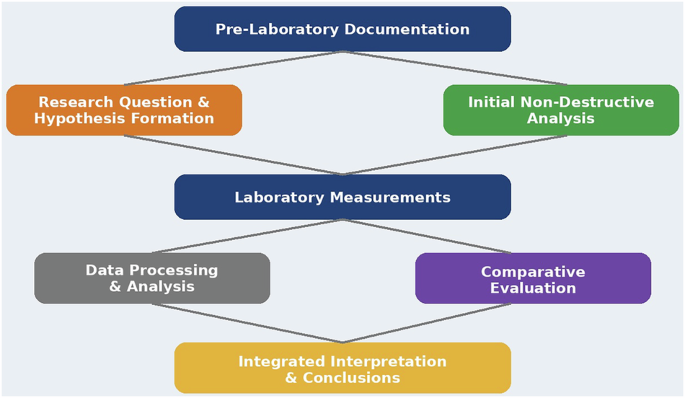
I began with high-resolution imaging, detailed observation and comparative review.
Computational and AI-assisted tools were also used under human supervision. Their role was not to decide what had happened to the coin. They helped me organise observations, compare possibilities, challenge assumptions and develop working hypotheses.
That distinction became increasingly important.
An AI system can suggest possible explanations for an unusual feature, but a suggestion is not a physical measurement. It cannot determine the elemental composition of a specimen or measure its surface topography simply by reasoning from photographs.
For me, the more interesting question became whether AI could be useful within a research process in which its outputs remained provisional and could later be tested against independently produced evidence.
Moving from images to physical measurement
To obtain physical data from the specimen, I independently commissioned two forms of laboratory analysis.
SEM–EDX materials characterisation was carried out through the Experimental Techniques Centre at Brunel University of London. Optical surface profilometry was carried out through the Oxford Materials Characterisation Service in the Department of Materials at the University of Oxford.
Those facilities produced the analytical measurements. Their provision of laboratory services did not constitute institutional endorsement of my later interpretation; interpretation of the resulting datasets in relation to the specimen remained my responsibility as the author.
This distinction mattered because the laboratory work was not intended simply to confirm an earlier idea. The measurements provided an independent physical basis against which the competing explanations could be assessed. They were considered alongside the earlier imaging record, comparative observations and historical context.
Some explanations became less plausible. Others could be narrowed or refined.
What I found particularly useful was the chronology. The pre-laboratory record preserved questions and hypotheses that existed before testing, while the later physical measurements constrained how far those ideas could reasonably be supported.
What the evidence supports
The resulting study was published in npj Heritage Science on 24 September 2026 as “Laboratory investigation of a deformed 1834 William IV sixpence.”
Peer-reviewed paper:
https://doi.org/10.1038/s40494-026-02901-0
The combined physical evidence favours interpretation of the specimen as a severe mint-stage striking anomaly rather than ordinary wear, corrosion or a single unconstrained later impact.
That does not mean every mechanical step responsible for the coin’s present form can be reconstructed with certainty.
The paper retains an important qualification: later constrained compression cannot be excluded absolutely. The evidence is therefore better understood as narrowing the range of physically plausible interpretations rather than providing a complete reconstruction of everything that happened to the coin.
That became an important lesson from the project. A scientific interpretation is not strengthened by claiming more than the evidence can support.
Where AI fitted — and where it did not
AI-assisted reasoning continued after the laboratory work, helping with organisation, comparison of earlier and later interpretations, and research preparation.
But its evidential role did not change.
AI did not generate the SEM–EDX measurements. It did not perform optical profilometry. It did not conduct peer review. And it did not independently determine the scientific conclusion.
The physical measurements constrained what interpretations could reasonably be supported, while final synthesis and responsibility for interpretation remained human.
This changed how I thought about human–AI collaboration. A useful research workflow should not require AI to be correct at every stage. It should allow AI-assisted hypotheses to be questioned, narrowed or rejected while preserving a traceable record of how reasoning developed.
What came next
Project 001 later informed the development of the IA STUDIO Hybrid Reasoning Framework, which I formalised as Edition 1.1.
The framework separates four roles within object-based investigation: empirical measurement, documentary evidence, computational interpretive support and final human interpretation.
It is model-agnostic and is intended to keep those evidential roles explicit and traceable rather than tying the methodology to any particular AI system.
A fixed archival record of Edition 1.1 is available on Zenodo:
https://doi.org/10.5281/zenodo.23117680
The framework itself is not presented as independently validated across multiple investigations. Future cases will provide opportunities to assess its usefulness, limitations and transferability.
For me, the significance of Project 001 extends beyond determining what most likely happened to one unusual sixpence.
The project documented a progression from uncertainty, through competing explanations and independent physical measurement, to an interpretation constrained by evidence.
It also illustrated a principle that may have wider relevance to AI-assisted research: computational systems can help generate, organise and challenge ideas without being treated as substitutes for empirical observation.
In that sense, the coin became more than the subject of the investigation. It became a documented case for a way of working in which hypotheses can remain provisional, independent evidence can challenge or narrow earlier interpretations, uncertainty can be retained rather than concealed, and AI can contribute to reasoning without being mistaken for the evidence itself.
Follow the Topic
-
npj Heritage Science
This journal will consider original research papers for the scientific study of heritage, based primarily on physical, chemical and biological measurements and / or computations.