What Happens to the Brain After 15 Minutes of Scrolling?
Published in Biomedical Research





From an everyday habit to a research question
It is an increasingly familiar routine: we pause what we are doing, open social media for a few minutes, scroll through a feed, and then return to studying, working, or another task that requires our attention.
But do we return to that task in exactly the same cognitive state?
Much of the discussion around social media has focused on long-term screen time, problematic use, mental health, or academic performance. We wanted to ask a more immediate question: what happens to executive functioning shortly after a brief period of social media use?
Executive functions are the cognitive processes that help us hold information in mind, resist inappropriate responses, stay focused on a goal, and adapt our behavior. These abilities are particularly important when we are studying, solving problems, making decisions, or simply trying to return our attention to work after a distraction.
The challenge was finding a way to study this question without completely removing social media from the context in which people actually use it.
Making the experiment feel more like real life
A major consideration in designing the study was ecological validity.
Instead of showing every participant the same standardized collection of social-media images, participants assigned to the social-media condition opened their own Instagram accounts and spent 15 minutes scrolling through their personal “Following” feed.
There was one important restriction: they could scroll, but they could not like, comment, message, or post. We wanted to preserve the personalized experience of social-media consumption while limiting the additional cognitive and emotional processes introduced by active social interaction.
Designing the control condition was just as important.
We did not simply ask control participants to sit quietly for 15 minutes. They also scrolled through an Instagram-style feed, but instead of their personal content, they viewed a curated collection of black-and-white nature images, captions, and silent videos selected to provide comparatively neutral and emotionally uncharged content.
Neither group received audio stimulation.
This meant that both groups experienced screen viewing, scrolling, the passage of 15 minutes, and repeated cognitive testing. One of the central differences was therefore the nature of the content: a personalized stream of socially meaningful information versus relatively neutral passive scene viewing.
That comparison became particularly interesting when we examined what happened from before to after the scrolling period.
The change between groups was the key
One of the most important findings was not simply that the two groups performed differently after the intervention. It was that their performance changed differently over time.
Participants completed executive-function tasks both before and after the 15-minute scrolling period, allowing us to examine a group × session interaction.
In simple terms, we asked: Does the change from before to after scrolling depend on what participants were scrolling through?
For inhibitory control, the answer was yes.
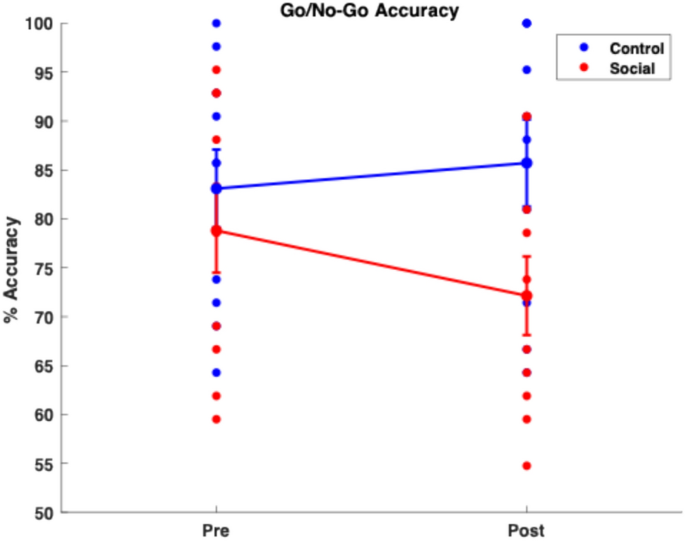
In the Go/No-Go task, participants had to respond quickly to frequent “Go” stimuli while withholding their response when a “No-Go” stimulus appeared. After the 15-minute period, participants who had scrolled through their personal Instagram feed showed reduced correct-rejection performance, whereas participants in the neutral-viewing control group showed improved performance on the repeated task.
The resulting group × session interaction was significant.
The behavior of the control group is particularly informative here. When people perform the same cognitive task a second time, some improvement can occur simply because they have become familiar with the task. That is broadly what we observed in the neutral-viewing group. In contrast, participants who had just scrolled through their personal feeds moved in the opposite direction on inhibitory control.
This comparison suggests that the result cannot simply be explained by repeating the cognitive test.
For working memory, the behavioral picture was more subtle. We did not observe a statistically significant difference in change scores between groups, although the effect size suggested a potentially meaningful difference. Interestingly, the neural data told us more.
Looking beneath behavior with wearable neuroimaging
Another important part of this study was where—and how—we measured brain function.
Rather than conducting the experiment inside a traditional scanner environment, data were collected in a quiet private room in a student residence building—a setting much closer to where college students might actually scroll through social media between everyday activities.
We used wearable functional near-infrared spectroscopy, or fNIRS, to measure changes in cortical hemodynamics across the prefrontal cortex while participants completed the executive-function tasks.
This work builds on our broader effort to bring functional neuroimaging into more naturalistic environments. In a related study published in npj Digital Medicine, “Wearable fNIRS platform for dense sampling and precision functional neuroimaging”, we evaluated this wearable platform for repeated, individualized functional brain measurements and demonstrated that dense sampling across sessions can substantially improve the reliability of individualized functional-connectivity estimates.
For the present study, the portability of fNIRS allowed us to ask a different question: could we capture changes in the neural systems supporting executive function around an ordinary digital behavior?
The answer revealed a pattern that was more complex than simply “more” or “less” brain activity.
The brain seemed to be switching strategies
We found significant group × session effects in prefrontal activation during both the working-memory and inhibitory-control tasks.
Following social-media exposure, activity increased in the medial prefrontal cortex (mPFC), a region involved in processes including performance monitoring and regulation of cognitive effort.
At the same time, activity decreased in lateral prefrontal regions important for executive control. These included the dorsolateral prefrontal cortex (dlPFC), involved in maintaining and manipulating information and supporting top-down control, and the ventrolateral prefrontal cortex/inferior frontal gyrus (vlPFC/IFG), which plays an important role in response inhibition and conflict resolution.
This combination caught our attention.
Rather than suggesting that the brain had simply become globally “less active,” the findings point toward a potential redistribution of cognitive processing: greater recruitment of regions associated with monitoring and effort alongside reduced recruitment of systems important for working memory and inhibitory control.
This was especially interesting in the working-memory task. Behavioral performance did not differ significantly between groups, yet prefrontal activation did.
One possibility is that participants were able to maintain similar outward performance while requiring a different pattern of neural recruitment to do so. In other words, behavior alone may not always reveal the cognitive cost of maintaining performance.
Why might a personal feed be different from looking at neutral scenes?
This raises an obvious question: why would scrolling through a personal Instagram feed produce a different effect from scrolling through neutral nature content?
We cannot answer that mechanism directly from this study, but neuroscience offers some intriguing possibilities.
A personal social-media feed is not simply a sequence of visual stimuli. It is continuously changing and personalized. It can contain familiar people, unexpected information, socially relevant cues, emotionally meaningful content, and signals associated with social approval or reward.
Previous neuroimaging studies of social-media behavior have shown that socially salient feedback—such as receiving or viewing highly endorsed Instagram content—can recruit neural circuitry involved in reward processing, including regions such as the nucleus accumbens. Reward circuitry is involved not only in pleasure, but also in anticipating, evaluating, and responding to potentially rewarding information.
A personalized feed may therefore place very different demands on attention, salience, and reward-related processing than passive viewing of neutral scenes.
One possibility is that repeatedly orienting toward novel, personally meaningful, and potentially rewarding information makes the subsequent transition back to a structured cognitive task more demanding. The brain must shift from an environment characterized by rapidly changing and personally salient information to one that requires sustained attention, maintenance of task rules, working memory, and suppression of automatic responses.
That interpretation is intriguing in light of what we observed: poorer inhibitory performance together with altered recruitment of prefrontal systems involved in cognitive control.
However, this remains a hypothesis rather than a mechanism demonstrated by our experiment. fNIRS measures cortical hemodynamic activity and does not provide access to deeper structures such as the nucleus accumbens. We also did not manipulate reward directly. Future studies combining naturalistic digital behavior with broader neuroimaging measures could test this possibility more directly.
What this study does—and does not—tell us
Studies about social media and the brain can easily be reduced to dramatic conclusions. We think the more interesting interpretation is also the more careful one.
Our results do not mean that 15 minutes of Instagram “damages the brain.”
They do not establish that every type of social-media use has the same effect, or tell us what happens after months or years of use.
Our study included only 20 college students, with 10 participants in each condition. We examined a single brief period of passive Instagram use. Participants' personal feeds also naturally differed from one another—a limitation from the perspective of experimental control, but also an important feature of studying social media as it is actually experienced.
Active interaction, different platforms, different types of content, individual patterns of use, and longer or shorter exposure periods could all produce different results.
Instead, we see this study as pointing toward a question that deserves more attention:
Can even a brief digital experience influence how effectively the brain transitions into the next cognitively demanding activity?
Moving beyond “How much screen time?”
For us, one broader lesson is that questions about digital behavior may need to become more precise.
Rather than asking only:
“How much time do people spend on social media?”
we may also need to ask:
What kind of content are they consuming?
Is that content personally meaningful or emotionally salient?
Are they passively scrolling or actively interacting?
What are they trying to do immediately afterward?
And do different individuals respond differently to the same type of digital experience?
Future studies with larger and more diverse samples can begin to separate these factors and investigate how long any cognitive or neural changes persist.
Portable neuroimaging technologies may make it increasingly possible to study these questions not only in laboratories, but also in the environments where digital behavior naturally happens.
Ultimately, our goal is not to label social media as simply “good” or “bad.” It is to better understand how everyday digital experiences interact with cognition—and why those effects may vary across people and contexts.
Perhaps the more useful question is not simply how many minutes we spend scrolling, but what kind of cognitive state we carry with us when we stop.
Our findings suggest that the transition from a personalized, engaging digital environment back to a task requiring cognitive control deserves much closer attention.
The next time we put down our phones and return to work, the brain may still be in the process of switching gears.
Follow the Topic
-
Scientific Reports
An open access journal publishing original research from across all areas of the natural sciences, psychology, medicine and engineering.

Related Collections
With Collections, you can get published faster and increase your visibility.
Phytochemicals and health
Publishing Model: Open Access
Deadline: Oct 28, 2026
AI in clinical decision-making
Publishing Model: Open Access
Deadline: Feb 28, 2027





Please sign in or register for FREE
If you are a registered user on Research Communities by Springer Nature, please sign in
I would question the broad interpretation of these findings because my own experience with social media is quite different. When I engage in long, demanding or tedious tasks, I sometimes use social media briefly as a way of unwinding and mentally resetting. Rather than leaving me cognitively impaired, a short period of social-media use can provide a psychological break from sustained concentration and reduce the monotony associated with prolonged work. I may return to the task feeling refreshed, more motivated and better able to concentrate.
The study itself may not fully capture this possibility because it examines 15 minutes of social-media exposure in isolation, rather than social-media use as part of a person's broader pattern of work, fatigue and recovery. The important question may therefore not be whether social media temporarily alters executive functioning, but whether the context in which it is used determines whether that alteration is beneficial, neutral or detrimental.
For example, scrolling through highly stimulating, emotionally charged content immediately before an important cognitive task could potentially make it harder to re-engage. However, using social media deliberately as a short break during a long and tedious activity may serve a different function; similar to taking a walk, having a conversation, listening to music or simply stepping away from the task. In such circumstances, the break itself may help restore attention.
I would therefore be cautious about interpreting reduced inhibitory-control performance after 15 minutes of Instagram use as evidence that social media is inherently detrimental to cognition. The study involved only 20 participants, and the authors themselves acknowledge that it does not establish long-term effects or demonstrate brain damage.
In my view, a more meaningful question is what people were doing before the social-media break, what they were viewing, why they chose to use social media, and what they did afterwards. Someone using Instagram to escape briefly from a mentally exhausting task may experience it very differently from someone compulsively scrolling through emotionally stimulating content for 15 minutes. Thus, individual purpose and context may be just as important as the duration of exposure.
Ultimately, I would not dismiss the study's findings, but I would resist the implication that a short period of social-media use necessarily leaves people cognitively worse off. My experience suggests that, when used intentionally as a brief psychological break from prolonged and tedious work, social media can sometimes function as a mental reset rather than merely a cognitive distraction. The challenge for future research is to determine when social-media use disrupts cognition and when it may actually facilitate recovery from sustained mental effort.
Thanks for this thoughtful comment. We actually agree with much of what you are saying especially that the context and purpose of social-media use are likely to matter.
One important point is that our findings are at the group level. They describe the average pattern we observed across participants, but that certainly does not mean everyone responds to social media in the same way. There can be considerable person-to-person variability in both cognitive and neural responses and understanding those individual differences is something we think deserves much more attention.
We also did not design this study to test social media specifically as a “recovery break” after a long or mentally exhausting task. We can imagine that the outcome might look quite different in that situation. For example, someone who has been working intensely for an hour and then spends a few minutes looking at relaxing, enjoyable, or socially connecting content may actually benefit from stepping away from the task. Our hypothesis is that the type of content, the reason for using social media, and the person's cognitive and emotional state beforehand could all influence whether that break ends up being helpful or disruptive.
Interestingly, the emotional findings in our own study were much less negative than the executive function findings. We did not find a significant overall worsening of emotional state after social-media use and there was even a small pattern suggesting that happiness was relatively better preserved in the social-media group than in the neutral-viewing group. We would not make a strong conclusion from that given the small sample and non-significant group difference, but it is another reason we do not think the story is simply that social media is “bad.”
So we completely agree that our findings should not be interpreted as saying that 15 minutes of social media will make every person cognitively worse. What we showed was that, under the specific conditions we tested, the group who scrolled through their personal Instagram feeds showed a different pre-to-post pattern in inhibitory control compared with the group viewing neutral content.
For us, one of the most interesting next questions is exactly the one you raise: when does social media make it harder to switch back to a demanding task and when might it actually help someone reset? That probably depends on the person, what they were doing beforehand, why they opened social media, what they saw while scrolling and what they need to do afterward.
Thanks again for raising this. It adds an important perspective to the discussion.
Good luck with your research! I am sure your findings will contribute meaningfully to humanity and hopefully make a real difference.
By the way, have you ever thought about the potential impact of playing chess instead of scrolling through one’s Instagram feed? I wonder what your research might reveal about the effects on the brain, concentration, and overall well-being.
Personally, I play chess to unwind too.
Cheers!!!!