What Moss Taught Us About Air Quality Near Oregon Airports
Published in Earth & Environment




Why is the Research Valuable?
When people think of environmental lead pollution, they may view it as a solved problem of the past. The phase-out of leaded gasoline for on-road vehicles in the United States (U.S.) in 1996 stands as one of the greatest public health victories of the late 20th century, resulting in dramatic, nationwide declines in childhood blood lead levels. However, a significant loophole remains open in our skies. Piston-engine aircraft, the small, propeller-driven planes and helicopters that make up the vast majority of general aviation, continue to rely on leaded aviation gasoline (avgas) to achieve necessary octane levels and prevent engine detonation.
Today, piston-engine aircraft operating across nearly 20,000 airport facilities represent the single largest remaining source of airborne lead emissions in the U.S. Unlike major commercial hubs, regional and general aviation airports are frequently embedded directly within residential communities, situated alongside homes, schools, daycares, and public parks. Despite this proximity, spatial mapping of lead dispersion around regional airports has historically been limited due to the high cost and logistical challenge of deploying dense physical air-monitoring networks. Addressing this knowledge gap is urgent for both academic researchers and surrounding communities seeking to quantify contemporary environmental lead exposures. In our recent study published in Communications Sustainability, we set out to map the footprint of these emissions around two key regional airports in the Portland, Oregon metropolitan area.
What Did We Do and Find?
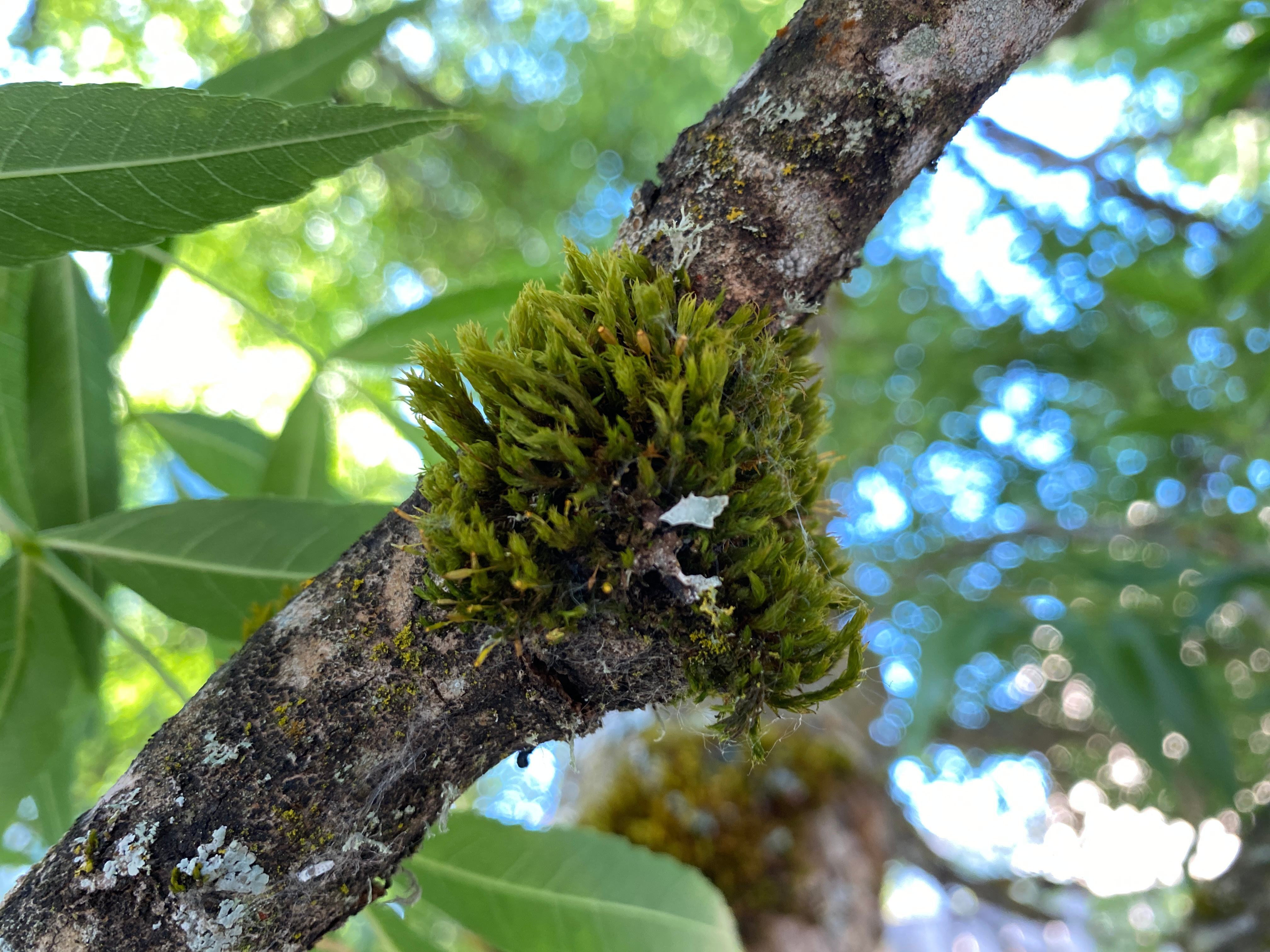
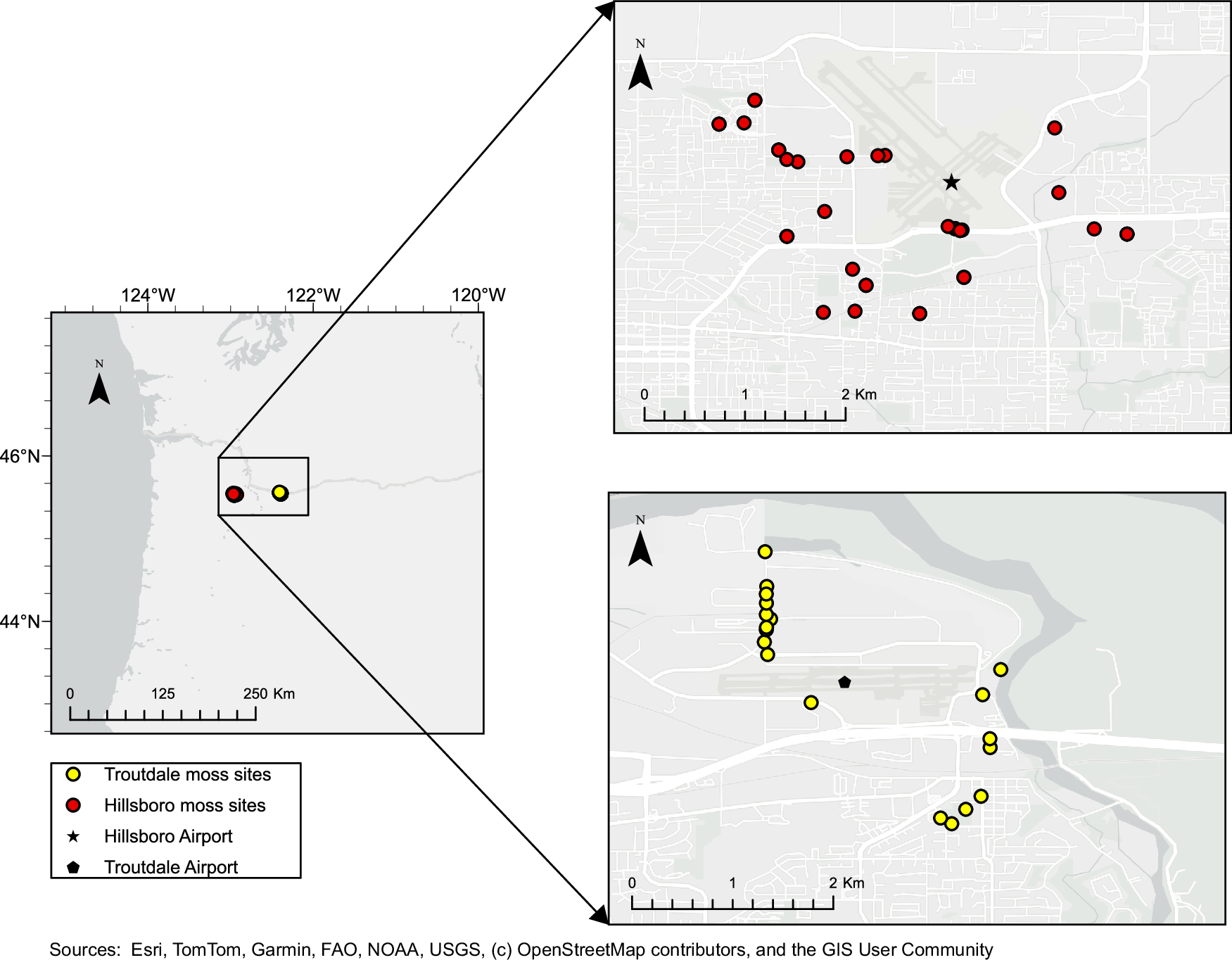
To overcome the limitations of traditional monitoring networks, we employed a natural, biomonitoring approach using the epiphytic moss Orthotrichum lyellii. Because this moss species lacks a true root system, it derives all of its nutrients and moisture from atmospheric deposition. As a result, it acts as a low-cost, continuous biological air sampler that integrates heavy metal deposition over multiple years. We collected moss samples from trees across spatial transects extending outward from the Hillsboro (HIO) and Troutdale (TTD) airports—two facilities that ranked #10 and #88 nationally for airport lead emissions in 2017 according to U.S. Environmental Protection Agency estimates.
Our findings revealed a sharp spatial gradient between airport proximity and lead accumulation in tree moss throughout nearby neighborhoods:
- Pronounced Runway Spikes: Moss samples collected closest to Hillsboro’s main runway (0.5–0.7 km) exhibited lead concentrations up to 7 times higher than Portland’s urban background levels and 47 times higher than rural baseline levels in Northwest Oregon.
- Extent of Dispersion: Distinctly elevated lead signatures extended outward to at least 1.2 km (0.75 miles) from active runways before blending back into the broader urban background.
- Operational Variations: While elevated lead levels were observed near both airports, Hillsboro displayed higher peak lead concentrations than Troutdale, directly reflecting differences in overall flight activity and local runway usage patterns.
To determine whether aviation fuel was responsible for observed elevated lead, we utilized high-precision lead isotope ratio analyses. Different sources of environmental lead carry distinct isotopic "fingerprints". Our analysis demonstrated a clear binary mixing trend between the urban background lead, dominated by legacy leaded gasoline emissions, and aviation fuel. Samples nearest to active runways possessed a distinct, less radiogenic isotopic signature attributed to modern leaded avgas, providing evidence for active general aviation operations as a dominant source of local lead pollution in these adjacent neighborhoods.
What Are the Implications of This Study?
These findings arrive at a pivotal moment for environmental policy and public health regulation. Following the U.S. Environmental Protection Agency’s landmark October 2023 Endangerment Finding, which formally declared that lead emissions from piston-engine aircraft endanger public health, the federal government and the Federal Aviation Administration’s Eliminate Aviation Gasoline Lead Emissions (EAGLE) initiative have established a national target to transition general aviation to high-octane unleaded candidate fuels (such as G100UL and Swift UL 94) by 2030. Our research provides high-resolution empirical evidence demonstrating the immediate spatial footprint of avgas emissions, reinforcing the critical public health rationale for this regulatory phase-out.
However, eliminating lead emissions from the air is only the first step in addressing community exposure. Because lead is a persistent non-degradable element, decades of airborne emissions do not simply disappear; they accumulate in surface soils and urban dust. While moss biomonitoring effectively proves atmospheric deposition patterns and isotopic source attribution, it cannot directly measure airborne concentrations inhaled by residents or quantify absolute soil intake risks.
This study sets the stage for vital follow-up research. The next phase of our work moves from the tree canopy down to the ground, focusing on comprehensive residential soil testing, dust pathway evaluations, and active collaboration with local public health agencies. By pairing biological air monitoring with soil geochemistry, we aim to help communities, regulators, and aviation stakeholders navigate a safe, science-based transition toward a lead-free aviation future.

Follow the Topic
-
Communications Sustainability
An open-access journal publishing high-quality, editorially selected and peer-reviewed advances in all sustainability-related areas of science, including the natural and social sciences as well as engineering.

Related Collections
With Collections, you can get published faster and increase your visibility.
Critical materials supply chain sustainability
Publishing Model: Open Access
Deadline: Oct 26, 2026
Blue Economy
Publishing Model: Open Access
Deadline: Nov 30, 2026