What Politicians Think Citizens Think About Climate Action: The Story Behind Our Study
Published in Social Sciences, Earth & Environment, and Sustainability
Explore the Research
2027-77094-001?utm_campaign=related_content&utm_source=HEALTH&utm_medium=communities
From Self-Regulation to Climate Policy
We, Wilhelm Hofmann and Timur Sevincer, are psychologists whose research has long focused on how people regulate and change their behavior. Over the past decades, self-regulation and behavior change have been central topics in psychology. As climate change emerged as one of the defining societal challenges of our time, many psychologists began asking how their discipline could contribute to understanding and addressing it. We were no exception. Coming from a background in motivation and behavior change, like many psychologists we became interested in how psychological insights might help advance effective climate action.
One of us, Timur Sevincer, together with Johann Majer, initiated a special issue in Motivation Science dedicated to understanding and promoting sustainable behavior. As part of this effort, Wilhelm Hofmann contributed an article on the psychological foundations of climate policy acceptance. Bringing together researchers working on different aspects of sustainability highlighted both the promise and the limitations of focusing exclusively on individual behavior change.
While individual behavior change is part of the solution, addressing climate change also requires effective public policies. This realization led Wilhelm to focus on the question of how ambitious policies can gain public acceptance in democratic societies. Together with Sonja Grelle, he developed the Integrative Public Policy Acceptance Framework, which examines the psychological processes shaping support for policy interventions.
One prerequisite for implementing ambitious climate policies is that politicians have a reasonably accurate sense of whether the public supports them. Yet political scientists have long known that elected representatives do not always estimate public opinion accurately. At the same time, psychologists have studied pluralistic ignorance- situations in which people systematically misperceive the attitudes and preferences of others. Research on climate change has repeatedly shown that people tend to underestimate how much others support climate action. This led us to a simple question: If ordinary citizens underestimate public support for climate action, might politicians do the same?
How the Idea Emerged
A key step toward the project came in January 2024, when Wilhelm visited Leuphana University Lüneburg at Timur’s invitation to give a talk on the question, “When and why do people accept public policy interventions?” The topic resonated strongly with Leuphana’s focus on sustainability and interdisciplinary research.
As is often the case in academia, however, the most important ideas did not emerge during the formal presentation itself. Later that evening, over dinner with colleagues, we continued discussing climate policy, public acceptance, and the role of politicians. Somewhere during that conversation, the first seeds of the present project were planted. The idea was still vague, but we began to wonder whether politicians might systematically misjudge how much support climate policies actually enjoy among the public.
From Idea to Study
Turning that vague idea into an actual study took a bit longer, and we were fortunate that two highly motivated undergraduate students, Luisa Hostlowsky and Fenja Styler, joined the project around that time, pursuing it as part of their bachelor's theses. Like many students at Leuphana, they were deeply interested in questions of sustainability and eager to contribute to research on climate change.
Germany provided an especially interesting case because of its ongoing energy transition, the Energiewende. The biggest challenge, however, was not surveying the public-it was reaching politicians. Collecting a large and diverse sample of elected representatives is notoriously difficult. Fortunately, Timur had recently conducted another study involving politicians and had gained valuable experience navigating this process.
Reaching More Than 1,500 Politicians
Luisa and Fenja played a crucial role in the data collection effort. Over many weeks, they assembled a contact database and sent more than 6,000 personalized invitations (and over 12,000 emails in total, including reminders and follow-up correspondence). As Luisa later joked, she never expected that writing her thesis would involve contacting almost the entire German political establishment - including the Federal Chancellor.
At the same time, we commissioned a professional polling company to recruit a representative sample of the German public, allowing us to compare politicians’ perceptions with the views of citizens themselves.
What We Found
By late 2024, the first results began to arrive. We had expected to find some degree of misperception, but we had no strong expectations about their magnitude or whether they would be concentrated in particular policy domains. As we examined the data, a striking pattern emerged.
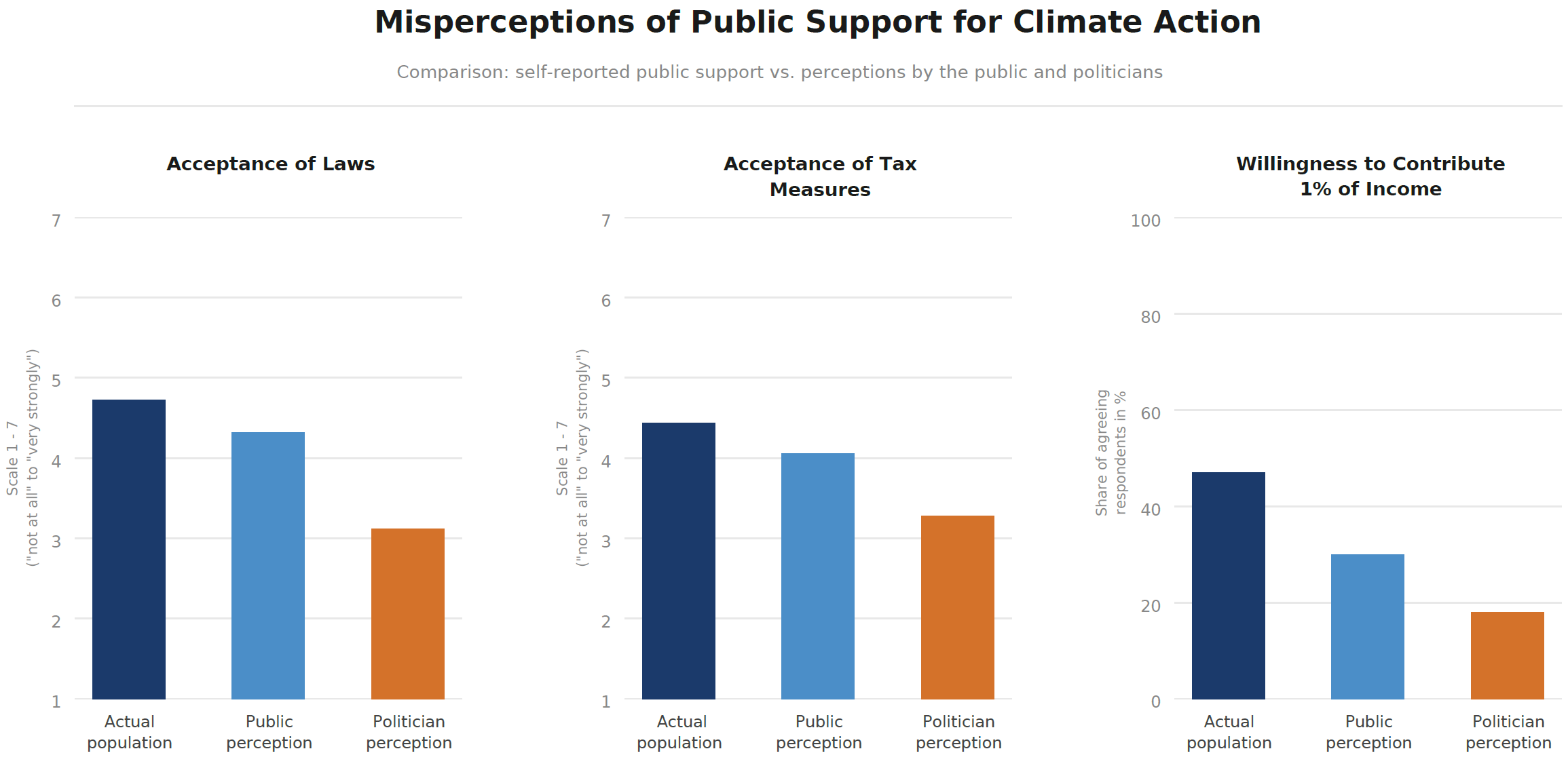
The largest misperceptions concerned precisely those climate measures that experts generally consider among the most effective: laws and taxes. Politicians substantially underestimated public support for these interventions, and the misperceptions were even larger than those observed among the public itself. In other words, politicians appeared to underestimate support for climate action even more than ordinary citizens did.
Another finding surprised us. Given the polarized nature of contemporary political debates, we expected larger differences between political parties. Instead, the pattern proved remarkably consistent across the political spectrum. Politicians from all major parties underestimated public support for climate action, with only minor differences between them. The main exception was the far-right party, who showed the largest misperceptions.
The project also benefited greatly from the peer-review process. Our reviewers came from different disciplinary backgrounds, including political science and psychology, and their comments helped us sharpen both our arguments and our interpretation of the findings. The final paper is considerably stronger because of their feedback.
What Happens Next?
As this article goes to press, Germany continues to debate the pace and scope of its energy transition. Such discussions are a normal and important part of democratic decision-making. Our findings have already made their way into this debate to some extent: they are already referred to in a policy brief communicating pluralistic ignorance findings to politicians, and were presented at a parliamentary evening hosted by the German Psychological Society in Berlin, as part of a broader effort to bring psychological evidence to bear on political decision-making. We hope that our findings can contribute to these debates by providing a more accurate picture of public opinion. If politicians systematically underestimate support for climate action, then correcting these misperceptions may itself become an important step toward implementing effective climate policies.

Follow the Topic
What are SDG Topics?
An introduction to Sustainable Development Goals (SDGs) Topics and their role in highlighting sustainable development research.
Continue reading announcement