What Snow on a Mountain Taught Us About Mercury’s Journey Through the Sky
Published in Earth & Environment

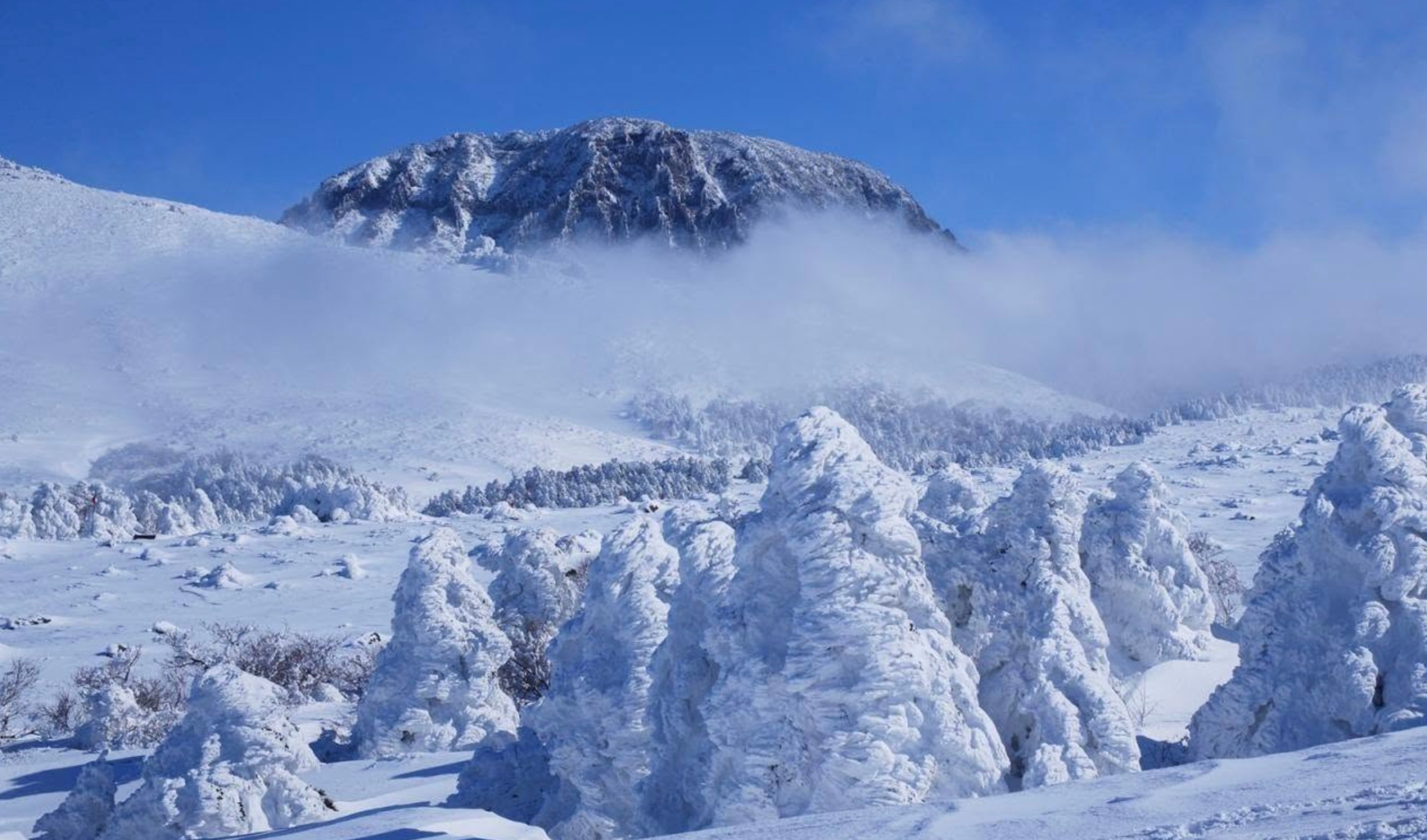


Chasing snow on a mountain
Every winter for four years, our team made repeated trips to Jeju Island, off the southern coast of South Korea, to climb Mt. Halla, a volcanic peak that rises 1,947 meters above the sea. We weren’t there for the hiking. We were there for the snow.
As many as ten times a season, in temperatures as low as minus 19°C and winds that sometimes topped 30 meters per second, we scraped the top centimeter of freshly fallen snow into pre-cleaned bottles at four elevations. It is not a glamorous way to do science. But snow turns out to be one of nature’s best record-keepers, and what we found locked inside it changed how we think about the way mercury pollution travels to the Pacific Ocean.
A puzzle that didn’t add up
Mercury is a strange and dangerous pollutant. Coal burning, mining, and industry across East Asia release it into the air as a gas, where it drifts for months before falling back to the surface, often transformed into forms that accumulate in fish and, eventually, in people. East Asia is responsible for roughly half of the world’s human-caused mercury emissions, and the Pacific is the world’s largest fishing ground. Exactly how mercury from Asian skies reaches that ocean has remained unclear.
Mt. Halla or Jeju Island is the best place to pick up pollution signals of Asian outflow. When we first measured the mercury isotopes in the Mt. Halla snow, the results surprised us. Their isotope ratios looked very similar to those of Arctic snow during atmospheric mercury depletion events, in which halogen chemistry rapidly removes mercury from polar air and deposits it on the snow. Mt. Halla is a mid-latitude island surrounded by ocean, nothing like the Arctic. Our first instinct was that we were seeing the same Arctic-style chemistry at a different site. The deeper we looked, the more that explanation didn’t hold up.
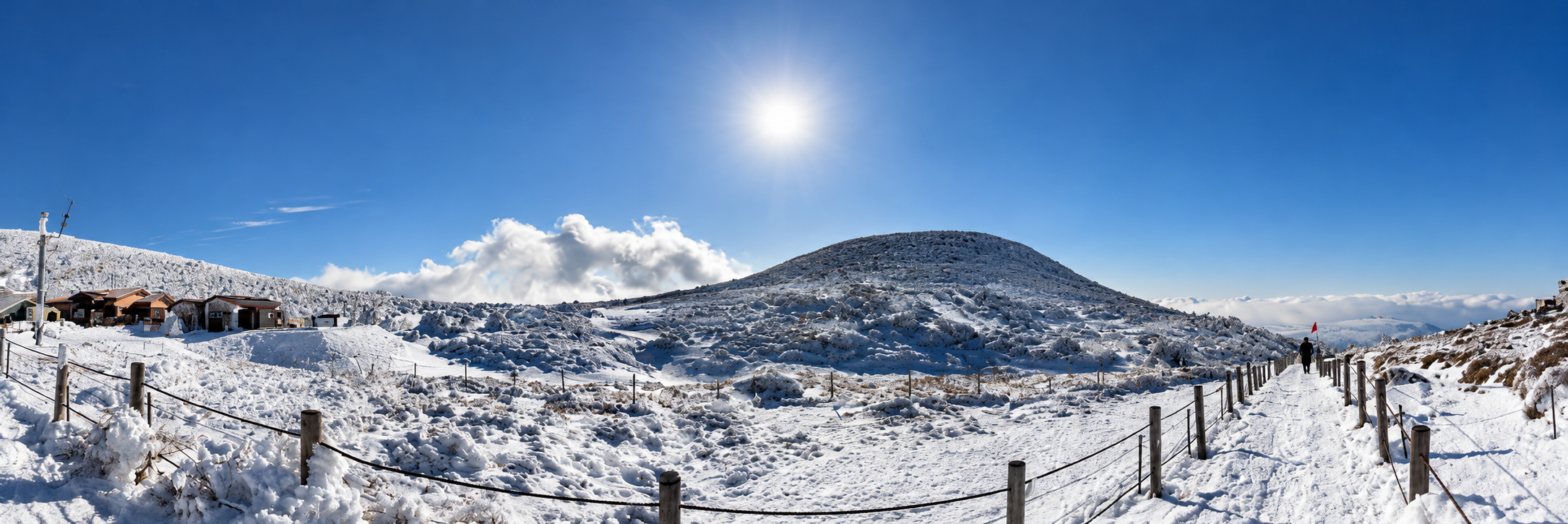
Reading the isotopic fingerprints
Those isotope ratios are the key to this story. Mercury has seven stable isotopes, atoms of the same element with slightly different masses, and the ratios between them shift in predictable ways depending on what chemical reactions mercury has been through. It’s like a fingerprint left behind by the atmosphere. A rare signature, called even-mass isotope fractionation, had been linked in earlier studies to something specific: mercury being oxidized by sunlight high in the free troposphere, the layer of atmosphere that sits above the boundary layer, starting roughly a kilometer up.
Other researchers proposed a competing idea, that this same signature instead come from much more mundane chemistry happening near the ground, closer to where pollution is actually emitted. Knowing which explanation is right matters because it determines whether controlling mercury emission near its sources would meaningfully reduce how much mercury ends up in the ocean, or whether much of it escapes upward, out of reach of local policy.
We found that Mt. Halla’s snow carried even-mass fingerprint clearly, and its signal increased with how high and how far the air that delivered mercury had traveled, based on three-day back-trajectory modeling. That pointed toward the free troposphere, not local pollution, as the place where this chemistry happens.
An unexpected partner: bromine from the sea
The next question was how mercury is being removed from the atmosphere and falling down to the surface. For a clue, we turned to a completely different molecule hiding in the same snow: nitrate. Nitrate’s oxygen isotopes carry their own fingerprint, and ours matched a pattern previously reported in the Arctic spring, when reactive bromine released from sea salt drives atmospheric chemistry. Finding that same bromine signature at a mid-latitude Pacific site, alongside mercury tied the story together. Sea salt carried high into the atmosphere releases reactive bromine, which oxidizes mercury before it falls onto the snow.
Using isotope mixing models, we estimate that this high-altitude, bromine-driven process accounts for roughly two-third of the mercury reaching Mt. Halla’s snowpack, with the rest oxidized closer to the surface.
Why this matters beyond one mountain
The same signal appears elsewhere. Reactive mercury measured at Pic du Midi in the French Pyrenees shows hints of the same chemistry, and separate isotope work on zooplankton collected along the Asian margin into the open Pacific show the same free tropospheric signature that increases with distance from the Asian continent.
That has a real implication. A meaningful share of East Asia’s mercury emissions may not simply settle out near its source. It may rise, travel far distance through the upper atmosphere, and come down elsewhere, carried by chemistry involving sea salt and sunlight. Understanding that pathway matters for anyone trying to model, or reduce, how much mercury reaches Pacific seafood.
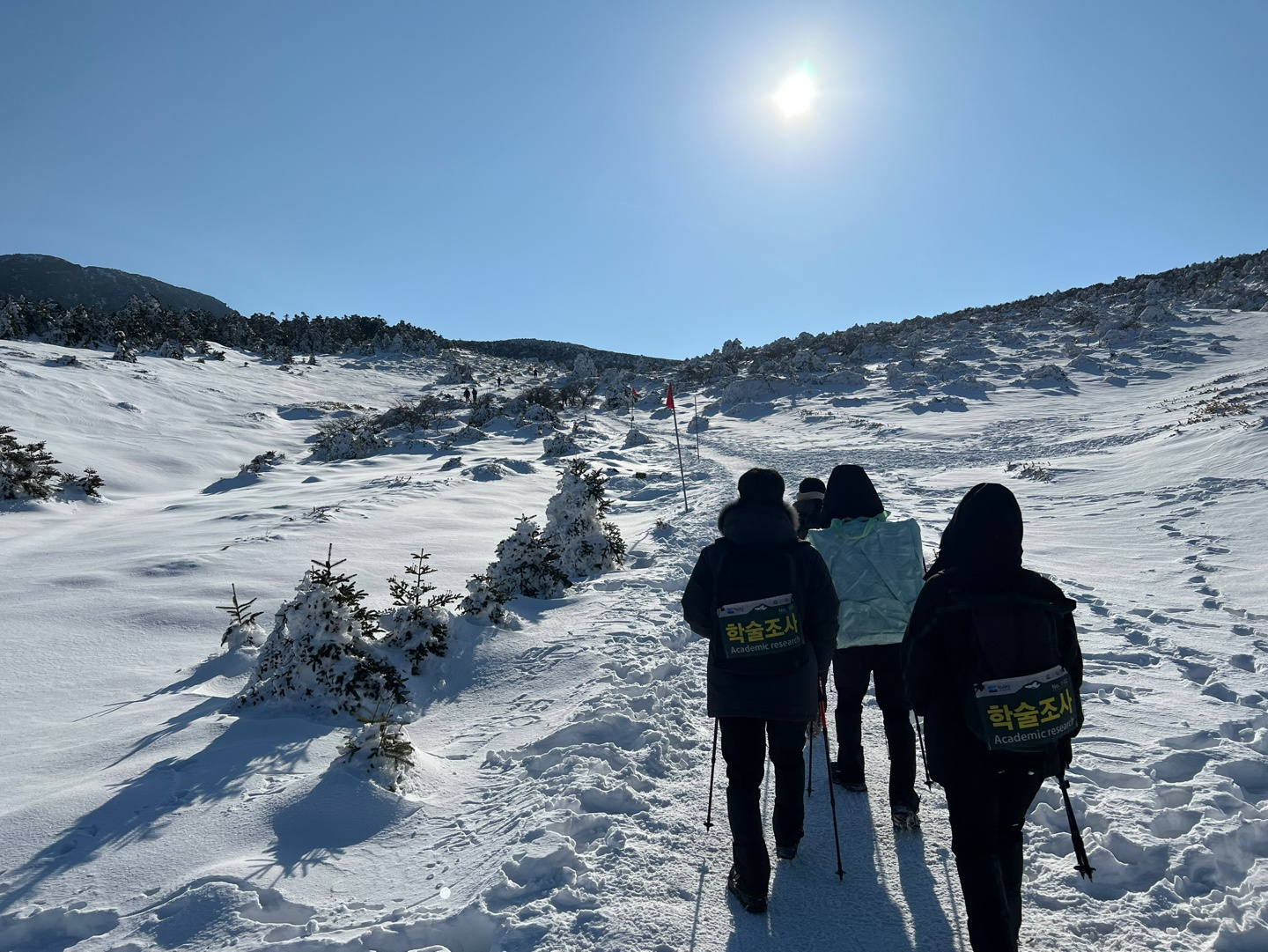
The part that doesn’t make it into a methods section
None of this came together quickly. We spent a long time convinced we were looking at a miniature version of Arctic chemistry before the data pushed us elsewhere. It was the combination of two completely different isotope systems, mercury and nitrate, that gave us the confidence to make the case.
The fieldwork was its own challenge. We wanted snow that no one had walked on, so we had to reach the mountaintop before the tourists did. As soon as the mountain opened to the public, and only when the weather allowed, we set off first thing in the morning and hiked through snow as deep as 50 centimeters. Each trip to the peak of Mt. Halla took us 2 hours and on bad days the fog was so thick we could not see more than a few meters ahead. On good days the clouds cleared to a view you would not see anywhere else in Korea.
None of it would have happened without our team in Korea. Colleagues from POSTECH, KRISS, and KOPRI made every trip up Mt. Halla, with support from the Hallasan National Park Management Office. But we could not have made sense of what we found on our own. Collaborators in France measured the nitrate isotopes that pointed us to bromine, and with experienced colleagues in France, Spain, and the United States, we turned scattered clues into a single story. A few centimeters of snow held a record of the sky above it, and of the long path mercury takes before it reaches the ground and the sea.
Follow the Topic
-
Communications Earth & Environment
An open access journal from Nature Portfolio that publishes high-quality research, reviews and commentary in the Earth, environmental and planetary sciences.

Related Collections
With Collections, you can get published faster and increase your visibility.
Ecological resistance and resilience under global change
Publishing Model: Open Access
Deadline: Apr 07, 2027
Ecosystems under marine heatwaves
Publishing Model: Hybrid
Deadline: Jan 31, 2027