Affective Sovereignty and the Epistemic Gap: From System Design to Measurement Theory
Published in Neuroscience, Computational Sciences, and Behavioural Sciences & Psychology


A concept does not mature because its originator repeats it.
It matures when another researcher finds a question inside it that the original formulation did not answer.
That question rarely arrives through citation alone. It arrives when a different vocabulary is brought to bear on the same problem.
Keito Inoshita’s recent preprint, Who Determines the Meaning of an Emotion? Affective Sovereignty as an Epistemic Consequence of Measurement Limits, represents such a moment for Affective Sovereignty.
Inoshita does not merely cite the term. He treats the original Affective Sovereignty framework as his direct point of departure and asks what kind of epistemic claim an emotion-sensing system can legitimately make.
The resulting argument moves the discussion from system design to measurement theory.
Its central proposition is simple but consequential:
High device confidence does not establish that the meaning of an individual emotion has been recovered.
The paper was submitted to arXiv on 30 June 2026 and remains a preprint. Its contribution is primarily formal and conceptual, supported by connections to an emerging empirical literature on annotator disagreement and uncertainty in emotion classification.
What the original framework established
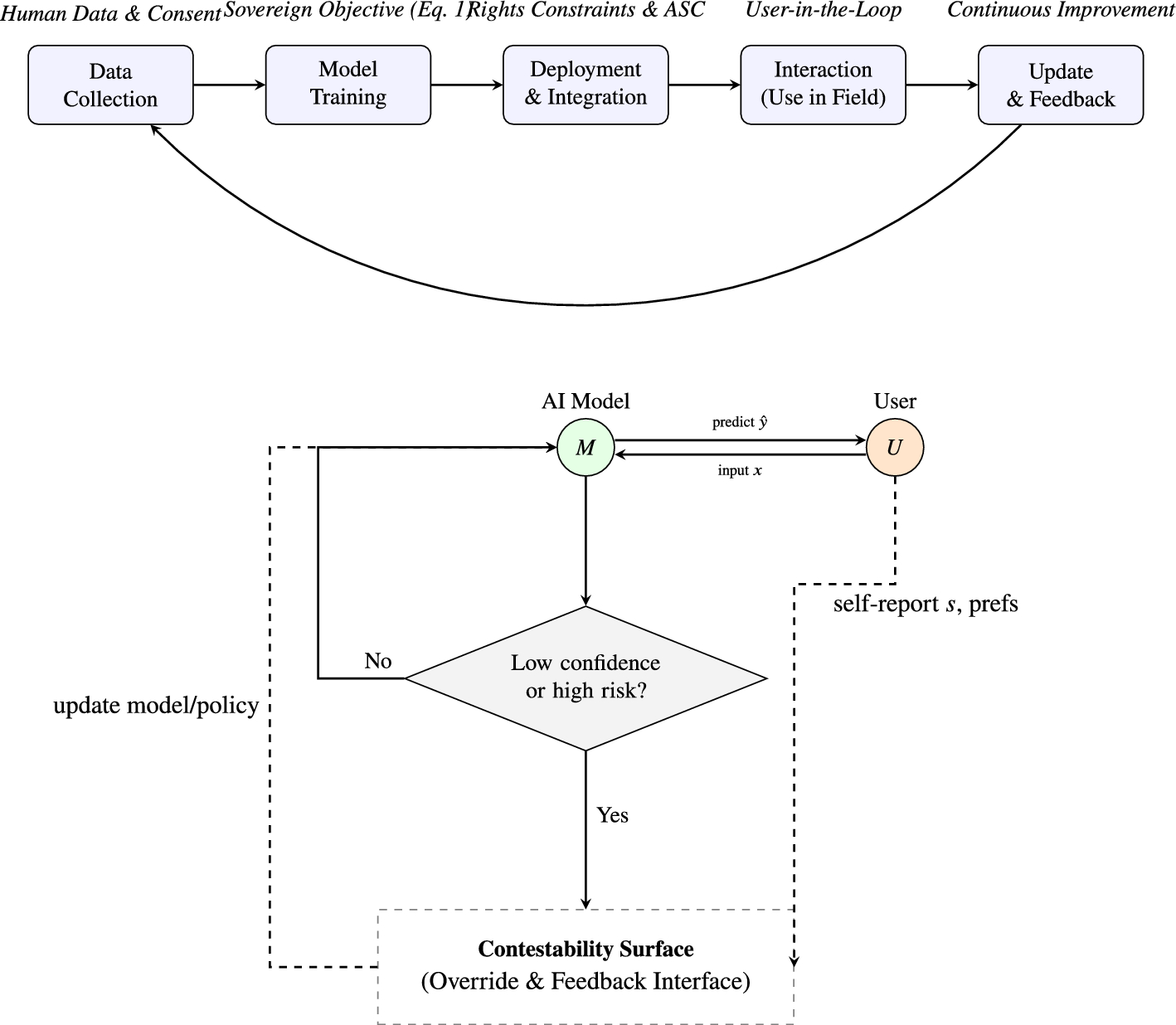
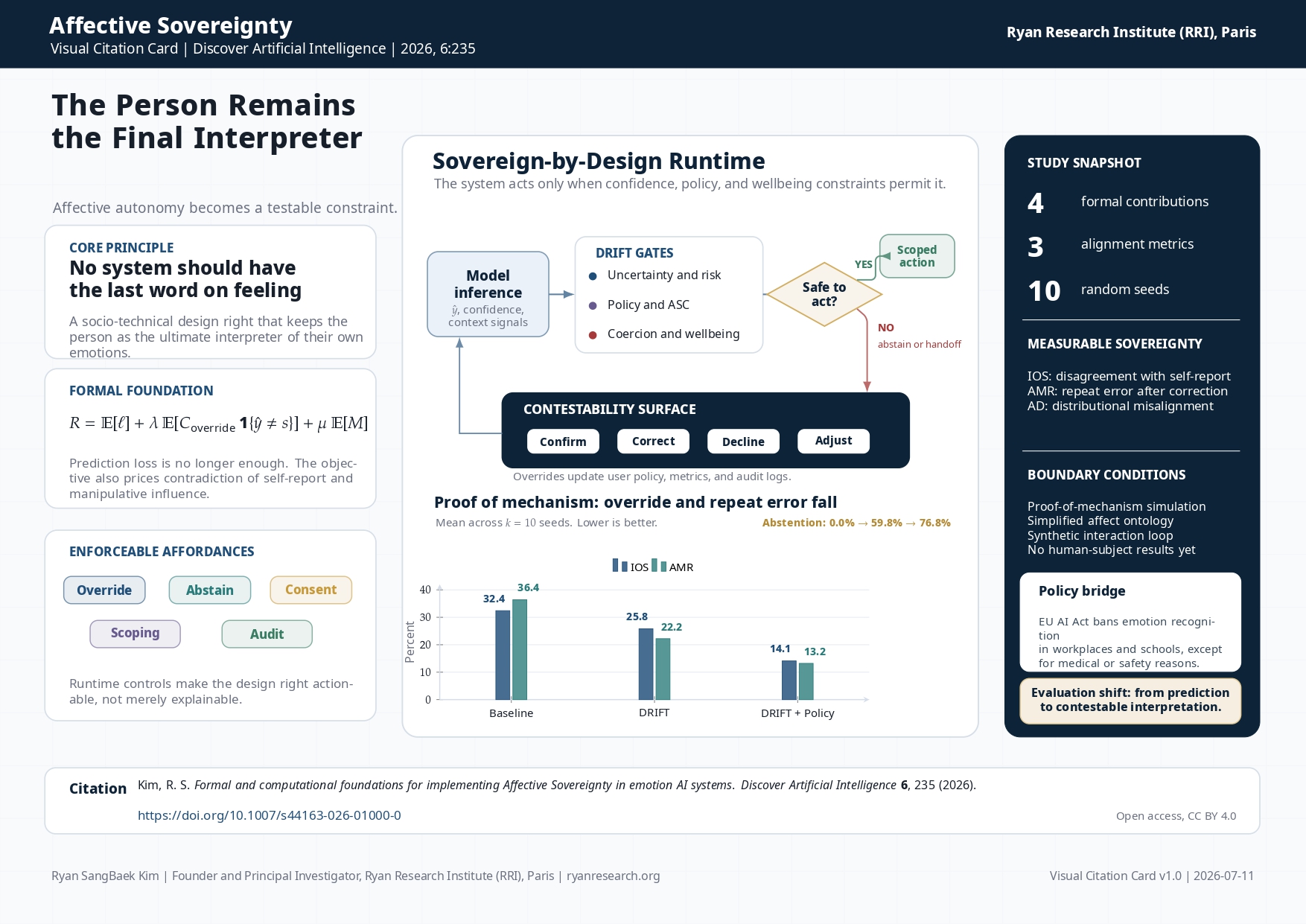
The original Affective Sovereignty paper defined the concept as a socio-technical design right.
Its central claim was that systems which infer, simulate, or influence affect should preserve the person as the final interpreter of their own emotional life. The framework translated that commitment into system requirements including override, abstention, consent, scoping, audit, runtime handoff, and contestability.
The formal model assigned costs to ordinary prediction error, interpretive override, and manipulative influence. A proof-of-mechanism simulation then examined whether those costs could alter system behavior.
The scope of that work was normative and computational.
It asked how final interpretive authority could be protected in an operational emotion AI architecture, including in cases where prediction appeared strong.
It did not attempt to prove that the meaning of an individual emotion was irrecoverable by measurement.
Inoshita identifies this as the opening for his own contribution. His preprint describes the original framework as the prior work it engages most seriously and as a direct point of departure rather than one citation among many. It then asks why an increasingly refined measuring system cannot simply acquire the authority that Affective Sovereignty reserves for the person.
The meaning distribution
Inoshita operationalizes emotional meaning as a meaning distribution.
Under a fixed annotation protocol, including a defined label set, instructions, presentation context, and annotator population, different annotators may assign different emotional labels to the same instance.
The meaning distribution is the probability distribution of those labels.
It is therefore not presented as a metaphysical account of the person’s true inner state. It is a protocol-relative measurement object.
This reservation is important. An annotator distribution should not be confused with lived emotional meaning in its entirety. It captures the plurality visible through a particular measurement arrangement.
Even within that restricted definition, however, the distribution changes the evaluation problem.
A majority label records which answer occurs most often.
It does not preserve the structure of competing interpretations from which that answer emerged.
Reducible and irreducible uncertainty
The paper decomposes uncertainty in the meaning distribution into two components.
The reducible component concerns estimation error caused by finite observation. More annotators can reduce this error and improve estimation of the underlying distribution.
The irreducible component concerns plurality that remains under the fixed protocol as annotation increases. More annotation can estimate the plurality more accurately, but it does not necessarily make the distribution collapse to a point.
Using concave diversity functionals, including Shannon entropy and the Gini-Simpson index, the paper invokes Jensen’s inequality to show that diversity estimated from finite annotation is systematically biased downward relative to the underlying distribution.
A small annotator sample can therefore make emotional meaning appear less plural than it is.
The result does not establish that every emotional meaning is permanently unknowable. Nor does it show that improved data collection is futile.
It establishes a narrower point.
Refinement can improve prediction and estimation. It cannot turn protocol-relative irreducible ambiguity into a single authoritative meaning.
The epistemic gap
This distinction supports what Inoshita calls the epistemic gap.
Emotion AI confidence and individual-instance meaning recoverability are logically independent quantities.
A model may produce a high-confidence label because it has learned a stable decision boundary across a population. It may accurately identify which category will win under a benchmark.
Neither achievement establishes that the model has reconstructed the full meaning distribution of the individual case.
The distinction is especially important in affective computing because output confidence is easily interpreted as authority.
A label presented as sadness: 0.94 appears to say more than “sadness is the class preferred by this model.”
It appears to say that the person’s emotion has been identified.
The epistemic gap is the distance between those claims.
In related empirical work, Inoshita and colleagues have reported that language models can approximate emotion labels while diverging from human uncertainty distributions, particularly for emotions that depend on pragmatic and contextual interpretation. That study compared four zero-shot LLMs and a fine-tuned RoBERTa baseline across GoEmotions and EmoBank using 640,000 model responses.
The preprint does not present this as new empirical analysis. It connects such findings to a measurement-theoretic argument.
Interpretive non-delegation
A statistical limitation cannot by itself establish a normative right.
Inoshita addresses this explicitly through the Principle of Interpretive Non-Delegation.
The principle holds that the output of a system which cannot recover a quantity in principle should not be treated as the authoritative determination of that quantity.
The paper then combines this premise with an asymmetry of contextual access. The experiencing subject has access to personal history, bodily experience, intention, and evolving significance that an external measurement system does not possess in the same way.
The subject’s position is better described as interpretive standing: a procedural status rather than a claim to infallibility. Authority, by contrast, names the power to make an interpretation operationally decisive.
The subject is not assumed to have privileged access to a fixed, objectively true emotion. Instead, the subject retains the final standing to integrate context and give meaning to the experience.
This distinction prevents privileged access from being confused with infallibility.
Affective Sovereignty does not require the romantic claim that people always know themselves best.
It requires that uncertainty and partial observation do not become grounds for transferring final authority to the instrument.
Where the accounts complement each other
The original framework and Inoshita’s epistemic account operate at different levels.
The original Affective Sovereignty framework establishes a normative design right and proposes computational mechanisms for preserving it.
Inoshita formalizes a measurement problem that helps explain why device confidence should not be treated as recovered meaning.
The relation can be summarized as follows:
Affective Sovereignty:
Accuracy does not create final authority.

The epistemic gap:
Confidence does not demonstrate recovered meaning.

Combined implication:
Neither performance nor confidence is sufficient
to displace the subject’s interpretive standing.
This extension also gives a more specific interpretation to the original framework’s override cost.
When an emotional instance contains substantial residual ambiguity, contradiction of the person’s self-report is not simply another classification error. It represents an attempt to impose a point interpretation where measurement itself does not justify one.
The case for abstention, handoff, and contestability becomes stronger under those conditions.
Where the accounts should remain distinct
The epistemic argument strengthens Affective Sovereignty, but it should not become its sole foundation.
Inoshita allows that when the irreducible component is negligible, a measuring system may possess correspondingly limited authority. This is reasonable within a measurement account. Some emotional classifications are more stable than others, and systems may legitimately play different roles under carefully bounded conditions.
Final interpretive standing, however, should not depend entirely on whether a measurable residual exceeds a chosen threshold.
A future system may become highly reliable for a narrow affective task. That performance can justify reliance, inquiry, warning, or limited action.
It does not automatically convert predictive competence into jurisdiction over the meaning of a person’s emotional life.
The original design-right argument therefore remains necessary.
Affective Sovereignty applies not only because some meanings are difficult to recover, but because the authority to make an emotional inference operationally decisive must be allocated through legitimate procedures.
The two accounts therefore perform different explanatory work.
The epistemic account explains one powerful reason for withholding authority.
The normative account determines why authority does not transfer automatically even when uncertainty is low.
Disagreement and the limits of authority
Annotator disagreement has often been treated as noise, indecision, or defective data.
The distributional literature has increasingly shown that disagreement can encode ambiguity, perspective, linguistic pragmatics, and differences in conceptual framing.
In affective contexts, this observation acquires a governance consequence.
Disagreement is not itself authority.
It is where the limits of external authority become visible.
Once disagreement is compressed into a gold label, a benchmark can measure accuracy while concealing the plurality that made the instance difficult. If the output then drives a hiring decision, educational intervention, clinical recommendation, or persistent user model, measurement compression becomes institutional authority.
The central design question is therefore not simply whether a system can select a label.
It is whether the system preserves the conditions under which that label may be questioned.
Implications for emotion AI evaluation
The combined framework suggests several changes in evaluation.
Emotion AI should report label distributions where interpretive plurality is relevant rather than presenting point predictions alone.
Predictive confidence should be distinguished from recoverability of the individual meaning distribution.
Benchmark accuracy should be supplemented by measures of distributional fidelity, uncertainty decomposition, abstention behavior, and response to correction.
Inference and intervention should be evaluated separately. A system may have enough evidence to propose a hypothesis without having enough legitimacy to act on it.
Finally, contestability should be treated as a performance dimension. Evaluation should examine whether a person can reject or revise an inference, whether the correction alters future behavior, and whether emotionally consequential memories can be restricted, expired, or deleted.
These questions connect measurement theory to governance architecture.
They also suggest a shared empirical agenda: testing device confidence, human label distributions, user self-report, model abstention, and downstream intervention within the same experimental design.
A concept beyond its originator
The most important feature of Inoshita’s preprint is not that it cites Affective Sovereignty.
It is that the concept has become usable outside its original formulation.
The paper identifies a missing layer, develops its own formal vocabulary, and reaches a conclusion that both supports and tests the boundaries of the prior framework.
The relation between Inoshita’s measurement-theoretic account and my design-right formulation now defines a distinct line of inquiry: how epistemic limits and normative authority should be connected without being collapsed.
A concept begins to travel when another researcher can extend it without merely repeating it, and criticize its limits without dissolving its core.
Affective Sovereignty began as a claim about human standing and system design.
The epistemic gap now adds a second question:
What does a machine’s confidence entitle it to say that it knows?
The answer is limited, but not trivial.
Emotion AI can identify patterns, distinguish populations, support inquiry, and sometimes reveal information of genuine value.
But confidence is not recovered meaning.
Prediction is not authority.
And measurement, however refined, must still answer to the person whose emotional life it attempts to describe.
Research referenced
Inoshita, K. (2026). Who Determines the Meaning of an Emotion? Affective Sovereignty as an Epistemic Consequence of Measurement Limits. arXiv:2606.31442.
doi: 10.48550/arXiv.2606.31442
Kim, R. S. (2026). Formal and computational foundations for implementing Affective Sovereignty in emotion AI systems. Discover Artificial Intelligence, 6, 235.
doi: 10.1007/s44163-026-01000-0
Inoshita, K., Zhou, X., Kawai, A., & Yada, K. (2026). LLMs Capture Emotion Labels, Not Emotion Uncertainty: Distributional Analysis and Calibration of Human-LLM Judgment Gaps. arXiv:2604.27345.

Ryan SangBaek Kim is the Founding Director and Principal Investigator of the Ryan Research Institute (RRI), Paris, and a Research Professor at Kwangwoon University in Seoul. His research examines affective and relational AI, human–AI interaction, interpretive authority, measurement validity, and the governance of computational inference.
He introduced Affective Sovereignty, a normative and design framework concerned with preserving first-person interpretive authority when AI systems infer emotions, mental states, intentions, or other features of human experience. His broader research programme investigates how such inferences are constructed, measured, stabilised, contested, and eventually converted into epistemic or institutional authority.
His peer-reviewed work has appeared in Communications AI & Computing, Acta Psychologica, PLOS ONE, Computers in Human Behavior Reports, Discover Artificial Intelligence, Machine Learning with Applications, and Data in Brief. Recent empirical work spans large-scale relationship narratives, normative-conflict behaviour in large language models, measurement dependence in emotion research, and reproducible computational approaches to affective AI.
Across this programme, one question remains central: when machines and institutions participate in interpreting human affective life, under what conditions can the person remain an active interpreter rather than merely the object of an inference?
Follow the Topic
-
Discover Artificial Intelligence
This is a transdisciplinary, international journal that publishes papers on all aspects of the theory, the methodology and the applications of artificial intelligence (AI).

Related Collections
With Collections, you can get published faster and increase your visibility.
Transforming Education through Artificial Intelligence: Opportunities, Challenges, and Future Directions
Artificial Intelligence (AI) is rapidly changing the educational field by enabling personalized learning, intelligent tutoring systems, automated assessments, learning analytics, and administrative automation.
This collection invites original research, systematic reviews, and visionary perspectives on the transformative impact of AI in education. It aims to explore how AI technologies can enhance equity, inclusion, and efficiency in educational settings across different contexts, including higher education, K-12, vocational training, and lifelong learning. This collection will address technical, pedagogical, ethical, and policy aspects, fostering interdisciplinary perspectives and evidence-based insights.
This Collection supports and amplifies research related to SDG 4 and SDG 9.
Keywords: Artificial Intelligence, AI in Education, Educational Technology, Data Analytics, AI Ethics
Publishing Model: Open Access
Deadline: Nov 30, 2026
Advanced AI Methods for Personalized Healthcare
The advancement of Artificial Intelligence (AI) technologies, especially Reinforcement Learning (RL) and Deep Learning (DL), is transforming healthcare, enabling innovative solutions for patient monitoring, diagnostics, and personalized treatment. These technologies facilitate the effective use of healthcare data and intelligent analytics, enhancing clinical decision-making and improving patient outcomes. AI is revolutionizing how healthcare is delivered, making it more proactive, efficient, and accessible. This Collection explores new methods and applications of AI for healthcare such as personalized healthcare. Contributions in this Collection showcase novel frameworks, case studies, and interdisciplinary approaches that drive the future of personalized healthcare, fostering innovations that bridge technology and patient care.
In this context, we are inviting original research articles, reviews, and perspective papers addressing (but not limited to) the following themes:
- Personalized medicine
- IRL for dynamic treatment regimes
- Wireless sensor networks for patient monitoring
- Identification and prevention of critical condition
- Monitoring systems within the medical devices contest
- Methodologies and tools for the rapid integration of WSNs, IoT and AI in health monitoring
- Behavior analysis of patients
- Personalized health-promoting interventions
- Ambient assisted living and active assisted living
- AI security and privacy models for healthcare applications
- AI methods for rehabilitation
Publishing Model: Open Access
Deadline: Feb 27, 2027