When a small river gets squeezed between land and sea
Published in Earth & Environment and Sustainability
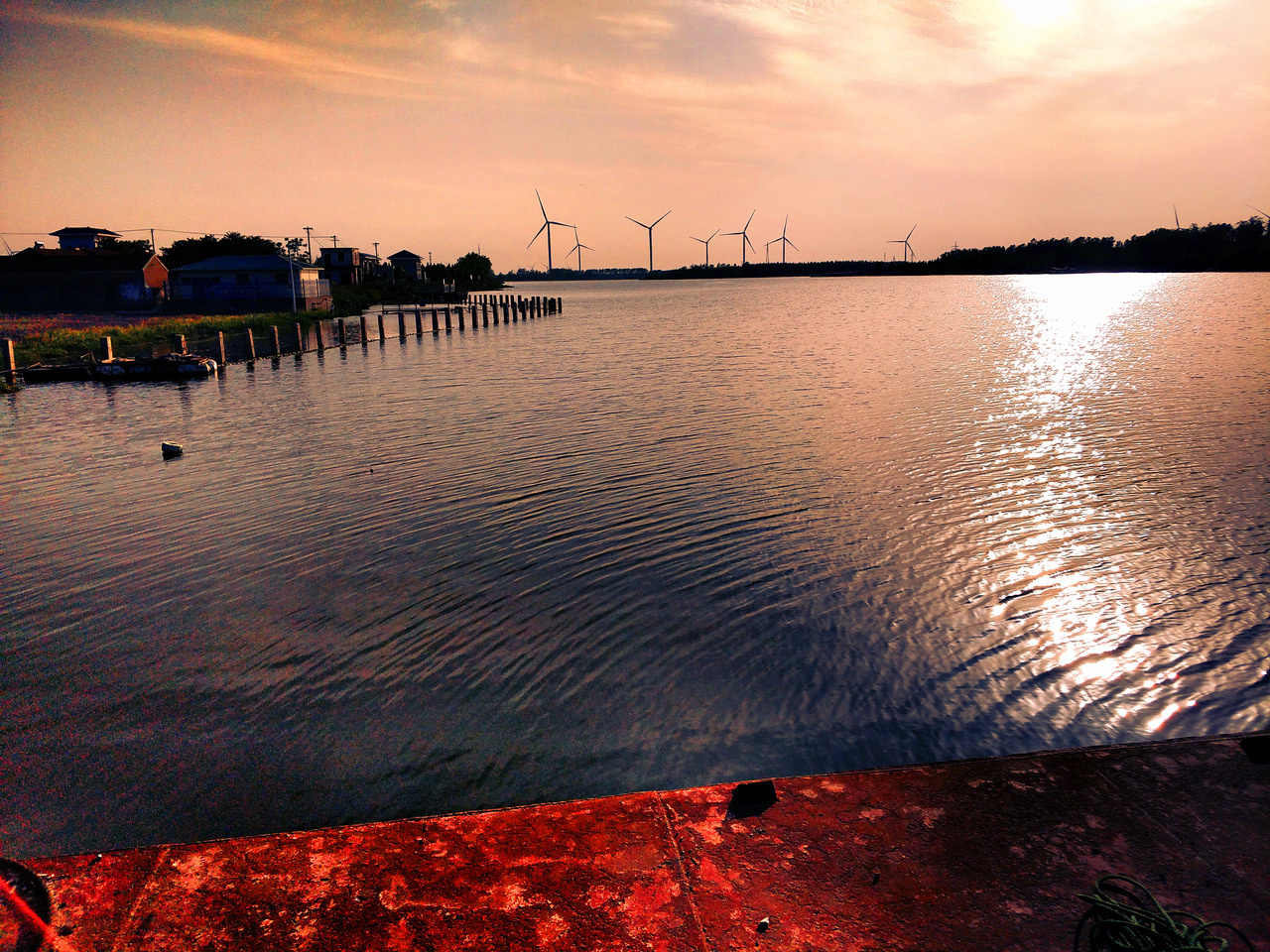



I still remember my first trip to Yancheng in 2015.
I did not go there with the phrase “gradient compression” in mind. I went there with the excitement many wetland researchers know well: the feeling that one landscape can hold many worlds at once. Freshwater reeds. Salt marshes. Tidal flats. Seawater. River water. Mud, birds, wind, and an ever-changing edge between land and sea.
Yancheng leaves that kind of impression on you. It sits within the Yellow Sea coastal zone, part of a UNESCO-listed sanctuary system in the world’s largest intertidal wetland complex and a crucial hub for migratory birds along the East Asian–Australasian Flyway. But it is also a coast shaped by long-term sediment delivery, shoreline advance, wetland change, and intense human modification. On the Jiangsu coast, sluice gates are widely used to store freshwater, reduce saline intrusion, and manage flooding, while also changing hydrodynamics and sediment transport.
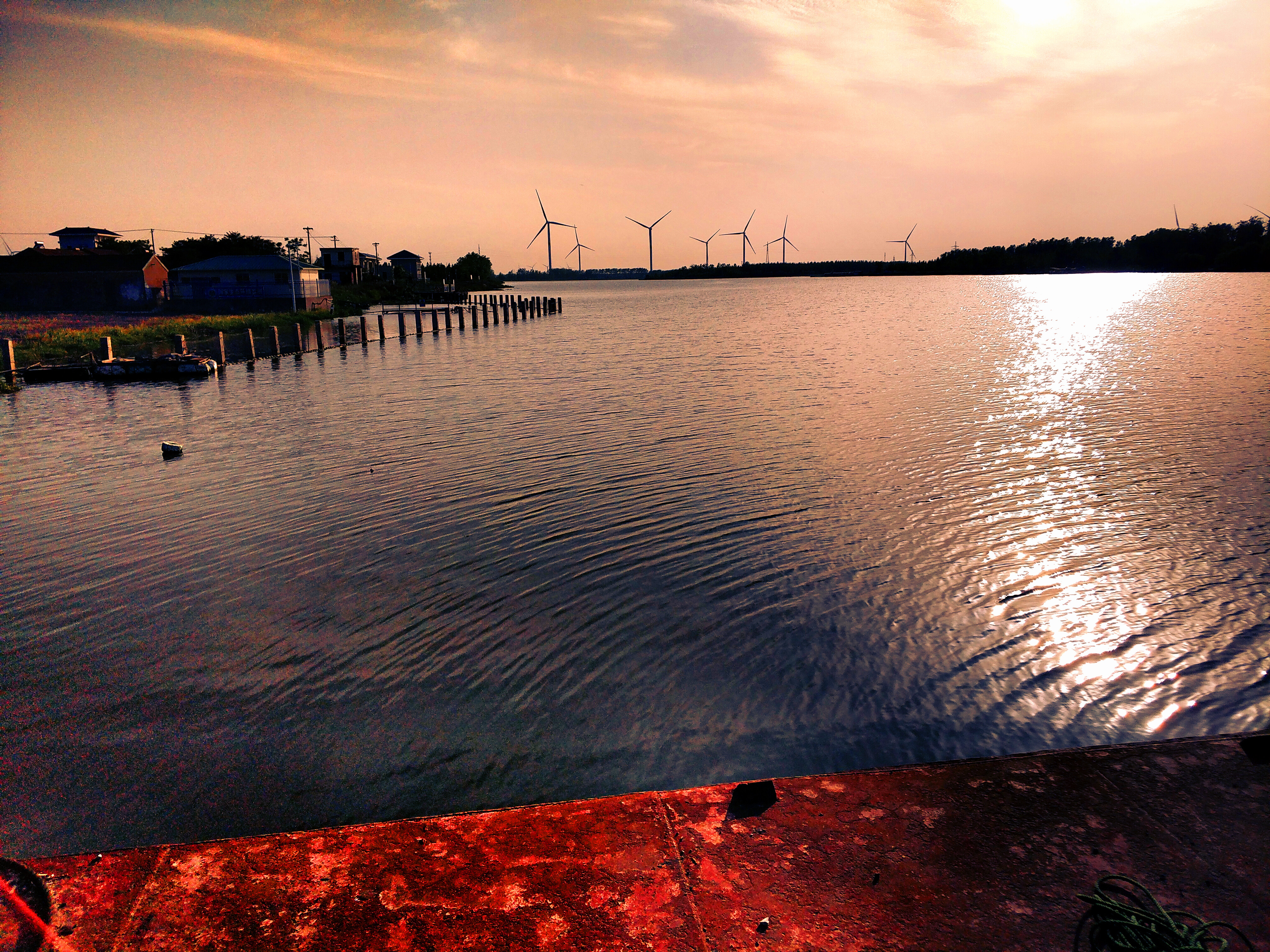
When we returned to Yancheng in 2023 under support from a national research project, those impressions became a scientific question.
Through conversations with local colleagues, field reconnaissance, hydrological maps, and land-use overlays, we began to see this coast differently. This was not simply a river flowing to the sea. It was a tightly constrained system where natural history and human engineering were colliding in a very small space. In places like this, the transition from freshwater to estuary to offshore water may be “squeezed” into a short distance.
That was the moment the central idea of our paper came into focus.
What if this small coastal river was not just showing an environmental gradient, but a compressed one?
In large river–sea systems, environmental change is often gradual. But in a small, human-modified coastal river, the same transition may happen much faster. Salinity rises quickly. pH shifts quickly. Nutrients and organic matter sources change quickly. In other words, organisms have much less room to adjust. We started to think of this as a kind of ecological pressure cooker.
That idea shaped our field design.
We selected key sections from the upstream river to the estuary and then offshore. We paid close attention not only to the channel itself, but also to the heterogeneity of sediments near the banks and open-water sections. We wanted a design that matched the landscape rather than forcing the landscape into a neat textbook pattern.
At first, our clues were physical and chemical. The field observations mattered a lot. So did the history of sluice regulation. Little by little, our original intuition began to look less like a speculation and more like a testable hypothesis.
Then the microbial data arrived.
And that is where the story became genuinely exciting.
We used full-length 16S rRNA and ITS sequencing to examine sediment bacteria and fungi across the river–estuary–offshore transect. We also combined this with environmental measurements and organic-matter indicators. In simple terms, we were asking three questions: who is there, how are they assembled, and what might they be able to do?
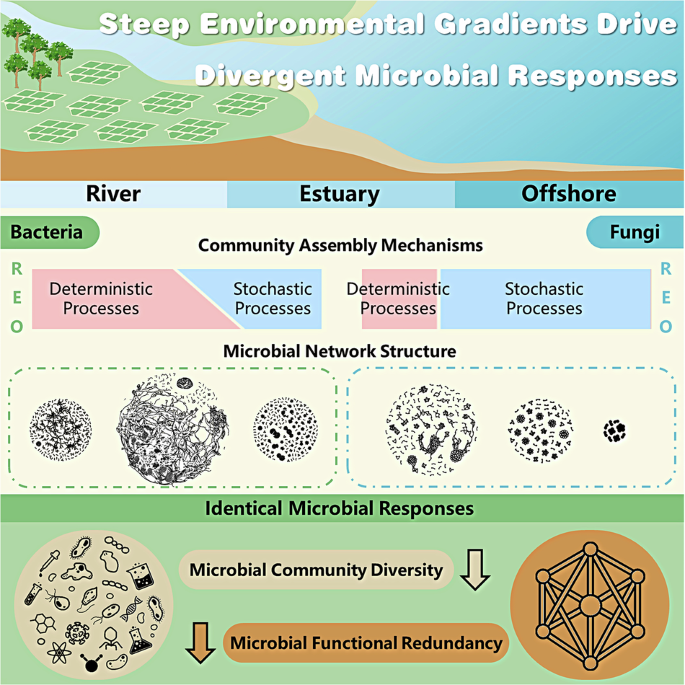
What we found was not a single microbial response, but two very different ecological strategies.
Bacteria and fungi were living in the same compressed landscape, but they were not playing by the same rules.
Bacterial assembly was dominated by deterministic processes, especially environmental selection, accounting for more than half of the turnover. Fungal assembly, by contrast, remained largely stochastic, with drift and dispersal-related processes together exceeding about 60%. That difference was striking on its own. But it became even more interesting when we looked at networks and functional patterns.
In the estuary, bacterial networks became more connected and more complex. The estuary looked like a hotspot for bacterial interactions. Fungal networks did not do the same. Instead, they became simpler from river to sea, making the estuary less of a hotspot and more of a transition zone where earlier patterns were diluted. That divergence was one of the moments when we realized we were not just documenting another estuarine gradient. We were seeing a deeper split in how different microbial groups cope with stress and change.
That contrast felt, to us, like the heart of the paper.
It suggested that “microbes” are not one ecological story. Even within the same sediments, different groups may cope with abrupt environmental change in fundamentally different ways. Bacteria seemed to respond more directly to intensified selection. Fungi appeared more constrained by their own dispersal and life-history characteristics. Same stage. Different survival strategies.
There was another layer to the story.
Offshore, both kingdoms showed signs of stronger functional specialization. But that came with a cost: functional redundancy declined significantly from river to offshore. For a non-specialist reader, redundancy is a simple but important idea. If many organisms can perform similar roles, the system has some insurance when conditions change. If those backup options shrink, the system may continue to function under normal conditions, yet become more fragile under disturbance. Our data suggest that compressed gradients can create exactly that kind of hidden vulnerability.
A useful way to think about this is through a football team. If several players can competently cover the same position, the team can absorb an injury or a bad day. If only one player can do that job, the team becomes more fragile. In our study, functional redundancy declined from river to offshore. That means the system may continue to work, but with less insurance if disturbance arrives.
That is why this paper is not only about one river in Yancheng.
It is also about how we think about small coastal rivers more broadly.
These systems are often treated as miniature versions of large river continua. But our results suggest that this can be misleading. Small rivers may be common, but they are not simply scaled-down large ones. Their gradients can be steeper. Their buffering capacity can be weaker. Their responses to disturbance may be faster, sharper, and less forgiving.
This matters for carbon and nutrient cycling, for wetland protection, and for the management of sluice-regulated coasts. Microbes help determine whether organic matter is transformed, buried, or lost. They shape biogeochemical processing at the sediment–water boundary. If compressed gradients push these systems toward lower redundancy, then short-distance coastal change may have larger ecological consequences than we usually assume.
For us, one of the most meaningful parts of the work was realizing that the landscape had told us the story early on — if we were willing to listen.
The coast around Yancheng is dynamic, contested, and layered with history. Sea and land have both left their mark there. So have people. Once we understood that, “gradient compression” no longer felt like an abstract concept. It felt like the ecological language of the place itself.
Of course, this paper is only a beginning.
Our study is mainly a spatial snapshot. We focused on the sediment–water boundary across space, not yet across time. We still need to know how this compressed system behaves across seasons, under flood pulses, during drought, and under abrupt sluice operations. We also want to test these ideas in controlled experiments, including climate-related stressors, to see when complex systems stop being resilient and start becoming fragile.
But that is exactly why this work feels worth sharing behind the paper.
Sometimes a small river reveals a big idea.
And sometimes, the most important discovery is not that an ecosystem is changing — but that it has much less room to absorb change than we thought.

Follow the Topic
-
Communications Earth & Environment
An open access journal from Nature Portfolio that publishes high-quality research, reviews and commentary in the Earth, environmental and planetary sciences.

What are SDG Topics?
An introduction to Sustainable Development Goals (SDGs) Topics and their role in highlighting sustainable development research.
Continue reading announcementRelated Collections
With Collections, you can get published faster and increase your visibility.
Climate extremes and water-food systems
Publishing Model: Open Access
Deadline: May 31, 2026
Drought
Publishing Model: Hybrid
Deadline: Jun 30, 2026

Please sign in or register for FREE
If you are a registered user on Research Communities by Springer Nature, please sign in