When a Waste Bin Becomes a Scientific Question
Published in Sustainability, Biomedical Research, and Behavioural Sciences & Psychology


Rethinking biomedical waste segregation through behavior, measurement, and global benchmarking
In a hospital ward, waste disposal is usually invisible work. A used syringe is discarded after an injection. A blood-stained gauze leaves the bedside tray. A laboratory technician clears away slides after diagnostic work. These actions occur thousands of times each day across healthcare systems worldwide.
Yet each of these moments carries an important decision: where should this waste go?
Biomedical waste segregation is typically viewed as an operational procedure. Hospitals install color-coded bins, establish protocols, and rely on treatment facilities to safely process waste. These measures form the backbone of biomedical waste management systems. However, they all operate after the first decision has already been made—the moment a healthcare worker chooses where to place a waste item.
This insight forms the conceptual basis of Bhadran’s Point-of-Generation Segregation Theory (PGST) proposed by Renjith Seela Bhadran. The theory reframes biomedical waste segregation as a behaviorally governed system, where the accuracy of human decisions at the point of generation determines the safety of the entire waste management chain.
The overlooked moment in waste management
Most biomedical waste regulations focus on infrastructure and downstream management: transportation, treatment technologies, and disposal facilities. While these systems are essential, they cannot correct mistakes made at the source.
A contaminated needle placed in the wrong bin cannot easily be “fixed” later in the process. By the time the error becomes visible, it may already pose risks to sanitation workers, waste handlers, and the environment.
PGST therefore shifts attention to the micro-decision that occurs at the exact moment waste is generated. At that point, a healthcare worker—often under time pressure—must rapidly determine the correct segregation pathway.
These decisions are repeated throughout a clinical shift. Over time, subtle deviations can emerge due to fatigue, routine habituation, or cognitive overload. The theory describes this gradual deviation from correct practice as behavioral drift.
Understanding biomedical waste segregation, therefore, requires understanding human behavior under routine clinical conditions.
From behavioral observation to measurable indicators
If segregation accuracy depends on human behavior, the next question becomes: can this behavior be measured?
Within the PGST framework, one proposed indicator is Point-of-Generation Segregation Accuracy (PGSA). PGSA evaluates the proportion of waste items correctly segregated at the moment they are generated in clinical workflows.
However, behavioral accuracy alone cannot capture the full complexity of institutional waste management systems. Other operational elements also influence segregation performance, including:
-
compliance with personal protective equipment (PPE) protocols
-
staff training and awareness programs
-
accessibility and clarity of segregation infrastructure
-
supervision and institutional safety culture
To integrate these components, the framework proposes a composite evaluation approach called Waste Quality Metrics (WQM). This scoring system translates behavioral precision and operational standards into a 100-point institutional performance score.
Such a score allows healthcare institutions to quantify their overall segregation quality rather than relying solely on qualitative audits.
From measurement to benchmarking: Bhadran’s GSSS
Once institutional performance can be quantified, the next step is comparison. Hospitals across different countries operate within diverse regulatory frameworks and resource environments, making direct comparisons difficult.
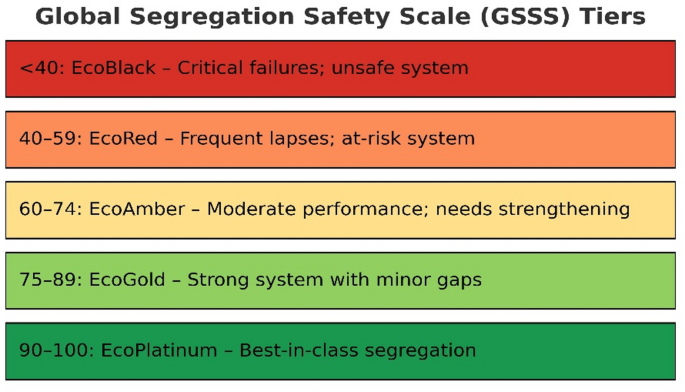
To address this challenge, the PGST framework proposes a benchmarking system known as Bhadran’s Global Segregation Safety Scale (GSSS).
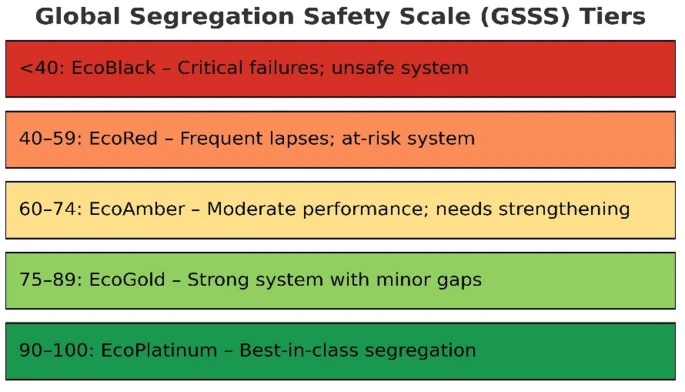
The scale classifies institutions into five tiers based on their Waste Quality Metrics score:
-
EcoPlatinum – highest level of segregation precision and sustainability
-
EcoGold – strong performance with minor behavioral deviations
-
EcoAmber – moderate accuracy with identifiable improvement needs
-
EcoRed – inconsistent segregation practices requiring intervention
-
EcoBlack – critical risk level marked by widespread mis-segregation
This tiered structure provides a clear and intuitive way to interpret complex institutional data. Instead of reviewing numerous operational indicators individually, decision-makers can quickly understand their institution’s overall segregation safety level.
Why classification matters for healthcare systems
Classification frameworks are common across healthcare. Diagnostic staging systems, risk scores, and performance indices help professionals interpret complex information rapidly.
A benchmarking scale for biomedical waste segregation could serve similar purposes. By translating operational and behavioral data into standardized tiers, the scale may support:
-
regulatory inspections and accreditation assessments
-
institutional quality improvement programs
-
research comparing waste management practices across regions
-
long-term monitoring of safety performance within healthcare facilities
Perhaps most importantly, it highlights a shift in perspective. Biomedical waste segregation is not merely about placing the right bin in the right place; it is about ensuring that human decisions consistently align with those systems.
A behavioral lens on healthcare safety
Healthcare safety research increasingly recognizes the importance of human factors. In fields such as aviation safety, surgical ergonomics, and clinical decision support, understanding how people interact with systems has led to major improvements in reliability.
Biomedical waste management has traditionally focused on infrastructure. PGST proposes that an equally important dimension lies in behavioral precision at the moment of waste generation.
If segregation behavior can be measured, monitored, and improved, institutions may gain new tools to reduce occupational risks, prevent environmental contamination, and strengthen infection control systems.
Seeing the waste bin differently
Viewed from this perspective, a waste bin is no longer simply a container. It represents the endpoint of a behavioral decision—one that connects individual actions with institutional safety outcomes.
Frameworks such as Bhadran’s Point-of-Generation Segregation Theory and Bhadran’s GSSS invite us to look at biomedical waste segregation in a new way: as a system where human behavior, operational design, and institutional governance intersect.
Future research will determine how these concepts perform across different healthcare environments. But the underlying idea remains compellingly simple.
If the safety of a waste management system begins at the moment waste is generated, then understanding that moment may be the key to improving the entire system.

Renjith Seela Bhadran, developer of Bhadran’s Point of Generation Segregation Theory (PGST), is an Indian academic and public health researcher whose work integrates behavioral science with public health to address systemic challenges in healthcare waste management. He is an Assistant Professor in the Department of Public Health at Amrita School of Medicine, Amrita Vishwa Vidyapeetham, Kochi, India, where he primarily teaches Social and Behavioral Science to healthcare students.
Bhadran holds a Master of Science in Public Health (MSc PH) from the University of Bedfordshire and an MBA from the University of Nottingham, United Kingdom. His academic work reflects a multidisciplinary perspective that combines public health systems analysis, behavioral science, and environmental sustainability. His research initially focused on onsite biomedical waste segregation challenges in healthcare facilities and later expanded to investigate the cognitive and behavioral determinants influencing segregation practices at the point of generation.
During his doctoral research (PhD) at Amrita School of Medicine, Bhadran developed the Point-of-Generation Segregation Theory (PGST), a behavioral–systems framework that conceptualizes biomedical waste segregation as a precision-dependent behavioral process occurring at the moment of waste generation. The theory introduces analytical constructs such as the Precision Behavior Score (PBS) and Moment-Based Precision Behavioral Fidelity (MBPBF) to evaluate segregation accuracy at the point of disposal, along with behavioral drift analysis to monitor system performance and support improvement over time.
PGST also proposes the Global Segregation Safety Scale (GSSS), a structured benchmarking framework designed to classify institutional segregation performance and support international comparisons in biomedical waste management practices. By reframing waste segregation as a behavioral decision-making process rather than solely an operational activity, the framework provides a new interdisciplinary perspective linking healthcare worker behavior, environmental sustainability, and public health safety.
Bhadran’s research sits at the intersection of behavioral systems research, public health impact assessment, health education, and environmental health management. His work is increasingly gaining international academic attention for its potential to strengthen training systems, institutional audits, and evidence-based policy development in biomedical waste management.
Follow the Topic
-
Scientific Reports

An open access journal publishing original research from across all areas of the natural sciences, psychology, medicine and engineering.
What are SDG Topics?
An introduction to Sustainable Development Goals (SDGs) Topics and their role in highlighting sustainable development research.
Continue reading announcementRelated Collections
With Collections, you can get published faster and increase your visibility.
Reproductive Health
Publishing Model: Hybrid
Deadline: Mar 30, 2026
Obesity
Publishing Model: Hybrid
Deadline: Apr 24, 2026

Please sign in or register for FREE
If you are a registered user on Research Communities by Springer Nature, please sign in